Showing posts with label #faithfulness. Show all posts

Sunday, 26 May 2024

PROMISES


The most endearing story of Father Abraham is the one, according to Jewish tradition, of his death. He was 175 years old. It was the Feast of Weeks celebration and both Isaac and Ishmael had come to Hebron with their families to celebrate the Feast with their father. During the feast, Abraham praised his creator in thanksgiving and among other things asked that God’s mercy and peace be upon the posterity of his sons ‘that they may be a chosen nation and an inheritance from amongst all the nations of the earth’. This was no doubt in reference to the covenant which God had made with him (Genesis 13).

During the feast, Abraham called Jacob, ‘the chosen patriarch heir with the authority to establish Zion over all the earth’ and invoked the blessings of heaven upon him and his seed forever. And this is the tender part of Abraham’s death. Jacob and Abraham laid down together on one bed and ‘Jacob slept in the bosom of Abraham, who kissed him seven times and his heart rejoiced over him and he pronounced another blessing upon his head. He then ‘blessed the God of gods, and he covered his face, and stretched out his feet and slept the sleep of eternity, and was gathered to his fathers’ (Jubilees 22:26-30, Apocrypha and Pseudepigrapha, 2:47; as quoted in The Blessings of Abraham by E. Douglas Clerk, p 232, 233).

It touches me to tears that Abraham died with Jacob in his arms because Jacob would be the fulfilment of God’s promise to Abraham that through him the blessings of the priesthood would be given to all the nations of the earth. Abraham waited 37 years for the promise of Isaac and he didn’t live to see his posterity as numerous as the dust of the earth, as promised (Abraham 2:8-14; Genesis 13:16), but he trusted that through his grandson Jacob this promise would be fulfilled. It’s an incredibly touching story of patience and faithfulness.

Abraham stands as an example of everything we stand to gain if we remain faithful at all odds. From his youth in the land of Chaldeans to his valiant death in Hebron, Abraham held fast to the promise the Lord gave him that through him will all the nations of the earth be blessed (Abraham 2:9-11). I cannot think of anyone that deserved more to be called The Father of The Faithful (D&C 139:41) and the Friend of God (James 2:23; Isaiah 41:8). What kind of a man would you have to be for God to make such a covenant with you? An exceedingly faithful one.

In his great discourse on faith, apostle Paul spoke of valiant saints, such as Abraham, who wandered the earth as strangers and pilgrims and died ‘not having received the promises’ (Hebrews 11:13, 38,39). Very often we want fulfilment of all our dreams and all the Lord has promised us, here and now, and we forget that this life is not a life for fulfilment. May we for now, do the works of Abraham (D&C 132:32) and be patient enough to abide this world of sorrow, disillusionment and imperfection that we, being the posterity of the Father of the Faithful, might one day ‘enter into our exaltation and sit upon our throne’, even as Abraham (D&C 132:29, 32).

The Saviour ALWAYS fulfils His promises. Mormon testified of this throughout the Book of Mormon with phrases such as 'all this was done that the word of the Lord might be fulfilled' and 'God is powerful to the fulfilling of all his words' (Mosiah 21:4; Alma 37:16; 50:19; Mormon 1:19; Helaman 4:21; Ether 15:3; Words of Mormon 1:4; 3 Nephi 1:13,20; Mosiah 21:4; Alma). If a promise is not forthcoming, we need to reflect on our role in its’ fulfilment more than on a God who cannot lie. Sometimes it’s a matter of our worthiness or our fears (D&C 67:1-3), sometimes not in the way we expect, and oftentimes it is simply God’s timing and our necessary growth.

May we be faithful and believe in the God who fulfils all His promises……the Saviour Jesus Christ, the Rock of Our Salvation……

- CATHRYNE ALLEN 

(Art: Rock of Our Salvation by Jay Bryant Ward)


Wednesday, 24 November 2021

YOUR PURPOSE - ODE TO ABINADI


If you have ever wondered what your purpose in life is, then the story of Abinadi is the story for you.  When Abinadi first came on the scene preaching repentance in 148 B.C., he escaped King Noah’s edict of execution only to resurface two years later to go from a frypan into the fire.  And not any fire. Being burnt at stake would have been more merciful than what he suffered. Abinadi was scorched to death by flames of faggots that were used to poke and sear his skin until death (Mosiah 17:13,14). This practice of torture and death by fire was practiced widely among native American cultures. 


This is what will forever be recorded in the annals of history about this man:  His unwavering testimony of Christ. When questioned by the priests of Noah, Abinadi recited Isaiah 53 in its perfection and entirety. I am sure he didn’t carry scriptures around and most certainly didn’t have them handy when handcuffed standing in front of his accusers. How many of us could memorise Isaiah, recite it word for word and then explain it? This is chapter 53: “….surely he hath borne our griefs and carried our sorrows….he was wounded for our transgressions…he was oppressed and afflicted….”. It is about Messiah’s humiliation and sufferings. But there is something else very interesting about Chapter 53. Abinadi quoted that Christ would, because of His death, divide His eternal reward ‘with the strong’ (Mosiah 14:12).  Well, you can’t get stronger than Abinadi who knew he was going to meet his death but who wouldn’t abstain from finishing his message. Take note why: “I finish my message; and then it matters not whither I go, if it so be that I am saved.” (Mosiah 13:9). Never a more poignant statement has been made…..in the end, all that mattered is that he fulfilled his purpose. 


Another amazing thing about Abinadi…..he focused on delivering his message, he did not fixate on the success thereof….so he went to his death believing he fulfilled his purpose without any results, but there was a convert….Alma, then Alma the Younger, then Helaman, then his son Nephi, then 3rd Nephi…and we all know what these men achieved. 


In your journey of self-discovery, be not afraid to step into deeper waters to discover what your true purpose in life is, and do not be worried about obvious results. Only be concerned with God’s approbation. Find the Abinadi in you and do not be afraid of the flames…..


ODE TO ABINADI:

How beautiful were your feet

As you published peace

And were numbered amongst His seed

Of the faithful and the believing;

As you so valiantly accepted His call

To bring Him as an offering

To the proud and the unbelieving.

You stood without flinching

As the flames licked your body

And defiant spirit without yielding.

With courage you proclaimed His Sonship

And His godly might;

With righteous devotion

You earned entrance to His holy heart.


- CATHRYNE ALLEN

(Art by Briana Shawcroft)

Wednesday, 18 August 2021

A CALL TO RISE


Many of us are wondering how much more wicked does the world have to become before the Saviour makes His appearance. The thing is, it's not the state of the world that will determine that but the state of us, His people. Not until Zion can be established among us will the Saviour be able to come. And since the Lord works through us and He honours our free agency, our wickedness or righteousness can impede or accelerate His work (Doctrine and Covenants Student Manual, p 258).
Section 105 of Doctrine and Covenants tells us that the early Saints failed to establish Zion and were driven from their inheritances in Missouri because they failed to comply with the order of consecration. In other words, their hearts were not right to live the principles of the Celestial Kingdom. Since Zion is THE PURE IN HEART, there is no Zion where there is no purity of heart. What does being pure in heart mean? Elder McConkie taught that living by the principles of the Celestial Kingdom means living by the law of the gospel because through it men are sanctified by the reception of the Holy Ghost, thus becoming clean, pure, and spotless (Mormon Doctrine, p 117). But there is more....being pure in heart means having the pure love of Christ within you.
This is the pure love of Christ: It means having no motive for self-advancement. Think for a moment of the Saviour and what He volunteered to do. There was no self-advancement in His sacrifice, He didn't need it, He was already a God. We were the only ones who received advancement through His sacrifice. Until we come to the point where we can be selfless like He is and care about others as much as we care about ourselves, we will not be fit enough to live a Zion life in the Millenium. Zion cannot be redeemed, meaning we cannot expect to live there, until such a time as this and until this can happen, the Saviour cannot come. So you see it is up to us to make this happen.
It is time for us to stop worrying about the state of the world and start focusing on our state of being and on our worthiness. Now is the time for us, the House of Israel, to walk the path the Saviour has paved; to become as He is; to seek the purity of heart that He has; to become a Zion people. It is time for us to RISE.
I gave you my all;
My heart, my body, my soul,
Your salvation to ensure.
I paved the way and opened the gate,
Come and take my hand;
Eat and do not hunger,
Drink and do not thirst.
I am in your midst;
I am the only,
I am the last,
And I am the first.

  • Cathryne Allen
(Art: Dr. Ashraf Fekry)

Tuesday, 17 November 2015

ABSENCE OF FEAR


"Legend has it that one day a man was walking in the desert when he met Fear and Plague. They said they were on their way to a city to kill 10,000 people. The man asked Plague if he was going to do all the work. Plague smiled and said, 'No, I'll take care of only a few hundred. I'll let my friend Fear do the rest'."   -  Author unknown


During some of the toughest persecutions experienced by the saints in the meridian of times Apostle Paul wrote tirelessly to the Church exhorting the members to faithfulness and endurance. During his second imprisonment in Rome and just prior to his martyrdom, Paul wrote his second epistle to Timothy which stands as 'one of the great monuments to faith and hope in the face of loneliness and adversity' (The Life and Teachings of Jesus and His Apostles, p 375). One of the most profound things he said in this letter had reference to fear: "For God hath not given us the spirit of fear; but of power, and of love, and of a sound mind" (2 Timothy 1:7). This statement should become the creed by which we, the saints of this dispensation, live by because we live in a world filled with turmoil, uncertainty, calamities and strife. We who are living during the winding up scenes of this earth's 6,000 years of time are living during the best and the worst of times. Before the Saviour comes again to personally reign for a thousand years we will experience some of the most intense trials of all dispensations that will drive fear into the hearts of all who will stand as witnesses of such times. Discoursing on the signs that will precede the Second Coming, the Saviour described the condition of our day: "And they shall hear of wars, and rumours of wars....for nation shall rise against nation, and kingdom against kingdom, there shall be famines, and pestilences, and earthquakes, in divers places" (JSM 1:28,29).

This scripture is a very accurate description of our world today for "nations and kingdoms and peoples are at war all over the globe. The D&C 45 version of this discourse says that men "will take up the sword (or its modern equivalent) one against another" (vs 23). We see this as people fight among their own without regard to any living person; and this, according to Christ, is due to the hardening of their hearts. There will be commotions and desolations as we just read that will come in the form of famines, pestilences, disasters and earthquakes. Such events have increased dramatically in just our lifetime. The D&C version also indicates that these wars and catastrophes will increase until "the whole earth shall be in commotion" which will cause "men's hearts to fail them" (vs 26). We already see the beginning of a general feeling of hopelessness, despondency, depression and despair among many in the world today. This, for instance, is one of the primary purposes of terrorists - to strike a feeling of fear and hopelessness in others - and this will only increase" (Larry D. Keeler, If Ye Are Prepared, Ye Shall Not Fear (Now Is the Time to Prepare), p.3). Like the civilizations of old we allow and even foster 'secret combinations' within our societies which drive fear into the inhabitants of the whole earth. These are our modern day 'Gadianton Robbers' who seek power by inducing fear for the purpose of controlling countries and nations in upholding Satan's plan of destruction of the plan of salvation.


Perilous times equal fear. For this reason the Saviour chose to make the signs of the times known to us who follow His teachings. He said He did so for the 'elect's sake' (JSM 1:29), 'elect' meaning those who have taken upon themselves His name through the covenant of baptism. In His infinite mercy, the Saviour wanted us to have hope of the promises He has made so that we would not be troubled and fearful of the present: "Be not troubled, for, when all these things shall come to pass, ye may know that the promises which have been made unto you shall be fulfilled" (D&C 45:35). In other words, instead of fearing the calamities, rejoice that the end is fast approaching and the promises of something better are about to be fulfilled. Here are a few priceless promises made to the faithful who watch for the signs of His coming:
  1. We can have peace in the midst of turmoil of the world and live without fear.
  2. We can be assured that in the coming destruction of the world, we will be caught up to escape the baptism of fire for it is written 'that in the last days, two shall be in the field, the one shall be taken and the other left' (Matt 24:40-41).
  3. We can be assured a place in His Kingdom after this life, which He promised when He said to His disciples: "In my Father's house are many mansions: I go to prepare a place for you" (John 14:2)
An absence of fear equals a brighteness of hope. Hope and fear cannot co-exist for one will always dispel the other. If we choose not to fear, should we not hope for something better? Considering the bleakness of today's world, can we not rejoice when contemplating the promise of eternal life in Christ's Kingdom of which John the Beloved said: "And I saw a new heaven and a new earth: for the first heaven and the first earth were passed away; and there was no more sea. And I John saw the holy city, new Jerusalem, coming down from God out of heaven, prepared as a bride adorned for her husband. And I heard a great voice of of heaven saying, Behold, the tabernacle of God is with men, and he will dwell with them, and they shall be his people, and God himself shall be with them, and be their God. And God shall wipe away all tears from their eyes; and there shall be no more death, neither sorrow, nor crying, neither shall there be any more pain: for the former things are passed away" (Rev 21:1-4). Can we not in the absence of fear, have an abundance of hope in the Prince of Peace who can indeed dry all tears from our eyes and give us splendour and glory after the valley of shadow and death?


The greatest promise of all that we have been given is to receive the Second Comforter while still in mortality. The Prophet Joseph Smith has said that this is a reality for every faithful and worthy Latter-Day Saint who continues to humble himself before God; who hungers and thirsts after righteousness; and who lives by every word of God. Once a person has proven through his faithfulness that he will serve God at all cost, the Saviour Himself will come to Him and even manifest the Father to him, "and the Lord will teach him face to face" (Teachings of the Prophet Joseph Smith, p. 150-151, 298). Can we not be lifted up above fear when we hear the Saviour's divine promise such as this: "I will not leave you comfortless: I will come to you....I will love [you], and will manifest myself to [you]....and my Father will love [you] and we will come unto [you] and make our abode with [you] (John 14:18, 21, 23). This promise is, firstly, that the Son and the Father will visit us in person; and secondly, that we can receive from Him an assurance while still in mortality that we will be exalted. This divine promise is given even though we are not yet perfect. This promise means that the Lord knows the innermost desires of our hearts and will assure us divine tutoring beyond the grave that will qualify us for exaltation. Joseph Smith himself received this promise: "For I am the Lord thy God, and will be with thee even unto the end of the world, and through all eternity; for verily I seal upon you your exaltation, and prepare a throne for you in the kingdom of my Father, with Abraham your father" (D&C 132:49)

What could we possibly fear if we had an assurance of exaltation and if we knew the Saviour was bringing with Him at His appearing the fulfillment of all His wondrous promises? No earthquake, no flood, no act of terrorism could possibly consume us with fear. We are children of the promise, the elect of the covenant, who have everything to hope for. We are here but for a moment; a moment of learning, a moment of faith, a moment of preparation. As we witness the fulfillment of the signs of the times may we be propelled to urgent preparation to meet our Maker and may we be like John the Beloved,to whom the Saviour gave a glorious vision of the Second Coming and following which He said: "Surely, I come quickly", meaning quickly after all has been fulfilled and to which John simply replied: 

"Even so, come, Lord Jesus"
(Rev 22:20)


A special thanks to my good friend Larry D. Keeler from whom I learnt most of what I posted here and his insightful talk entitled "If Ye Are Prepared, Ye Shall Not Fear" on which this post was based.

Sunday, 13 September 2015

THE SORROWING HEART


We live in a fallen world. A world of pain, suffering, grief, sorrow and many other negative emotions and maladies of the mind and heart. It is for this purpose we were sent here, to experience and master the world of opposites; that in our experience with sorrow we might know joy. This world was made for the perfection of our experience; to shape, mould and perfect us that we might have joy in this life and the fullness of joy throughout our eternal existence. Without knowing mortality, we would never have known this fullness but would have languished in innocence and imperfection for eternity. It was therefore imperative that we became agents of our own fate whereby we could choose the outcome of our eternal station. In the process of choosing between right and wrong that would lead us to this outcome, is a necessary teaching tool known as sorrow. This sorrow is born from our inclination to indulge the natural man and is meant to lead us back from wayward paths to the path of accountability, purpose and wisdom. 

The sorrow spoken of here falls into two categories: the sorrow of the world and 'godly sorrow'. It is important for us to understand the distinction between the two because one can keep us trapped in misery while the other can grant us emotional and spiritual freedom. When we choose to be in the world and have no regard for God's laws, we are prone to experience worldly sorrow. The world is trapped in this type of sorrow which offers no peace and no redemption. When the Nephite civilization began it's demise into total destruction, many of them lamented the state they were in which gave Mormon great hopes that their sorrow would lead them to repentance. In this, Mormon was greatly disappointed because he records: "But behold this my joy was vain, for their sorrowing was not unto repentance, because of the goodness of God; but it was rather the sorrowing of the damned, because the Lord would not always suffer them to take happiness in sin" (Mormon 2:13). In other words, the Nephites sorrowed because they could not have it both ways; they could not live in sin and at the same time be happy. And herein is found one of Satan's biggest lies; that we are free to do whatever we want. Freedom of the heart, however, does not come with 'whatever we want'. Very often 'whatever we want' comes with sorrow. Today, in our attempt to prove that we are free to choose, we have surrounded ourselves by the sorrow of the world: lives devastated by drugs, cruelty, abusive behaviour, greed, selfishness, corruption, immorality, deceit and much more. Those who are of the world experience sorrow for their reckless behaviour when they are shocked into it by the consequences of their actions or when they are found out. 


Unlike worldly sorrow, godly sorrow leads to repentance and freedom. A truly repentant person will experience sorrow not only because of the cost of sin to themselves but also because they offended God. They can see clearly they have put in jeopardy the salvation of their soul, they come to regret their actions and their sorrowing results in a broken heart. This is godly sorrow. This sorrow brings about grieving that teaches us accountability and grows in us a desire to abstain from further sinning. Desisting the sin is simply not enough to effect true repentance because it does not bring about a change of heart. Merely desisting without godly sorrow means it is just a matter of time before we go back to the sin which has had us in its grip. When we experience godly sorrow, we show sincerity in our intentions to forsake the sin. This painful 'payment' acts as a perfect deterrent in the repentance process.

God's love for us is always there but when we are living a sinful life we distance ourselves from that love. Catastrophically, we also distance ourselves from our chance of salvation and ultimate exaltation. Repentance is perhaps the greatest proof of God's mercy towards His children. Not wanting to leave us in the fallen world forever He has provided the way for us to be reconciled to Him and be once more worthy of His presence. Repentance is crucial for this reconciliation. No unclean thing can enter the kingdom of God (3 Nephi 27:19) because God Himself is clean, pure and perfect therefore He cannot receive us into His presence if we are unclean and tainted by sin. But uncleanliness can be eradicated for those 'who have washed their garments in [Christ's] blood, because of their faith, and the repentance of all their sins, and their faithfulness unto the end' (3 Nephi 27:19). 

The path to reconciliation with God is in Christ. He is the healing in our wings and the path back to freedom and spiritual security. Because of Him we need not suffer the sorrow of the world but the sorrow that will bring us back to God. This is the sorrow that is worth the pain because it is momentary as opposed to the sorrow of the world that is never ending. "The delightful promise of the Gospel to those who 'sorrow after a godly sort' (2 Cor. 7:11) is complete forgiveness and reconciliation to God. There is a power in the Atonement of Christ that makes the repentant soul new again: "Therefore if any man be in Christ, he is a new creature: old things are passed away; behold, all things are become new. And all things are of God, who hath reconciled us to himself by Jesus Christ" (2 Cor. 5:17-18). This dream of a new life, a new start, a new chance is made reality in the Atonement of Christ." (Breck England, NT Lesson 35, Be Ye Reconciled to God)


A bird 
Once broken
Can never fly,
They say,
Quite so high
Again.

Perhaps.

But as for me,
Now desperately
In need of mending,
I have a healer
Who would restore
These foolish wings
Without a scar.

I will lie quiet
Beneath His touch.
I will listen
As He whispers,
"Rise, and fall no more"

And then -
Then I shall
Soar.

- Carol Lynn Pearson


Thursday, 19 June 2014

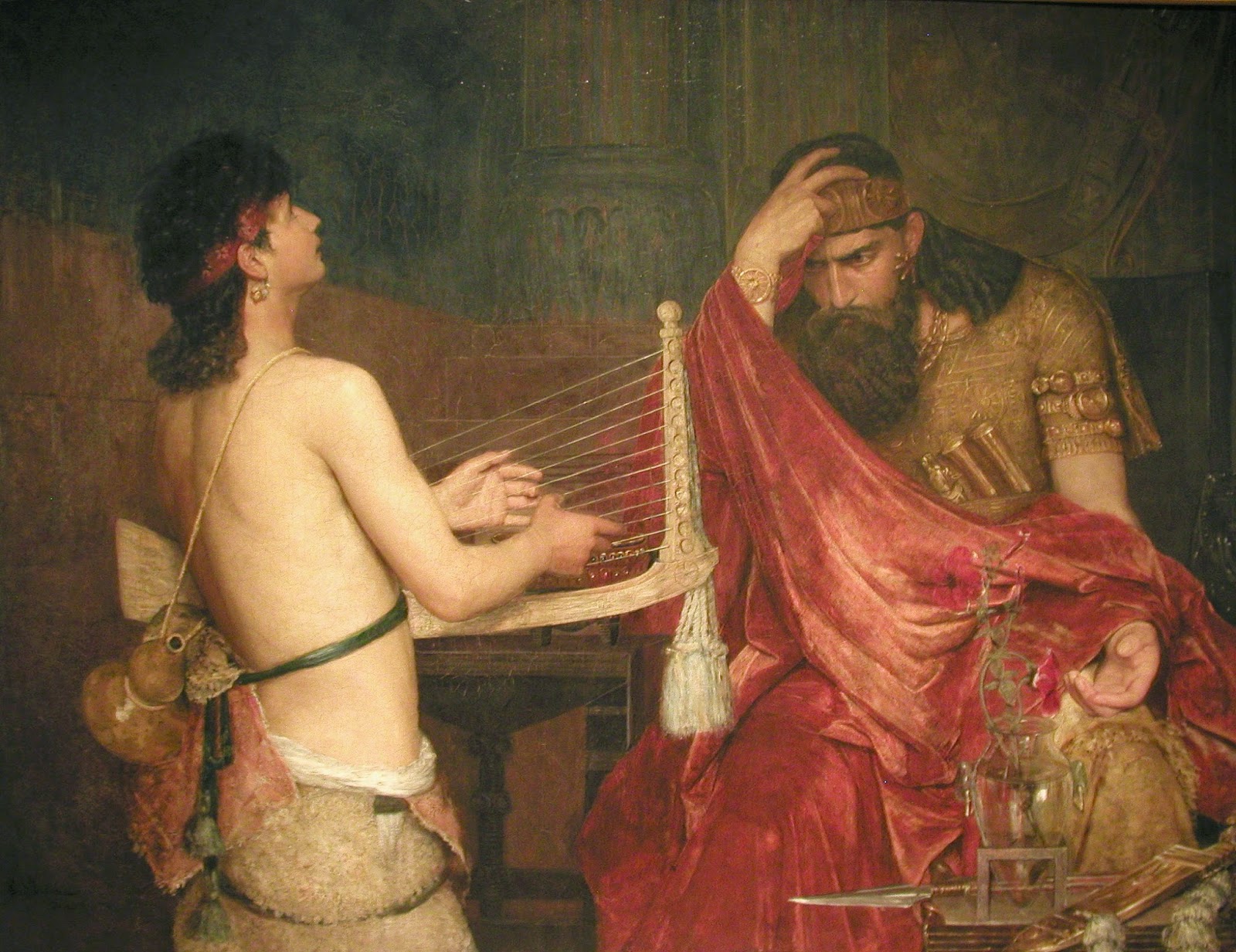
THE MADNESS OF SAUL


This is a very sad story of a fallen king who allowed jelousy to corrupt his heart and who invited the forces of evil to torment his soul. Having already lost God's favour through disobedience, Saul, the first king of Israel, continued on the down hill slide to self-destruction. Saul, who was born great and was above all Israel in stature and goodness ended up a bitter man not worthy of his kingdom and feared by all, even his family.

David having found favour with the king of Israel by slaying Goliath, was taken away from his family and installed into the king's household. So impeccable was his behaviour that he was beloved by all Judah and Israel (1 Sam 18:16). And so obedient was he to any task that he was given by the king that Saul placed him in charge of his army (1 Sam 18:5). It naturally followed that David had great success in his battles with the Philistines and Saul was soon overshadowed by his popularity (1 Sam 18:6,7). Saul perceived this popularity as a threat to himself and his kingdom. In his mind, praise for another somehow diminished him in the eyes of the people. Saul, who had everything, who was the king of Israel, chosen by God, under whose command armies moved, who had all power and influence in the land, wanted more. From the moment Saul heard the women chanting "Saul hath slain his thousands, and David his ten thousands" (1 Sam 18:7), he hated David and became exceedingly jelous of him (1 Sam 18:8,9).


Saul's good qualities and his ability to rule with wisdom were totally subverted as he allowed jelousy to consume him. What would seem a rather harmless emotion became a deadly murderous obsession. He makes it his life mission to kill David even risking the life of his son Jonathan (1 Sam 20:33) and willing to annihilate a whole city (1 Sam 23:10) to accomplish his purpose. How did Saul come to sink so low? Armies could not have toppled him if he had remained righteous. Only one person had the power to destroy him and that person was himself. Jelousy, a seemingly harmless emotion proved to be not so harmless after all. The scriptures record that Saul came to be overcome by an evil spirit continually (1 Sam 18:10, 19:9). Through the life of Saul we can see the author of all jelousy and envy, he who sought to elevate himself above all else, not wanting anyone to have what he had. The father of all lies would have us believe that somebody else's greatness diminishes our own and that blessings others receive means blessings taken away from us. He convinces us so well that self-seeking is the path to abundance and therefore happiness. Elder Holland cites one observer who summed this up well:

"In a world that constantly compares people, ranking them as more or less intelligent, more or less attractive, more or less successful, it is not easy to really believe in a (divine) love that does not do the same. When I hear someone praised, it is hard not to think of myself as less praiseworthy; when I read about the goodness and kindness of other people, it is hard not to wonder whether I myself am as good and kind as they; and when I see trophies, rewards, and prizes being handed out to special people, I  cannot avoid asking myself why that didn't happen to me." (Meridian Magazine, "The Lord Be Between Thee and Me Forever", p 2)

What leads us to these assumptions and feelings of want? Elder Holland elaborates:

"As others seem to grow larger in our sight, we think we must therefore be smaller. So unfortunately, we occasionally act that way. How does this happen, especially when we wish so much that it would not? I think one reason is that every day we see allurements of one kind or another that tell us what we have is not enough. Someone or something is forever telling us we need to be more handsome or more wealthy, more applauded or more admired than we see ourselves as being. We are told we haven't collected enough possessions or gone to enough fun places. We are bombarded with the message that on the world's scale of things we have been weighed in the balance and found wanting. Some days it is as if we have been locked in a cubicle of a great and spacious building where the only thing on the TV is a never-ending soap opera entitled Vain Imaginations." (Elder Jeffrey R Holland, Meridian Magazine, "The Lord Be Between Thee and Me Forever", p. 2)


Opposite to Satan's plan to make us greedy and self-absorbed is the Saviour's plan to nurture in us the ability to become Zion people. A Zion person seeks the welfare of others and not just his own. A Zion person is one that is bound in love to his fellow beings. A very good example of this comes from the same story as Saul. It is the friendship and bond of love between his son Jonathan and David, the future king of Israel. Where his father sought to slay David, Jonathan sought to preserve his life. Jonathan was the next in line to the throne and his father warned him that as long as David lived, his kingdom will not be his (1 Sam 20:31). Jonathan however, was more interested in being faithful than in being a king. He shows that faithfulness through his friendship with David by saying: "....the Lord be between thee and me forever" (1 Sam 20:23). Whereas Saul, in cahoots with an evil spirit, seeks to take away David's life, Jonathan fueled by his faithfulness to God, seeks to preserve it. Jonathan and David share a common bond of faithfulness which binds them in friendship and love forever. Because of this bond of love, they seek each other's welfare rather than their own. The only author of such love can be God. David too shows his faithfulness to God by resisting an opportunity that delivers Saul into his hands and refuses to take his life reasoning that Saul is anointed of the Lord and that there is no evil nor transgression in his hand and would therefore not commit such wickedness (1 Sam 24:6,11,12). Had David murdered Saul in the cave in which he found him asleep he would have obtained the kingdom through the evil design of murder and not be given it by the hand of the Lord. If that had been the case, that would have been the beginning of David's demise. He could have rid himself of Saul and his dogmatic murderous pursuit forever but he would also have succumbed to the same hatred and evil that came to possess the heart of Saul and would therefore become lost.  David was more interested in respecting and loving the Lord than in self-seeking and because of it he became the next king of Israel.


What blessings that come from serving others will we miss out on if we engage ourselves in self-seeking and elevating ourselves above our fellowman? Whether it is being better, having better or doing better than someone else, it is all the same. It all leads to pride which robs us of the godly nature which we need to be of benefit to our fellowman. Self-seeking has no future. It is of this world only for in celestial kingdom there will be no one that is more or has more than someone else. It will be a perfect existence with equality of heart and mind and possession. The only children of God who will be able to abide this existence will be those who love others as themselves. This is what we are here to learn most of all, to love. Without this love we cannot pass through the gates of eternity and have eternal life with God. The author of this love beckons us to follow Him and to 'pray unto the Father with all the energy of heart, that we may be filled with this love, which he hath bestowed upon all who are the true followers of his Son..." (Moroni 7:48).

Tuesday, 11 March 2014

JOSEPH, THE PURE IN HEART


"My life is but a weaving, between my God and me,
I do not choose the colours,  He worketh steadily.
Oftimes He worketh sorrow and I, in foolish pride,
Forget He sees the upper, and I the underside.
Not till the loom is silent, and the shuttles cease to fly, 
Will God unroll the canvas, and explain the reasons why
The dark threads were as needful in the skillful weaver's hand, 
As threads of gold and silver in the pattern He has planned."
- Anonymous

"The scriptures give us the opportunity to watch some great people come out of broken homes.  Abraham was one whose life was threatened by family members.  Joseph was another.  We are told of his brothers that 'they conspired against him to slay him' (Genesis 37:18).  And yet few men rose higher in life than these two.  It may be hard for people who suffer from imperfect families to convince the Father on judgement day that their lack of devotion and obedience ought to be excused because of what happened in their homes."
(Ted L. Gibbons, OT Lesson #11, "How Can I Do This Great Wickedness?")

We see in Joseph of Egypt a perfect study in commitment, dedication, determination, persistence, endurance and faithfulness to God under any circumstance. Joseph is a perfect example of someone 'willing to submit to all things which the Lord seeth fit to inflict upon him' (Mosiah 3:19), willing to endure valiantly through trials with faith unshaken, not knowing the reason why.  Father Lehi lamented over his son Lemuel by saying: "O that thou mightest be like unto this valley, firm and steadfast, and immovable in keeping the commandments of the Lord" (1 Nephi 2:10).  This is exactly what Joseph was like: firm, steadfast and immovable like a valley.  Jesus claimed if we had faith 'as a grain of mustard seed' we could move mountains (Matt 17:20). The brother of Jared did just that (Ether 12:30) and proved that even something as formidable as a mountain can be moved but the valley, however, is firm, steadfast and immovable.  This was Joseph of Egypt. Because he was steadfast and trusted God in all things, God made of him a mighty man, a prototype of the Saviour himself.

At the tender age of 17 Joseph was torn away from his family by the brothers who were supposed to love him and protect him and spent 13 years as a slave or a prisoner. You could say he had every reason to believe that the Lord had dealt with him unjustly despite his devotion to the God of his fathers.  Joseph, however, knew he had an important destiny which was revealed to him through his dreams, and he chose to continue to believe in God by recognising opportunities that could turn his tragedies into blessings.  He trusted the Lord at every turn throughout all his tribulations.  The scriptures are replete with the Lord's promises that He will prosper those who keep His commandments (1 Nephi 2:20, 1 Nephi  4:14, 2 Nephi 1:9, 2 Nephi 1:20, 2 Nephi 4:4, Jarom 1:9, Omni 1:6, Mosiah 1:7 etc)  As Joseph sat in prison, stripped of his position and livelihood and unjustly accused because he chose to resist evil,  he could have been excused for believing that this promise did not apply to him.  Joseph, however, proved that God keeps his promises under any circumstance.  Where ever Joseph was, he endeared people to him because 'the Lord was with him'.  We read in Genesis chapter 39:

"And the Lord was with Joseph, and he was a prosperous man, and he was in the house of his master the Egyptian.  And his master saw the the Lord was with him, and that the Lord made all that he did to prosper in his hand.  And Joseph found grace in his sight, and he served him; and he made him overseer over his house, and all that he had he put into his hand.  And it came to pass from the time he had made him overseer in his house, and over all that he had, that the Lord blessed the Egyptian's house for Joseph's sake; and the blessing of the Lord was upon all that he had in the house, and in the field.  And he left all that he had in Joseph's hand; and he knew not ought he had, save the bread which he did eat.  And Joseph was a goodly person and well favored." (Genesis 39:22-6)

Imagine having earned such respect and trust of someone that they put all their financial affairs in your hands, to the point that they don't even know how much money they have but trust that you would provide their next meal.  This is the kind of man that Joseph was.  This kind of trustworthy and good character can only come through obedience to God and his commandments.  Consider this:

"This blessing comes only by obedience, and in this case it came to a young man who had every excuse to be disobedient.  His faith in God had not seemed to help him avoid troubles.  His obedience to the commandments had not prevented tragedy.  He cannot ask the bishop for an interview nor seek a blessing from his father.  No thoughtful members of his priests' quorum will be by to offer support in his troubles. He is alone and utterly on his own.  He has no reason to keep the commandments unless he wants to. If he does not, other than God, who will ever know?"  (Ted L. Gibbons, OT Lesson #11)


Joseph's ultimate test of faith came in the form of a woman.  This test of faith became the crowning glory of proof that he would never stray from his faith and commitment to live God's laws.  Joseph referred to Potiphar's wife's invitation as 'great wickedness' (Genesis 39:9).  The following insight into Joseph's character helps us have appreciation of Joseph's tenacity and his ability to overcome what could have been an overwhelming sense of hopelessness as his life took a turn for the worse:

"Young man, a thousand miles away from home, can you keep the standards of your mother and father?  One man changed the history of the world by taking into a foreign country these standards: He was good looking, he had personality; he was young.  Because of his physique and general carriage, he carried prestige.  She was a woman of importance - yes, I presume she was attractive. She tempted him once - she tempted him twice - yes, and many more times.  Each time he remembered the teachings of his folk at home.  He looked sin in the face and stood like a rock.  Yes, as the saying goes, he took it on the chin.  For just a moment what a price he paid to keep straight - and don't forget he was praying all the time. When she found herself unvictorious, she caught his garment as he fled.  The sample of the clothing was shown to her husband and if we can use our imagination, a remark from her treacherous lips went to her husband about as follows: "Well, here's the evidence. You thought he was lily-white, didn't you?"  Into a dark dungeon he went for two years.  And he was still praying.  And when he was sold into Egypt by his brothers for a few pieces of silver, he was praying.  Does the Lord really answer prayers? But let's shift to the last act of our play. The curtain goes up with an entirely different scene. "And they came from all nations to buy corn". Who was head of this great commissary department? Who was it that was next to the king of the land? Joseph, who was sold into Egypt, the boy who could say "no" - the lad who took the standards of his parents into a foreign land!  It was that boy who stood at the crossroads all alone". (Bisop Marvin O. Ashton, Improvement Era, Vol. XIviii, December, 1945, No. 12)

Joseph never failed to recognise that something good always comes out of something bad.  He believed that even his unjust imprisonment was a blessing.  The Testament of the Twelve Patriarchs quotes Joseph as saying "I gave thanks to the Lord and sang praise in the house of darkness, and how I rejoiced with cheerful voice, glorifying my God, because through her trumped-up charge I was set free from this Egyptian woman".
(James H. Charlesworth, The Testament of the Twelve Patriarchs, The Old Testament Pseudepigrapha, Apocalyptic Literature and Testaments)


It is staggering to think of what lay on the line when Joseph was tempted by his master's wife.  Had Joseph succumbed,  his destiny, the destiny of his family and the destiny of his descendants would have all been in peril. Had he chosen the life of sin, he would never have become the man that he became.  Joseph became the temporal saviour of his father's house by saving them from famine.  According to the dream he had where his brother's sheaves of grain bowed to his, Joseph was elevated to his position, not to be worshipped by his brothers, like they had supposed, but to serve them.  Their bowing 'was an act of receiving their brother's help, not meant to establish some kind of family pecking order'. (Phillip Allred, OT Lesson 11, Meridian Magazine)

Just as Joseph saved his family temporally, his progeny is to become spiritual saviours to their brethren of Israel and the rest of the Father's children.  The JST records the responsibility of Joseph's seed in our day:

"Wherefore thy brethren (the other tribes of Israel) shall bow down unto thee, from generation to generation, unto the fruit of thy loins (Ephraim and Manasseh) for ever; For thou shalt be a light unto my people, to deliver them in the days of their captivity, from bondage; and to bring salvation unto them, when they are altogether bowed down under sin". (JST Gen. 48:10-11)

"During this last dispensation, Joseph's descendants are charged with providing the covenants, ordinances, and saving truths of the gospel for the rest of the family.  With this in mind, it is exciting to see our modern temples as veritable spiritual granaries or storehouses where souls are literally delivered and saved while all around a famine seeks to lay waste precious mortal opportunities". (Phillip Allred, OT Lesson 11, Meridian Magazine)

"It is Ephraim who is building temples and performing the ordinances in them for both the living and for the dead. When the 'lost tribes' come, and it will be a most wonderful sight and a marvelous thing when they do come to Zion, in fulfillment of the promises made through Isaiah and Jeremiah, they will have to receive the crowning blessings from their brother Ephraim, the 'firstborn' in Israel".  (Joseph Fielding Smith, Doctrines of Salvation, 3:252)


What a glorious destiny Joseph stood to lose!  When his father Jacob gave Reuben, his first born, his final blessing he began the blessing with some powerful words, "Reuben, thou art my firstborn, my might, and the beginning of my strength, the excellency of dignity, and the excellency of power....".(Gen. 49:3)  What amazing words those are.  Reuben was the birthright son who stood to receive the priesthood blessings of the fathers and through whom the patriarchal line should have continued but Reuben did not abstain from temptation like Joseph did.  Reuben committed a terrible sin by committing adultery with one of his father's wives, Bilhah.  Because of this he lost everything.  What should have been an amazing blessing ended with:
"Unstable as water, thou shalt not excel; because thou wentest up to thy father's bed; then defiledst thou it..." (Gen. 49:3)

Because he was 'unstable as water' Reuben's birthright was inherited by Joseph who received a double portion for his sons.  If you poured water into different shape glasses, the water would take the shape of the glass that it is in.  If however, you tried to put a brick into three different containers, the brick would not change its' shape.  The containers would have to change their shape instead.  While water is changeable, variable, mutable, unsteady, uncertain, transitory and unstable; a brick is entirely opposite. While Reuben was 'weak as water',  Joseph was as strong as a brick and because of it, he in the end had it all.


Sunday, 23 February 2014

A LIFE OF RIGHTEOUSNESS


"Yea, verily, verily, I say unto you, if all men had been, and were, and ever would be, like unto Moroni, behold and very powers of hell would have been shaken forever; yea, the devil would never have power over the hearts of the children of men" (Alma 48:17)

Imagine if this was said of you.  What kind of a life would you have to live for this to be true?  Would it be possible for you to distinguish yourself among your peers as an upholder of righteousness?  Could you imagine being so righteous that the adversary cringes at the mention of your name?  Joseph Smith recorded something to this effect in his history, the magnitude of which I am sure he did not fully understand at the time:

"It seems as though the adversary was aware, at a very early period of my life, that I was destined to prove a disturber and an annoyer of his kingdom......" (JSH 1:20)

We, of this the last dispensation of times, have been sent to earth to be just that, 'disturbers' and 'annoyers' of adversary's kingdom for we have been sent to counteract evil and wickedness in this world by living a life of righteousness.


This week's Sunday School lesson offers a very valuable insight regarding this subject through the story of Abraham and Lot, his nephew.  Following their sojourn in Egypt, Abraham and Lot were blessed so abundantly that the land could not contain them and it became apparent they would have to go their separate ways (Genesis 13:7).  Abraham, being the man that he was, offered Lot his choice of the land first.  Lot who was not as generous and mindful of others, chose the fertile plain along the Jordan River and left Abram the rocks of upper Canaan.  At first sight, it appears Abraham was very much disadvantaged but not so.  The rocks of upper Canaan offered Abraham and his household refuge and distance from the wickedness of Sodom. Lot, who it would seem had every advantage by settling on the green, fertile part of the valley, was so close to the city he should have avoided at all cost, that he unwisely pitched his tent toward it (Genesis 13:12). One would assume that looking at something day in and day out would eventually entice you to it. This truly must have been the case with Lot because when messengers came from the Lord to do a little inspection of Sodom, Lot was no longer living toward Sodom, he was living in it.

Abraham tried to make a deal with the Lord.  He asked him to spare Sodom if there could be found 10 righteous people in it.  He knew Lot's family numbered that much but when the time came for Lot to leave, the scriptures record he only had his wife and two unmarried daughters with him. That's 4 out of 10.  His wife must have been of two minds too because she turned to look back, perhaps even attempting to go back and was lost in the process and his daughters later committed moral transgressions with their own father. Where did they learn such behaviour?  In Sodom.  In reality Lot had lost his whole family to the wickedness of the world.  Where did Lot go wrong?  I think Lot's cracks first started to appear when he grabbed for himself what he thought was the better part of the land not considering his good hearted uncle.  The second bad move he made was setting his sights on the 'world' which was so visible from his tent.  Sooner or later the world sucks you in if you are looking at it longingly enough.

Consider the opposite example in Abraham who had a desire for righteousness at the center of his heart. Sometime after he and Lot first settled in Canaan, a confederation of kings attacked the cities of that valley. Lot didn't fare very well in that attack and was captured with his family and taken away together with all their possessions.  Abraham felt it his duty to rescue his brother's son and together with his servants pursued the invading kings and conquered them bringing Lot and his family back.  When he returned to his home, there were two kings there to meet him: one was the king of Sodom and the other was the king of Salem called Melchizedek: the king of wickedness and the king of righteousness.

Abraham's experience with these two kings teaches us about being righteous in a world of wickedness.  The king of Sodom, being one of Abraham's allies in the conquest that was just made, offered Abraham all the booty he had captured in the war but Abraham refused to take anything from this king of wickedness.  His reply to this king was:

"I have lift up mine hand unto the Lord, the most high God, the possessor of heaven and earth, that I will not take from a thread even to a shoelatchet, and that I will not take anything that is thine, lest thou shouldest say, I have made Abram rich" (Gen. 14:21-23)

Not only did Abraham know and acknowledge the true source of his prosperity, he was careful not to be a partaker of anything that was unrighteous and unclean, that had the potential to make him a part of the world. Alma spoke of this very thing when he said:

"And now I say unto you, all ye that are desirous to follow the voice of the good shepherd, come ye out from the wicked, and be ye separate, and touch not their unclean things; and behold their names shall be blotted out that the names of the wicked shall not be numbered among the names of the righteous, that the word of God may be fulfilled, which saith: The names of the wicked shall not be mingled with the names of my people." (Alma 5:57)

Not only did Abraham abstain from taking the tiniest endowment from the king of wickedness, he willingly gave to the king of righteousness:

"And Melchizedek king of Salem brought forth bread and wine: and he was the priest of the most high God. And he blessed him, and said, Blessed be Abram of the most high God, possessor of heaven and earth: And blessed be the most high God, which hath delivered thine enemies into thy hand.  And he gave him tithes of all." (Gen. 14:18-29)

Abraham's allegiance was to God and no earthly possession, entitlement or situation could entice him to be a part of the world of wickedness.  For this reason, his life was a model of righteousness.  Beside the Saviour, could there be a more righteous person than Abraham?


Tuesday, 4 February 2014

WHAT'S IN A NAME?


My patriarchal blessing cites two significant blessings connected with my name. In the first instance it says my children will grow up to bless and honour my name and in the second it says that my name will always be known among the faithful.  These two blessings are of course predicated upon my faithfulness.  I desperately want both of them.  The first one because it means my faithfulness will have an influence on my children and in some way be instrumental in their salvation and the second because I do truly desire to be known as a faithful follower of Christ.  When I read The Book of Mormon and come across Mormon boldly proclaiming, "Behold I am Mormon and I am a disciple of Jesus Christ...", my heart yearns to say this of myself with the same confidence and boldness with which Mormon did.  So when my patriarchal blessing tells me that I will be known as one of the 'faithful' I know that there will be evidence enough to that fact otherwise I would not be numbered among them.  

Whilst attending our new ward recently, my daughter was introduced on a number of occasions with significant reference to her grandparents who are well known far and wide for their faithfulness and Church service. Her grandmother, who has passed away,  is highly regarded in the Church in Sydney by many saints who knew her. I have heard her name mentioned often in different wards I have attended since her death. It makes me so grateful that my children are associated with her good name. I believe this is the greatest legacy she has left to her grandchildren.  It is my desire that I will leave a good name to my children also.   Adversely, I would be devastated if my name was an embarrassment to them in any way.  So much is associated with the name we bear: our reputation, what kind of life we created, the caliber of the person we have been, our good works, people's perception of us, how loved we are, how much we have helped others and how well we have treated them.  The influence, whether bad or good, is far reaching.

As Church members we are largely known by two significant names: Mormons and Christians.  Some members of the Church resent being called Mormons because more often than not, this name overshadows the fact that we are Christians to the rest of the world.  However, the rest of the world doesn't know Mormon like we know him.  Mormon is my favourite prophet of the Book of Mormon. The obvious reason being is that he is a writer. The other reason is that in my opinion Mormon was one of the most Christ like people to have ever graced this earth. For that reason, being called Mormon to me is just about the same as being called a Christian.  


Mormon was faithful to the latter in one of the most evil societies that have ever existed. A people who were so wicked that the Holy Ghost was entirely withheld from them (Mormon 1:14); who 'willfully rebelled against their God' (Mormon 1:16); who, in their extremities 'cursed God and wished to die' (Mormon 2:14); who were consumed with revenge (Mormon 3:9-10); who forcibly deprived women of their virtue, killed them, and 'devoured their flesh like unto wild beasts' (Moroni 9:10).  After much unsuccessful effort to turn the society of such evil doers around to repent and trust in God you would think Mormon would be justified in wishing God's justice to come upon them.  But this was not in Mormon's nature.  Mormon knew God and how merciful He is and therefore he never stopped hoping that his people will repent and once again become a righteous people.  Instead of smugly sitting on his housetop and recording their destruction, punctuated with frequent "I-told-you-so's", Mormon continued to urge the Nephites in their battles  and inspired them to consider their wives and their children and their homes. (Todd A Knowles, Gospel Doctrine Lesson 43, Mormon 1-6,9)  Not only did Mormon continue to love and serve the Nephites despite their lack of willingness to repent, he fought along side them knowing they were doomed and when the Nephites went down to complete destruction, he went down with them.

In writing The Book of Mormon, Mormon's one purpose was to bring us 'unto Christ'.  If you asked a classroom of people who wrote The Book of Mormon, everybody would hesitate to answer trying to figure it out.  This is so because when you read The Book of Mormon, you do not hear Mormon's voice, even though he occasionally offers editorial commentary.  The voice we hear when we read The Book of Mormon, is the voice of God.  Mormon makes himself transparent as the writer of this book and succeeds gloriously in helping us draw closer to God.  (Todd A. Knowles, Gospel Doctrine Lesson 43, Mormon 1-6,9)

Mormon lived by an eternal perspective that enabled his life long service among his fellowmen. : "...for we have a labour to perform whilst in this tabernacle of clay, that we may conquer the enemy of all righteousness...." (Moroni 9:6)  I often quote this scripture during my lessons as a means of inspiration to help us be focused on winning the battle that we began so long ago.  The more I know about Mormon, the more I want to be like him.  It makes me feel good to say that I am a Mormon, to be associated with his name.


In Mosiah 5:7-12, the word 'name' occurs 11 times.  These particular scriptures contain King Benjamin's address to his people who were willing to enter into a covenant with God 'to do his will and to be obedient to his commandments in all things....all the remainder of our days' (Mosiah 5:5).  What is interesting is that King Benjamin responds to their willingness to enter into this covenant by talking about the importance of taking upon ourselves Christ's name.  He specifically says that:
  • our hearts are changed through faith on his name (verse 7)
  • there is no other name given whereby salvation comes (verse 8)
  • whosoever enters into this covenant shall be known and called by the name of Christ (verse 9)
  • whosoever is not called by the name of Christ shall be found on the left hand of God (verse 10)
  • His name will never be blotted out of our hearts except through transgression (verse 11)
By virtue of our covenant to be obedient to His commandments, we become Christ's, his sons and his daughters and thereby we take upon ourselves His name, much like we take upon ourselves our earthly father's name when we are born into mortality.  In this instance however, Christ becomes our spiritual father and we thereby become Christ-ians. What we do with Christ's name speaks volumes about our integrity and character. Being Christian means being like Christ and behaving as He would behave. It reminds me of that saying:  "If you were arrested for being a Christian, would there be enough evidence to convict you?" 

King Benjamin closes his address admonishing his people to be steadfast and immovable and always abounding in good works for the greatest of  all blessings depends on this: "....that Christ, the Lord God Omnipotent, may seal you his, that you may be brought to heaven, that ye may have everlasting salvation and eternal life..." (Mosiah 5:15)  The Saviour will hold us responsible for His name when we face Him at the judgment bar.  As his children, it is our duty to bring honour and glory to his name through the life that we live.  For this He will exalt us so that we can have all that He has and be all that He is. Alma spoke of being spiritually born and thereby receiving His image in our countenance (Alma 5:14).  Let us live so that this image will be recognized by all we associate with and that we will be known by His name more readily than by our own.  Does He not deserve this? 

For "behold, I have graven thee upon the palms of my hands...." (1 Nephi 21:16)


Sunday, 19 January 2014

HOPES AND PROMISES


The other day I had an opportunity to spend a day with my 3 year old granddaughter.  Just she and I, together for the day, playing with abandon.  It always touches my heart that she wants to be with me and that we can have such a good relationship, that she trusts me to take care of her.  Before she was born I had decided that I wanted to be called Grandmummy.  My granddaughter though decided otherwise.  When she was 2 she declared that my name would be Damma.  I am convinced she brought this name with her from pre-existence.  This is the name her mother used to call her paternal grandmother when she started to speak. She could not pronounce Grandma so Damma it was for awhile but the name remained a special reminder in the family of my daughter's early life.

My daughter and her grandmother had a very special bond.  Her grandmother, my mother-in-law, was a wonderful person and a unique grandmother.  When I started to look forward to being a grandmother myself I hoped ardently that I would be a grandmother like her.  This special woman passed away while my daughter was still pregnant with her first child, my granddaughter Addy.  Before Addy was born her paternal grandfather had a dream about his mother who had passed away and in that dream saw her instructing a little girl about earth life.  We all knew Addy was going to be Addy before she even appeared.  I could not be more sure that my mother-in-law told Addy about the name 'Damma' and that Addy remembered it when the time came in her life to put a name to me.  I sometimes feel that this is a special message to me from beyond the grave.  Addy had never heard anybody else use this name and she can pronounce Grandma perfectly so I feel that this name could not have come from anywhere else. Such a simple thing but such a strong cord binding us together in this great adventure of mortality made possible by the plan of salvation.

When Abraham had a vision of the intelligences that were organized before the world was created he found himself standing among the 'noble and great' ones and was told by the Saviour that he was chosen before he was born. (Abraham 3:23)  Among these noble and great spirits Joseph Fielding Smith identified prophets of our dispensation whom he saw in his vision of the dead who he declared 'were reserved to come forth in the fulness of time to take part in laying the foundations of the great latter-day work....I observed that they were also among the noble and great ones who were chosen in the beginning to be rulers in the Church of God". (D&C 138:53-55)  These great spirits were 'prepared to come forth in the due time of the Lord to labour in his vineyard for the salvation of the souls of men' (D&C 138:56).  Joseph Smith taught:

"Every man who has a calling to minister to the inhabits of the world was ordained to that very purpose in the Grand Council of heaven before this world was.  I suppose I was ordained to this very office in that Grand Council" (TPJS, p 365)


How would you feel being one of the great spirits chosen to come to earth to do a specific job and one of great importance and magnitude?  Would you feel important?  Would you understand the gravity of your responsibility and live up to it every day?  How would you feel if you knew you were responsible for salvation of the souls of men?  What Joseph Smith said is true.  It is true of every one of us.  We have all been called to minister to the inhabitants of the world in one way or another.  Looking into my granddaughter's sweet face, I am convinced that I could not have a more important calling in life than that of being her grandmother.

As I considered our relationship the other day, I wondered what promises I had made to her in pre-existence.  I have always believed that we choose our parents but I never gave it much thought to grandparents and beyond.  Did we know each other as such back then?  My patriarchal blessing tells me that my time of coming to earth was set that I may fulfill the promise I made in my pre-existence and that I had fulfilled that promise by entering the waters of baptism.  It goes on to say that many of those spirits who were with me had rejoiced when that promise was fulfilled.  Could it be that those spirits were my ancestors and my posterity who depended on me to assist them in working out their salvation whilst in the flesh?  Were they watching me beyond the veil as I progressed through my life hoping against all hope that my promise will one day bear fruit?  I am a convert to the Church and by my conversion and acceptance of the truth, I have not only been instrumental in redeeming the dead in my family, I have also paved the path for my granddaughter to be born a child of the covenant.  This has given her a great start in life. If I continue faithful, my love, my example and what I can teach her will be the priceless legacy I will leave her when I am gone. Is this my work of any less importance than the one of 'the great and noble ones'?

We are not here just for ourselves.  I am certain we covenanted with one another through the bonds of love before the plan of salvation unfolded that we would contribute to the salvation of each other's souls.  I am certain our hearts were turned to one another and bonded through the promises that knitted our souls together.  It is not by chance that we have a responsibility whilst here to love and serve one another and to become 'saviours on mount Zion'.  When fulfilled, this responsibility in turn makes us like the Saviour, possessors of the pure love of Christ without which we cannot be saved.  (Moroni 7:46-48)


Contrast this pure love of Christ that binds us together to the self-serving objective of the adversary's plan which had no capacity to bring us together in love and unity.  Satan had only one goal, to exalt himself above everyone else.  He had no regard or love for any of us and even his dysfunctional plan to save us was for his own benefit and not ours.  His goal to draw away after him as many as he can is purely to make us as miserable as he is, his promise of eternal life based on a lie, a plan that could never work.  Why did so many in our pre-existent state fall prey to his empty promises?  Consider the following:

"When we talk about our relationship to the Savior and our redemption, we must begin with the pre-mortal life.  I think we often miss the real issue of the contention in the spirit world that eventually led to the War in Heaven.  We talk about it as though Lucifer was going to force everybody to obey.  Most people don't want to be forced.  As I see it, the real issue is that Lucifer would guarantee their salvation.  He promised salvation without effort, without excellence, without hard work, without individual responsibility.  That's the lie that he promulgated in the pre-earth councils.  That so-called shortcut to salvation captivated many gullible and lazy spirits.  They wanted something for nothing.  We have certain aspects in our life today where things are awkward.  Something for nothing - a free lunch, we sometimes call it - with certain kinds of subsidies which promise to guarantee the reward without the effort.  On that basis Lucifer led away many spirits."
(Robert J. Matthews, "The Price of Redemption", The 11th Annual Sidney B. Sperry Symposium - New Testament, January 29, 1983)


Redemption is not for the faint hearted and we know that we are not of such disposition because we chose Christ's plan which comes with a price.  Some of us can afford to pay more than others, some of us are stronger, more capable and some of us need help but none of us can make it alone.  Even the strongest of us need help to hold onto the iron rod at some point in our lives.  We all need succor, guidance, positive influence, inspiration, motivation, a righteous example, a kind word, to be loved, to be cherished. None of us can do without any of these and yet all of these are given and provided by another.  You would not be you without the people you have had in your life.  Both of my granddaughters have the same birthmark as I do on the back of their heads.  It makes me feel like this is evidence that they are mine but more than this physical proof of our kinship I hope that their spirits will bear resemblance to mine as I strive to be an example of faithfulness to God and show them the path to righteousness.  I feel as responsible for their spiritual welfare as I did for my children's.  I cannot afford to let go of the iron rod, small eyes are watching and small hearts hoping that I will not fail in my promises.


Whilst attending our new ward yesterday, my daughter was introduced in Relief Society with significant reference to her grandparents who are well known far and wide for their faithfulness and Church service. Her grandmother who I believe passed onto Addy the famous name of 'Damma', is highly regarded in the Church in Sydney by many saints who knew her.  My daughter whispered to me: "Gram and Grandpa are famous in the Church" and I whispered back: "Wherever you go, you will be associated with their good name. This is the legacy they have left for you".  I hope that one day Addy will be introduced somewhere as my granddaughter and that she will be proud of that fact.