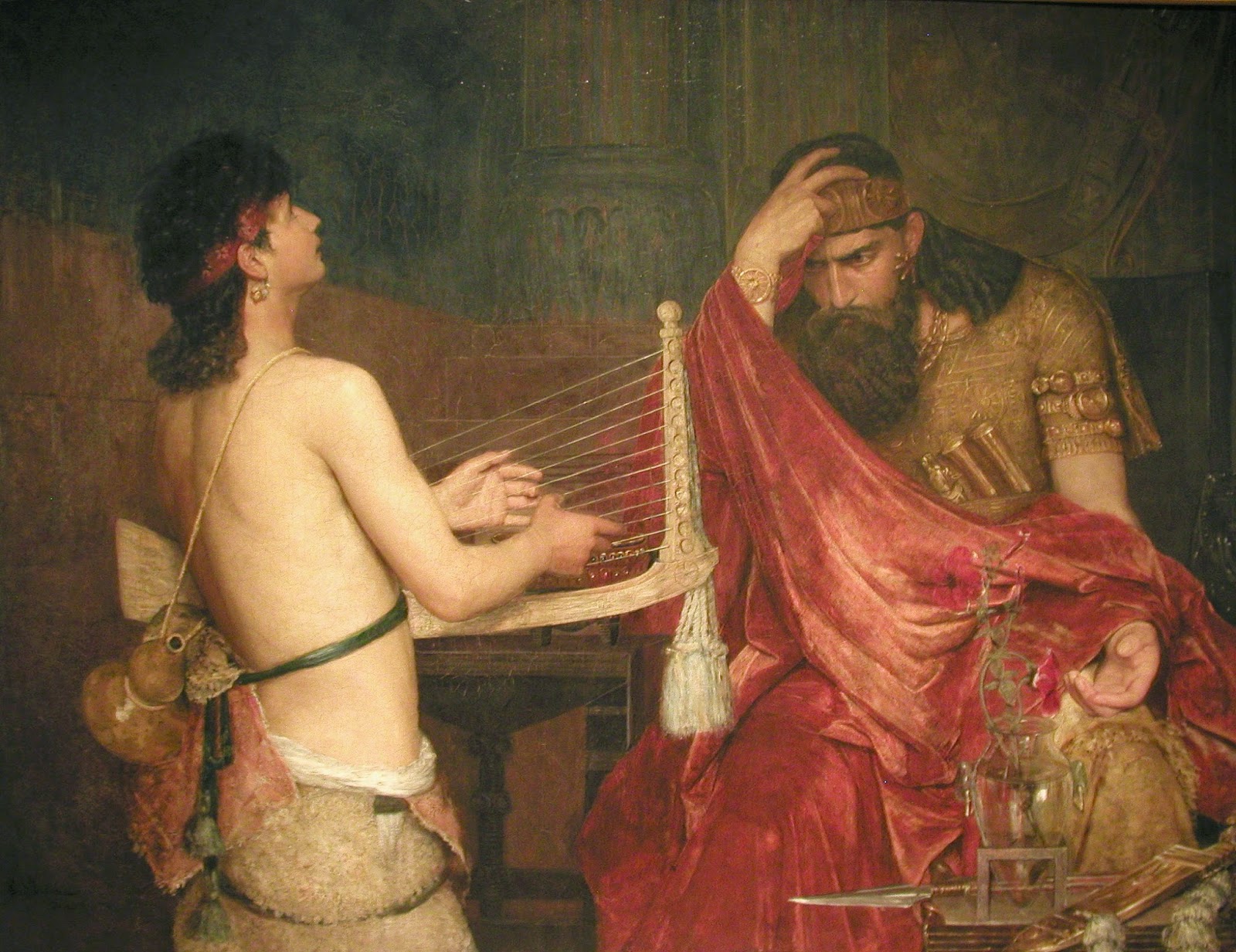
David's accomplishments were not only great but they were great accomplishments. David did three things for temporal Israel that typify what Christ will do for spiritual Israel. Following Saul's death, Israel's kingdom was divided in two for seven years. The tribe of Judah accepted David as their king and the rest of the tribes of Israel were ruled by Ishbosheth, one of the sons of Saul, whom Abner, Saul's commanding general set up as the new king (2 Sam 2:8-9). Despite being anointed as Israel's king, by Samuel, the prophet, David refrained from taking action against Ishbosheth in honour of the covenant he made with Jonathan not to retaliate against Saul's family when he came to power. Following Ishbosheth's murder (2 Samuel 3) David showed great wisdom and judgment by executing the two men responsible. This brought him into favour with the tribes under Ishbosheth and ultimately united all twelve tribes into one nation under the ultimate leadership of God. Secondly, David succeeded in winning the whole extent of the promised land for the covenant people. For the first time the chosen people of the Lord controlled the whole land promised to Abraham's posterity nearly a thousand years earlier. Thirdly, David established Zion or Jerusalem as the spiritual and political center of Israel. Under David's reign Israel reached its golden age. Never before had Israel achieved such heights of power nor did they ever again. (Old Testament Student Manual, p 291)
Despite all his great accomplishments David made one very big error of judgment. He became very comfortable as a monarch of a successful kingdom. This comfort zone became detrimental to his ability to endure to the end. As his kingdom ran like a well oiled machine, his approach to his kingly duties became somewhat lax. "At the time when kings go forth to battle" (2 Sam 11:1) David chose to send Joab and all Israel to fight Ammonites while he remained in Jerusalem, strolling upon the roof of his house to cool off in the heat of the night. This was David's first and big mistake that began his gradual demise into depths of sin from which he could not extricate himself. Sin seldom happens in one giant leap. As Elder Boyd K. Packer says: "I don't think anyone steps off a precipice into the depths of immorality and apostasy. They slide down the slippery sides of the chasm...." (Improvement Era. May 1970, p. 7) It would seem that David didn't think he needed his armour of God on such a hot night while he was lounging and relaxing away from battle but the adversary doesn't take sabbaticals and he took advantage of David's lack of protection. David spotted a temptation bigger than the Goliath he slew so valiantly some years prior. Not turning away once he happened to see a woman washing herself his gaze lingered enough to discover she was beautiful. Not content with leaving it there, he inquired about her. This should have stopped him in his tracks for the reply he got was that her name was Bathsheba (which means "daughter of the covenant") and that she was married to a man called Uriah (which means "Jehovah is my light"). These two names alone should have lifted him to a higher plain but 'his casualness in righteous things had dulled his spiritual senses' (Bruce Satterfield, Lesson 24, "Create In Me A Clean Heart", Meridian Magazine). The adultery that happened next was tragic but what happened after it was devastating. David dared to believe that he could conceal his sin, not just from Israel but from God. As he devised one plan after another to cover his sin he developed a treacherous character that led him to the loss of his salvation. When he failed to entice Uriah to spend time with his wife so that the conceived child could be passed off as his, David allowed the spirit of murder to enter his heart. He devised a plan that would insure Uriah's death at the front lines of battle and took Bathsheeba to be his wife. At what point do you think David could have stopped himself from advancing towards the edge of the precipice? None of this need have happened if David was at the right place at the right time, namely, out on the battle field instead of the roof of his house.

David had many wives and concubines which were given to him of the Lord by the hand of Nathan, the prophet (D&C 132:39). It was Nathan who was sent to prick David's conscience regarding the one wife that was not given to him of God and which 'displeased the Lord' (2 Sam 11:27). Nathan recounted a parable to David in these words: "There were two men in one city; the one rich, and the other poor. The rich man had exceeding many flocks and herds: But the poor man had nothing, save one little ewe lamb, which he had bought and nourished up: and it grew up together with him, and with his children; it did eat of his own meat, and drank of his own cup, and lay in his bosom, and was unto him as a daughter. And there came a traveller unto the rich man, and he spared to take of his own flock and of his own herd, to dress for the wayfaring man that was come unto him; but took the poor man's lamb, and dressed it for the man that was come to him" (2 Sam 12:2-4). Perhaps the most sombre words spoken to anyone in the scriptures were Nathan's words to David as he responded to David's outrage about the rich man who took the poor man's lamb and prepared it as a meal to a weary traveller whilst sparing so many lambs that he owned. At David's insistence that the man should be put to death for such a selfish act, Nathan's response to him cut deep as he said: "Thou art the man" (2 Sam 12:7). Nathan then continued to recount all that the God of Israel had done for David, pointing out his gross sin of murder and prophesying all the calamities that would befall him. He would not be put to death as the law required but he was given a worse punishment than that. The child born to David and Bathsheeba died and David lived to see many of his wives and sons turn against him and much of his household turn to infighting and blood.
Unlike Saul, David acknowledged where he had gone wrong and suffered godly sorrow that brought him to repentance. His sins, however, were grievous and even though he will eventually receive forgiveness in the sense that all sins are forgiven except the sin against the Holy Ghost, the forgiveness he will receive will not assure him axaltation. In the LDS Bible Dictionary we read: "Like Sault he was guilty of grave crimes, but unlike Saul, he was capable of true contrition and was therefore able to find forgiveness, except in the murder of Uriah. As a consequence David is still unforgiven but he received a promise that the Lord would not leave his soul in hell. He will be resurrected at the end of Millennium", meaning he will receive the telestial glory. Is this not a tragedy of gigantic proportion? A great man who accomplished so much, who had unwavering faith in God, who stood to remain a king throughout all eternity, will be resurrected to the lowest kingdom of glory. Joseph Smith said that David could get forgiveness only through hell but that his soul would not be left there. The question begs to be asked, who wishes to spend a term in hell with the devil before being cleansed from sin? If you are sitting on the edge of the precipice pushing the boundaries every which way, as far as you can, move. The cost of your falling will far outweigh the thrill and excitement of the edge.

David was promised by God that his throne shall be established through Christ forever, that he would become the progenitor of the Messiah and Saviour of the world (2 Sam 7:16). Jesus thus came into mortality as a descendant of David, through his mother, and as an heir to his throne both physically and spiritually. Elder James E. Talmage explains it like this: "At the time of the Saviour's birth, Israel was ruled by alien monarchs. The rights of the royal Davidic family were unrecognized; and the ruler of the Jews was an appointee of Rome. Had Judah been a free an independent nation, ruled by her rightful sovereign, Joseph the carpenter would have been her crowned king; and his lawful successor to the throne would have been Jesus of Nazareth, the King of the Jews". (Jesus The Christ, p. 87)
So David, a man of greatness who left such a huge mark on the world and who became an ancestor to the most important figure in human history turned out to be a study in tragedy. As we study this tragedy we cannot fail to recognise that the fall from grace is extremely easy. Sometimes we think we can handle a little temptation, that we are bigger than the pull of sin, or that we are strong enough to stand in the side lines and just watch but if you give in to the desire to watch, you will eventually have the desire to do. And sometimes we don't like to be regimented by the Church and we allow our 'right for freedom' to loosen that armour of God and it starts to slip and eventually it becomes a nuisance to us and we remove it altogether endangering our ability to endure to the end for no matter how great you started off, what matters more is how great you end up.

It is never too late to turn around and go the other way. The road of repentance might be rough and steep as opposed to the smooth road that requires nothing of us and that leads to nowhere. You might get a few blisters and a few cuts but if you press on, by the time you come full circle you will be a possessor of a humble heart worthy of the redemptive power which can make you clean. The Saviour waits ready to forgive and to encircle you in the arms of his love.
What win I if I gain the thing I seek?
A dream, a breath, a froth of fleeting joy?
Who buys a minute's myrth to wail a week
Or sells eternity to get a toy?
For one sweet grape, who would the vine destroy?
Or what fond beggar but to touch the crown,
Would with the scepter straight be stricken down.
- William Shakespeare