Showing posts with label #jonathan. Show all posts

Thursday, 19 June 2014

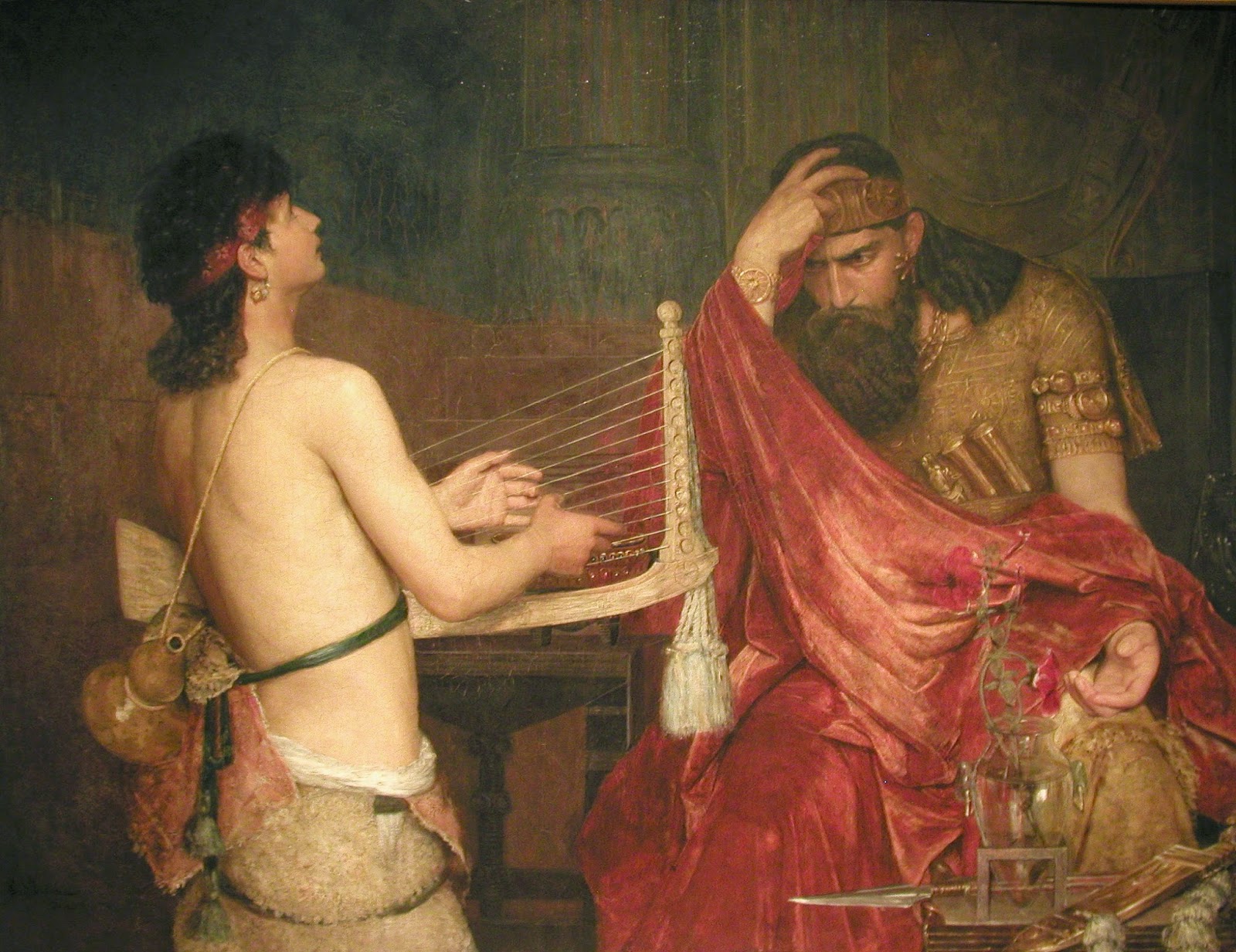
THE MADNESS OF SAUL


This is a very sad story of a fallen king who allowed jelousy to corrupt his heart and who invited the forces of evil to torment his soul. Having already lost God's favour through disobedience, Saul, the first king of Israel, continued on the down hill slide to self-destruction. Saul, who was born great and was above all Israel in stature and goodness ended up a bitter man not worthy of his kingdom and feared by all, even his family.

David having found favour with the king of Israel by slaying Goliath, was taken away from his family and installed into the king's household. So impeccable was his behaviour that he was beloved by all Judah and Israel (1 Sam 18:16). And so obedient was he to any task that he was given by the king that Saul placed him in charge of his army (1 Sam 18:5). It naturally followed that David had great success in his battles with the Philistines and Saul was soon overshadowed by his popularity (1 Sam 18:6,7). Saul perceived this popularity as a threat to himself and his kingdom. In his mind, praise for another somehow diminished him in the eyes of the people. Saul, who had everything, who was the king of Israel, chosen by God, under whose command armies moved, who had all power and influence in the land, wanted more. From the moment Saul heard the women chanting "Saul hath slain his thousands, and David his ten thousands" (1 Sam 18:7), he hated David and became exceedingly jelous of him (1 Sam 18:8,9).


Saul's good qualities and his ability to rule with wisdom were totally subverted as he allowed jelousy to consume him. What would seem a rather harmless emotion became a deadly murderous obsession. He makes it his life mission to kill David even risking the life of his son Jonathan (1 Sam 20:33) and willing to annihilate a whole city (1 Sam 23:10) to accomplish his purpose. How did Saul come to sink so low? Armies could not have toppled him if he had remained righteous. Only one person had the power to destroy him and that person was himself. Jelousy, a seemingly harmless emotion proved to be not so harmless after all. The scriptures record that Saul came to be overcome by an evil spirit continually (1 Sam 18:10, 19:9). Through the life of Saul we can see the author of all jelousy and envy, he who sought to elevate himself above all else, not wanting anyone to have what he had. The father of all lies would have us believe that somebody else's greatness diminishes our own and that blessings others receive means blessings taken away from us. He convinces us so well that self-seeking is the path to abundance and therefore happiness. Elder Holland cites one observer who summed this up well:

"In a world that constantly compares people, ranking them as more or less intelligent, more or less attractive, more or less successful, it is not easy to really believe in a (divine) love that does not do the same. When I hear someone praised, it is hard not to think of myself as less praiseworthy; when I read about the goodness and kindness of other people, it is hard not to wonder whether I myself am as good and kind as they; and when I see trophies, rewards, and prizes being handed out to special people, I  cannot avoid asking myself why that didn't happen to me." (Meridian Magazine, "The Lord Be Between Thee and Me Forever", p 2)

What leads us to these assumptions and feelings of want? Elder Holland elaborates:

"As others seem to grow larger in our sight, we think we must therefore be smaller. So unfortunately, we occasionally act that way. How does this happen, especially when we wish so much that it would not? I think one reason is that every day we see allurements of one kind or another that tell us what we have is not enough. Someone or something is forever telling us we need to be more handsome or more wealthy, more applauded or more admired than we see ourselves as being. We are told we haven't collected enough possessions or gone to enough fun places. We are bombarded with the message that on the world's scale of things we have been weighed in the balance and found wanting. Some days it is as if we have been locked in a cubicle of a great and spacious building where the only thing on the TV is a never-ending soap opera entitled Vain Imaginations." (Elder Jeffrey R Holland, Meridian Magazine, "The Lord Be Between Thee and Me Forever", p. 2)


Opposite to Satan's plan to make us greedy and self-absorbed is the Saviour's plan to nurture in us the ability to become Zion people. A Zion person seeks the welfare of others and not just his own. A Zion person is one that is bound in love to his fellow beings. A very good example of this comes from the same story as Saul. It is the friendship and bond of love between his son Jonathan and David, the future king of Israel. Where his father sought to slay David, Jonathan sought to preserve his life. Jonathan was the next in line to the throne and his father warned him that as long as David lived, his kingdom will not be his (1 Sam 20:31). Jonathan however, was more interested in being faithful than in being a king. He shows that faithfulness through his friendship with David by saying: "....the Lord be between thee and me forever" (1 Sam 20:23). Whereas Saul, in cahoots with an evil spirit, seeks to take away David's life, Jonathan fueled by his faithfulness to God, seeks to preserve it. Jonathan and David share a common bond of faithfulness which binds them in friendship and love forever. Because of this bond of love, they seek each other's welfare rather than their own. The only author of such love can be God. David too shows his faithfulness to God by resisting an opportunity that delivers Saul into his hands and refuses to take his life reasoning that Saul is anointed of the Lord and that there is no evil nor transgression in his hand and would therefore not commit such wickedness (1 Sam 24:6,11,12). Had David murdered Saul in the cave in which he found him asleep he would have obtained the kingdom through the evil design of murder and not be given it by the hand of the Lord. If that had been the case, that would have been the beginning of David's demise. He could have rid himself of Saul and his dogmatic murderous pursuit forever but he would also have succumbed to the same hatred and evil that came to possess the heart of Saul and would therefore become lost.  David was more interested in respecting and loving the Lord than in self-seeking and because of it he became the next king of Israel.


What blessings that come from serving others will we miss out on if we engage ourselves in self-seeking and elevating ourselves above our fellowman? Whether it is being better, having better or doing better than someone else, it is all the same. It all leads to pride which robs us of the godly nature which we need to be of benefit to our fellowman. Self-seeking has no future. It is of this world only for in celestial kingdom there will be no one that is more or has more than someone else. It will be a perfect existence with equality of heart and mind and possession. The only children of God who will be able to abide this existence will be those who love others as themselves. This is what we are here to learn most of all, to love. Without this love we cannot pass through the gates of eternity and have eternal life with God. The author of this love beckons us to follow Him and to 'pray unto the Father with all the energy of heart, that we may be filled with this love, which he hath bestowed upon all who are the true followers of his Son..." (Moroni 7:48).

Tuesday, 10 June 2014

SAUL, THE REBELLIOUS


"For rebellion is as the sin of witchcraft, and stubbornness is as iniquity and idolatry. Because thou hast rejected the word of the Lord, he hath also rejected thee from being king". (1 Samuel 15:23)

Even though rejected by His people as their king (1 Sam 8:7), the Saviour, whose mercy knows no bounds, ever honouring man's free-agency, ensured that the king that was appointed over Israel was the best that could be found (1 Sam 9:15,16), so He chose Saul, 'a choice young man' for 'there was not among the children of Israel a goodlier person than he' (1 Sam 9:2). By all accounts Saul, a Benjamite, was the perfect candidate for the first king of Israel. When he was chosen, Saul was: obedient (1 Sam 9:3), diligent and reliable (1 Sam 9:4), full of faith (1 Sam 9:10), humble (1 Sam 9:21, 10:16, 10:22) and forgiving (1 Sam 10:27, 11:13). It took Saul just two years to lose who he was and become a proud, vindictive man with exaggerated opinion of his power and importance. Through his disobedience he repeatedly showed lack of faith in God and disregard for following God's instructions with exactness. From this disobedience grew pride and from pride came reliance on his own wisdom and power to solve problems. You might say the power 'went to his head'.

Saul is the perfect example of someone who makes serious blunders when they rely on their own wisdom and importance rather than relying on God in matters that really matter. Saul's blunders were not just blunders but outright disobedience that cost him the throne and the kingdom the Lord had given him to rule. There were two acts of disobedience that were proportionate to the cost Saul paid for his disobedience. The first involved Israel's long standing warfare with the Philistines. The Lord chose Saul for the express purpose of saving Israel 'out of the hand of the Philistines' (1Sam 9:16). When he had reigned over Israel for two years, Philistines had 'gathered themselves together to fight with Israel' (1Sam 13:5) yet again. Their army was so formidable that Saul's men scattered in fright into caves and thickets and in rocks and in high places and in pits (1Sam 13:6). Saul watched as his army diminished from 3,000 to 600 men. He waited seven days for Samuel to come as he indicated he would, to offer a burnt offering ensuring success in battle. As Samuel showed no signs of appearing Saul decided that as he was king he would take matters into his own hands by offering the burnt offering himself. Not only was this a grievous sin as he did not hold the priesthood authority to do so, but he clearly showed no trust in God that He would assure Israel's victory no matter what. So Saul decided to trust in himself instead. As Samuel appeared and  asked him what he had done, Saul offered a feeble excuse that many of us offer when caught in the act of disobedience. He said 'I forced myself' (1 Sam 13:12). In other words, my hand was forced, the Philistines twisted my arm. This sounds like a lot of us who blame others for the choices that we make.

His second major act of disobedience occurred when Samuel sent him on a mission to destroy the Amalekites. There was no ambiguity or complexity in the instructions given to Saul: "Now go and smite Amalek, and utterly destroy all that they have, and spare them not; but slay both man and woman, infant and suckling, ox and sheep, camel and ass" (1 Sam 15:3). One could understand if he had perhaps spared the children but "Saul and the people spared Agag (the king), and the best of the sheep and of the oxen, and of the fatlings, and the lambs, and all that was good and would not utterly destroy them: but everything that was vile and refuse, that they destroyed utterly" (1 Sam 15:9). What was his excuse for not obeying with exactness? Saul thought he knew better than the Lord and reasoned with Samuel, "We kept the best of the animals for sacrifice and the rest we have utterly destroyed" (1 Sam 15:17). In other words, we thought we would do one better than what the Lord commanded so "we almost kept the commandment". Samuel's reply was classic, "Behold, to obey is better than sacrifice" (1 Sam 15:22). The Lord would rather have the obedience than excuses which would in the end have to come to repentance. Saul's excuses did not end there, he went on to blame the people who 'took of the spoil' (1Sam 15:21) "because he feared the people and obeyed their voice" (1 Sam 15:24). This is not a leader who would master a kingdom and lead others to God for he feared the people more than he feared God. Much like our politicians who want to please the people so they would be kept in power. And much like us today who like Saul offer excuses all day long as to why we 'almost' kept the commandments: someone twisted my arm, I thought this would be better, I didn't want to offend my friends, I almost obeyed.


Saul stands in sharp contrast to his son Jonathan and his friend David. Both of the youths surpassed Saul in their faith in God of Israel and they acted according to that faith. Fearless, Jonathan attacked Philistines' garrison of 20 men with just his armour bearer and slaughtered them sending trembling amongst the people and caused the earth to quake (1 Sam 14:12-15). His reasoning? "....there is no restraint to the Lord to save by many or by few" (1 Sam 14:6). In other words, it doesn't matter who many the Lord has to work with, the power is His and He'll get it done. Even before he charged at the garrison, he knew the victory was assured and that if the Lord worked with them, the two of them could defeat the entire Philistine army for he said to his armour bearer: "Come up after me: for the Lord hath delivered them into the hand of Israel" (1 Sam 14:12).

David, a mere shepherd boy, already chosen by God and anointed by Samuel to be the next king, was amazed, like Jonathan, that the army of the living God could fear anything. When sent to the Israelite camp by his father to deliver victuals to his brothers who served in Saul's army, David witnessed Goliath proposing a single combat with Israel. David's courageous response to the fear that was gripping skilled soldiers around him was one of derision: "For who is this uncircumcised Philistine, that he should defy the armies of the living God?" (1 Sam 17:26). When his brother accused him of pride rather than recognizing his bravery, David responded valiantly: "Is there not a cause (in Israel)?" (1 Sam 17:29). Where did David get such courage? Firstly, he was very skilled with the sling. "In defense of his father Jesse's flocks he had taken down a bear and a lion. The sling was a deadly weapon in the ancient world: it was said that the secret weapon of Hannibal of Carthage was his 1,000 Spanish slingers who could spray an enemy with bullets from a hundred yards. Saul probably knew the power of the sling, or he would not have allowed David to put the entire kingdom in jeopardy in single combat with Goliath. David was prepared for this encounter". (Breck England, Old Testament Lesson 22, Meridian Magazine). So David was skilled to take down Goliath but his fundamental source of courage was his trust in the Lord. His retort to Goliath who was offended that a mere youth was sent to slay him affirmed that faith: "Thou comest to me with a sword, and with a spear, and with a shield: but I come to thee in the name of the Lord of hosts, the God of the armies of Israel, whom thou has defied" (1 Sam 17:45).


Back in the beginning before Saul became king, when he was a 'choice young man', as a tall, strapping youth, he was sent out one day by his father to find his lost donkeys (1 Sam 9:3). Saul searched with his servant but could not find them anywhere. When he was just about to return home, his servant told him that Samuel the prophet lived nearby and that they should seek him out for advice and help (1 Sam 9:6). So Saul went to Samuel and thereby fulfilled the Saviour's promise of the previous day that He would send Samuel the man who should be king (1 Sam 9:15,16). This story has great meaning. In ancient Near East "kings were often depicted as riding donkeys. In its stubborn refusal to do its master's will, the donkey symbolized the king's errant subjects - and therefore the necessity for a strong royal hand. The stubbornnes and disobedience of Israel were legendary. They had already in a sense rejected the kingship of the Lord by demanding a mortal king, so it is appropriate that the Lord sent a man like Saul to seek out the 'donkeys' - that is, to corral them and rule them. It is also appropriate that Saul should ask for the prophet's help to find them." (Breck England, Old Testament Lesson 22, Meridian Magazine).  If Saul had only lived true to the symbolism of this incident in his life he would not have lost his throne. Instead Samuel's warning to the people rang true as he failed in his stewardship. One thing he did do well though. He proved that there is only one true king worth following. This true King entered the holy city of Jerusalem riding on a donkey a week before the Crucifixion. A great crowd laid palm leaves before Him symbolizing submission to royalty. By this they acknowledged in Him the great King who would master Israel as a man masters the stubborn animal he rides. The symbolism of the Lord riding upon a donkey was not lost on the people of Jerusalem and it should not be lost on us for He truly is the King of Kings and Lord of Lords.


Like Saul, if we are not ever vigilant, we stand to lose the throne by our disobedience. The Lord has said: "To him that overcometh will I grant to sit with me in my throne, even as I also overcame, and am set down with my Father in his throne." (Rev. 3:21) We stand to gain the whole splendor of eternity by being obedient. If we have erred, all is not lost for there is hope. The Lord stands with his hand outstretched, in His never failing mercy, willing to take us back: "For all this His anger is not turned away but His hand is stretched out still" (Isaiah 10:4) We have been bought with a great price for our worth is great in the sight of God. If you have wandered, know that you are loved still. He awaits and beckons: "Be faithful and diligent in keeping the commandments of God, and I will encircle thee in the arms of my love". (D&C 6:20)