Showing posts with label #godslove. Show all posts

Sunday, 16 January 2022

THE TREE OF LOVE


I don’t know about the rest of the world, but here in Australia, Easter goodies start appearing in stores as soon as the Christmas fare has been cleared away. I used to view this as greedy commercialism but this year I have begun to think differently. Greedy commercialism or not, the world’s focus on Christ diminishes post-Christmas and the Easter goodies now in our stores can somehow keep us in remembrance of Him as we near an even more significant event than His birth. 


It is my hope that before Easter, we will as members of His Church, reflect upon a set of enormously significant scriptures found in 2 Nephi. When Nephi, being the dutiful son that he was, inquired of God the meaning of the tree of life that his father had seen in a dream, an angel appeared to him to tutor him.  When the angel asked Nephi if he knew what the tree represented,  Nephi answered that it is the love of God, most desirable above all (2 Nephi 11:22,23).  Immediately following his answer he was shown a vision of the Savior during His mortal ministry.  It becomes very clear through Nephi's vision that the love of God is manifest to his children through the gift of His only begotten son.


Living on this side of the veil and experiencing the harshness of mortal life, it is easy at times to feel unloved by God because he allows misfortune to befall us or we don't get in life what we want.  We wonder how He could possibly love us when we are in the depths of despair and need so much that we don't have.  All the while we are wondering where the love of God is for us, He is hoping against all hope that we would open our eyes and see that He could not give us greater proof of His love than He has already done so through His son.  Why would Jesus be the ultimate expression of God's love for us?  Because through him God is offering us the greatest gift he could possibly give us, the gift of eternal life.  This life is but a moment, a few years of school so to speak but eternity is forever.  For this reason God's greatest desire is not that we have everything in this life but in the next and there is only one person who can make that happen.


Now that the celebration of His birth is over, let us prepare for the reminder of one event that we should never forget…..


The fruit, so precious and sweet,

The Father laid at our feet.

No greater gift He had to offer

The broken, the lost and the weary

Than the tree of life,

Yielding fruit with endless supply.

He gathers the fruit spilt on the ground

That multiplies with each harvest of

Penitent hearts.

The fruit, so precious and sweet,

Grows on the cross at the Father’s feet.


- CATHRYNE ALLEN

Art: The Tree of Life by Annie Henrie Nader


Tuesday, 11 July 2017

A GOD OF MERCY


There lived some 120 years B.C. a group of people in ancient America ruled by a self-serving and self-indulgent king called King Noah. So wicked was this king and his priests who taught the people 'lying and vain words' (Mosiah 11:11) that God saw fit to send them a warning voice through a prophet called Abinadi. Abinadi was hated and persecuted by the King and had next to no success in his attempt to turn the people to repentance. In fact Abinadi had only one convert by the name of Alma. Before he was burnt at stake Abinadi prophesied that King Noah and his people would suffer the same pains that they inflicted upon him and that they would be driven and taken by the hand of their enemies (Mosiah 17:15-18). Well God makes no promises that He does not intend to keep.

Abinadi's only convert Alma preached to the people of Noah in secret and was rewarded with a small following for his repentance and his efforts to convert others. Severe persecution necessitated this group of faithful followers to flee to safer pastures. Following their departure, God's prophecies to King Noah and his unrepentant people began to be fulfilled. King Noah suffered death by fire and his people under the new leadership of King Noah's son, Limhi, were taken into bondage by their enemies, the Lamanites.  Alma and his followers, through intricate circumstances, fell into bondage also. The lesson lies in these two groups of people and their respective conversions. The people of Alma repented of their sins when the call to repentance came. As the result of their conversion they covenanted with God through baptism to keep His commandments. The other group who were led by Noah's son Limhi repented out of necessity. Just as Abinadi prophesied, they were 'afflicted, smitten, driven to and fro and burdened according to the desires of their enemies' (Mosiah 21:13). And so the humility came in realising that only God could deliver them from their afflictions (Mosiah 21:4, 14).


Both the people of Alma and the people of Limhi repented, appealed to God and received deliverance from bondage but in different ways. The deliverance for the people of Alma came swift and totally engineered by God himself who caused a deep sleep to come upon the Lamanites so this little band of His followers could escape during the night. The deliverance for Limhi and his people came slowly and had to be devised by the people themselves. Why would there be such disparity in methods of deliverance for these converts to righteousness? The answer is this: it is a universal law that choice be followed by consequence. Consequence is a great teacher, one that is meant to help us develop our ability to choose wisely. If we choose to live within negative energy and in opposition to God's laws, we will reap negative situations wherein we have to be taught in a painful way that it is better to choose the right. In other words, be careful what you choose today because you will have to live with it tomorrow. The law of choice and consequence is also intended to make us spiritually and emotionally mature enough to be willing to be accountable for our actions.

Hidden from the world, but so evident throughout the scriptures, is one saving grace for our underdeveloped skill to always choose the right. We need never suffer more than we need to during the necessary lessons of consequence. When Limhi's people could no longer bear the afflictions of their bondage, having humbled themselves 'in the depths of humility', they began to 'cry mightily to God'....'all day long' begging to be delivered (Mosiah 21:5,14), but God was 'slow to hear their cry'. Evidently they had to suffer the consequence of their unwillingness to repent when the call came and they had to learn that God fulfills all His promises (Mosiah 21:4). There is, however, a light in this teaching moment.  The Lord could not erase the consequences of their actions but what He did do was soften the hearts of the Lamanites so that 'they began to ease their burdens' (Mosiah 21:15). In other words, the Lord, because of His mercy 'softened the blow'. To me, this story of accountability showcases the greatest need for us to remember that 'God is merciful'. In recounting the story of Limhi and his people, King Mosiah says thus: "And were it not for the interposition of their all-wise Creator, and this because of their sincere repentance, they must unavoidably remain in bondage until now. But behold, he did deliver them because they did humble themselves before him; and because they cried mightily unto him he did deliver them out of bondage; and thus doth the Lord work with his power in all cases among the children of men, extending the arm of mercy towards them that put their trust in him" (Mosiah 29:19,20).


Some of us are in bondage because of unwise choices we might have made. The path to freedom, however, is laced with mercy. In all our imperfections, we need not suffer long. The penitent and the obstinate both receive, but they alone determine the severity of that need and the swiftness of relief.  Mistakes can be made, wrong choices embraced, debilitating weaknesses indulged. But God is not far away and God is merciful, always. Such is the power of His love and His boundless charity towards the children of men.


Tuesday, 4 November 2014

THE DAY OF THE HUNTER


The prophet Jeremiah preached to the Kingdom of Judah for 40 years attempting to avert the impending captivity that eventually left Judah's land desolate. So seeped in sin and idolatry, Judah, like Ephraim and the 10 tribes, lost sight of the God they once promised to worship and serve. It would seem they needed the experience of captivity to discover them that this is indeed the god they wanted and not the dumb idols of heathen nations that they came to bow down to. The 10 tribes came to their senses quickly and were led by the hand of Jehovah into obscurity until such time that He would bring them back. Judah on the other hand became a very zealous nation for its God whilst in captivity to Babylon. They realised as their homes were left desolate that the prophets were right all along and that they needed to abandon image worship and return to the one true and living God. So zealous were they in their devotion to Jehovah's law that they became slaves to the numerous rules of conduct that went beyond the law itself. Out of this zeal different religious factions were born such as Pharisses and Sadducees which ensured strict observance to the overwhelming number of laws and rules that were invented. Up until the Babylonian captivity, scriptures were only read on special occasions and on the sabbath. Once Judah was taken into captivity this changed and scriptures began to be taught to the general public on regular basis by another factious group called scribes. Over time the Jews in Babylon began to adopt the language and culture of the Chaldeans forgetting the Hebrew language. This necessitated the assistance of scribes who read and interpreted the scriptures to them. "Through the years, each religious group - scribes, Pharisses, Sadducees and others referred to the written word, quoted it, enlarged upon it, interpreted it, and in other ways continued to add to what their fathers had established. The commentaries, explanations, interpretations, and inferences became known as oral tradition. In time, these traditions, written and oral, took on so much importance that they often overshadowed the law and became a stumbling block for the Jews" (Old Testament Student Manual, 1 Kings - Malachi, p. 262). This is the condition in which the Saviour found them when He made His appearance as the awaited and promised Messiah.


"....A voice was heard in Ramah, lamentation, and bitter weeping; Rachel weeping for her children refused to be comforted for her children, because they were not." (Jeremiah 31:15)

Rachel, the beloved wife of Jacob, the mother of Israel, is here depicted lamenting over the loss of her children which she longed for and which were given an inheritance in the household of God; once a chosen people, now lost in captivity (Old Testament Student Manual, p. 255). And they would be lost forever if not for one thing: the everlasting love of a God who never forsakes and abandons and never breaks the covenants which He has made; a god of mercy, a god of love, a god who fulfills his promises. As the Jews entered exile, the Saviour made a promise that He would bring them home to Jerusalem after 70 years of captivity (Jeremiah 29:10). True to His word, 70 years later to the day, King Cyrus of Persia, raised by the Lord for this purpose, ended the Babylonian rule and released Jews from their captivity giving them a charge to return to Jerusalem and rebuild the temple. And herein lies another testament of Jesus' endless love - after the time of Christ Judah endured another exile that would last for centuries but once again the Saviour of all mankind does everything in His power to reclaim that which is lost.


"Behold, the days come, saith the Lord that I will make a new covenant with the House of Israel, and with the house of Judah....this shall be the covenant that I will make with the house of Israel...I will put my law in their inward parts, and write it in their hearts; and will be their God and they shall be my people.....for I will forgive their iniquity and I will remember their sin no more." (Jeremiah 31:31-34)

Preceding the Saviour's second coming, a latter-day gathering of the scattered Israel will take place in three phases: the gathering of Israel to the land of Zion, the American hemisphere; the return of the Ten Tribes from the countries of the north; and the reestablishment of the Jews in Palestine as God's chosen people (Old Testament Student Manual, p. 254). The Lord will accomplish this work through the restoration of His Church. Israel will be gathered and return to the land of their fathers 'with weeping' (Jeremiah 31:9) 'because they will realise that the sufferings they have endured throughout the centuries came about because they rejected the Lord Jesus Christ, who shall lead them in the last days' (Old Testament Student Manual, p. 255). The Saviour, with everlasting love and willingness to always forgive will lead them as they come out of obscurity to once again possess their blessings: "I will cause them to walk by the rivers of waters in a straight way, wherein they shall not stumble; for I am a father to Israel and Ephraim is my firstborn" (Jeremiah 31:9)


 "Therefore, behold, the days come, saith the Lord, that it shall no more be said, The Lord liveth, that brought up the children of Israel out of the land of Egypt; But, the Lord liveth, that brought up the children of Israel from the land of the north, and from all the lands whither he had driven them; and I will bring them again into their land that I gave unto their fathers. Behold, I will send for many fishers, saith the Lord, and they shall fish them; and after will I send for many hunters, and they shall hunt them from every mountain, and from every hill, and out of the holes of the rocks." (Jeremiah 16:14-16)

In Jeremiah's day, most fishing was done with nets and so was in Peter's but Peter was no ordinary fisherman, he was called to be a fisher of men. Peter fished with his nets and brought in 3,000 converts on the day of Pentecost. In like manner the early converts of the Church used nets to fish and bring in multitudes of converts: Wilford Woodruff converted more than 2,000 people in eastern states of America and British Isles; The Twelve under the direction of Brigham Young converted over 6,000 people in Britain between 1839 and 1841 and Parley P. Pratt who repeatedly baptised in excess of 100 people wherever he stopped to preach. But after the fishers, the Lord promised that He would send many hunters. Hunting, unlike fishing with nets, is more precise work. It is not usual practice to hunt a heard but individual animals, 'from every mountain, and from every hill, and out of the holes of the rocks' (Jeremiah 16:14-16).... Is not the day of the hunter here as we seek for the honest in heart who want to become the pure in heart? Are not our missionaries searching with precision individuals who desire to know the Lord? Are we not labouring endlessly seeking out our ancestors and those who have gone before us to bless them with saving ordinances necessary for salvation? We are hunting in His name by day and by night so that not one is overlooked who seeks to know Him and come unto Him for He will go to any length and any depth and any measure to find that which is lost.


Tuesday, 1 April 2014

THE GREAT DELIVERER


I love anything old.  My daughter and I live in the mountains, in a house that was built in the 50's.  As I walk past the original doors and intricate ceiling designs, I am filled with appreciation for bygone days.  As we drive around our small town we notice old buildings with the year of construction imprinted on them and marvel how much history those buildings contain.  I love antiques because they have belonged to people who have once lived and loved and suffered and rejoiced.  Anything old to me is a mirror of someone's experience on this earth.  I also love to know about people who have graced this earth and lived fighting for God's cause, labouring for the salvation of men, leaving an imprint on the sands of time with their worthwhile works.  I love people who have been courageous enough to be leaders, who have inspired others and lifted them to higher ground, who have marched without fear at the front lines defending the truth, not fearing what man can do.  Nowhere can we find such witnesses better than in the Old Testament.

I love the Old Testament with a passion.  To me it is not just a compilation of feel good stories taught to children in Sunday School or a historical account with difficult language and complicated spiritual meanings.  To me the Old Testament is where our roots are, where modern day Israel has its' beginning.  It helps me understand who I am and what my earthly responsibility is.  Most importantly it helps me see the Saviour as the Great Deliverer.  I think this is the whole purpose of the Old Testament which is replete with examples of the Saviour's power to deliver, whether from intimate bondage of sorrow and suffering or a communal one such as the Israelites' exit from Egypt.  When our lives are over, we will be able to look back and see proof of the Saviour's deliverance from ignorance, pain, loneliness, sickness, sin, trial and every adversity of this mortal life.  I love the Jehovah of the Old Testament. Nowhere else in scriptures is he better depicted as majestic and powerful, merciful and loving. Through this set of scripture we see a God who forgives over and over again and when he does, he does it quickly.  Often people view Him through the Old Testament as the God of vengeance and wrath, harsh and easily angered. If we however, examine the situations in which God has had to reprimand his people or punish them in some way and if we look at the whole story we will come to know a different God of our fathers and we will believe Him when he describes himself as: "The Lord God, merciful and gracious, longsuffering and abundant in goodness and truth" (Exodus 34:6).


The exodus of the children of Israel from Egypt should 'stand as the salvation act that God will be known by until the days of the Millenium" (Phillip Allred, "Bondage, Passover and Exodus", Meridian Magazine).  It intrigues me then that when this mammoth event of history is brought up, Moses is the person that comes to people's mind as the deliverer of Israel. A great man, thoroughly committed to God and foreordained before this world began, he became a prolific figure throughout history due to the great task that he accomplished.  In him we find another prototype of the Saviour.  He is one of those who marched at the front lines that I admire but I believe the deliverance of Israel is not about Moses but about the God of Israel. The Saviour went to great lengths to impress upon the Israelites of the day and therefore us, who read of the account in our day, that even though he had chosen a man to accomplish his work, He was the true deliverer that brought Israel out of Egypt. This he proclaimed to the Israelites in a very clear message:

"I am the LORD, and I will bring you out from under the burdens of the Egyptians, and I will rid you out of their bondage, and I will redeem you with a stretched out arm, and with great judgments: And I will take you to me for a people, and I will be to you a God: and ye shall know that I am the LORD your God which bringeth you out from under the burdens of the Egyptians.  And I will bring you in unto the land, concerning the which I did swear to give it to Abraham, to Isaac, and to Jacob; and I will give it you for an heritage: I am the LORD. (Exodus 6:6-8)

When the Lord made his intention of deliverance known to Moses, he simply said: "....for I know their sorrows" (Exodus 3:7).  Here is a God of love and compassion.  As the story progresses, it becomes obvious that He is not only delivering them from physical bondage but from a spiritual one too and offering them a covenant that will lead them to eternal life.  He brings them to Mount Sinai with the intention to bind them in this covenant, to seal them His forever: "If ye will obey my voice indeed, and keep my covenant, then ye shall be a peculiar treasure unto me above all people....and ye shall be unto me a kingdom of priests, and an holy nation". (Exodus 19:5,6)  "The word 'treasure' in Hebrew is segullah, which refers to closely held personal wealth or property.  According to Hugh Nibley, the word also means 'set apart, sealed, removed from the rest of the world" (Breck England, OT Lesson 14, "Ye Shall Be a Peculiar Treasure Unto Me", Meridian Magazine") By bringing Israelites out of Egypt, the Lord sought to take Egypt out of Israelites. Imagine being a kingdom of priests and a holy nation and being known as the Lord's treasure. In this Israelites failed miserably and proved that they didn't really know the God of Abraham and of Jacob and of Isaac but they sure knew the gods of Egypt. The knowledge of their God had somewhat dimmed over the 400 years of their sojourn in Egypt plunging them into spiritual bondage as well as the physical one.  As soon as they took upon themselves the covenants of the priesthood, they abandoned them and fashioned for themselves a new god, a molten calf which represented the Apis Bull, a god particularly associated with Pharaoh. (Breck England, OT Lesson 14, Meridian Magazine)


If only Israel had trusted in the God of Israel who went to such great lengths to show them who He was and prove to them that there is no other above Him. For this reason God instructed Moses to send plagues and perform miracles in Egypt that could be replicated by the magicians and priests of Egypt for this is all that man can do. He then performed what no man or false god can do by smiting the firstborn of every household all at once, at the stroke of midnight. This spoke volumes that very clearly no wonder of Egypt could overshadow the one true and living God. I love symbolism in the Old Testament.  To me the parting of the Red Sea is symbolic of a new life the Lord would lead the Israelites to by clearing the way before them and drowning the Egyptians who pursued them, symbolic of the destruction of Israelites' physical and spiritual bondage.  And what greater proof could they have had that He was with them every step of the way than this:

"And the Lord went before them by day and in a pillar of a cloud, to lead them the way; and by night in a pillar of fire, to give them light; to go by day and night:
"He took not away the pillar of the cloud by day, nor the pillar of fire by night, from before the people".
(Exodus 13:21,22)

It seemed, however, that nothing was enough for the children of Israel.  Not the manna from heaven, not the water from a rock, not the serpent on a stick, nor their victory over Amelekites. Because of this it took Israelites 40 years to be ready to enter the promised land.  Because of their unwillingness to obey the higher law they were not allowed to 'enter into his rest while in the wilderness, which rest is the fullness of his glory'. The fullness of that glory is exaltation which would not be available to the house of Israel until a new dispensation of the gospel in the meridian of time - our time.  We are the modern day Israel who can enjoy the fullness of the covenant and the blessings of exaltation.  How well do we know and trust the God who offers us this privilege through his never-ending mercy and love?  Are we like Israelites who kept promising "All the words which the Lord hath said will we do" (Exodus 19:8, 24:3,7) but then turned back to the gods of Egypt? Is there an acre or two of Egypt within us too? President Kimball puts it well:

"Few men have ever knowingly and deliberately chosen to reject God and his blessings.  Rather, we learn from the scriptures that because the exercise of faith has always appeared to be more difficult than relying on things more immediately at hand, carnal man has tended to transfer his trust in God to material things....Whatever thing a man sets his heart and his trust in most is his god; and if his god doesn't also happen to be the true and living God of Israel, that man is laboring in idolatry".

Do we know the God who we profess to believe in and do we trust Him enough to place our lives in His hands and to obey his covenants?  Do we trust Him enough to deliver us from our personal Egypt? Do we know Him as The Great Deliverer or do we trust someone else to bail us out of our darkness?  Do we know in whom we should trust?


"There is a story told that a company of botanists seeking some special flowers up in the Canadian Rockies, came one day to a very rare flower down on the side of a cliff.  To reach it they would have to retrace their steps and go back ten miles to come up from the valley below.  Someone suggested that if they had a rope they could let a boy down to pick the specimens.  That suggestion was prompted by the fact that a little boy had been following them for about an hour, watching them silently.  They got the rope and said:

'Here lad, we'll give you $5 if you will put this rope around you and permit us to let you down to get those flowers'.

Without saying a word the lad scampered off.  They thought they had frightened him.  He went to a house nearby and soon came back with a man by his side.  Then the little fellow answered:

'You may put that rope around me, and I'll get the flower, if you'll let my dad hold the rope'."
(President David O. McKay, CR. April 1944)


Thursday, 23 January 2014

FEAR NOT


".....Fear ye not, stand still, and see the salvation of the Lord...." (Exodus 14:13)

When the children of Israel saw the Egyptians pursuing them with the entire chariot fleet of Egypt such fear took over them that they forgot all the miracles that had been wrought by Moses to persuade Pharoah to let Israel go.  In fact, their fear of slaughter was so great that they even forgot all the pleading with God they had done so God would deliver them from slavery and blamed Moses for taking them out of Egypt almost against their will (Exodus 14:11,12)  In the midst of that fear the picture of reality got totally distorted.

It has been said that all our worrying is fueled by fear of loss of life. Just about all our day to day worrying is associated with survival in this temporal world and most of it has to do with money.  Without money you cannot meet your basic human needs such as shelter or food.  Without shelter you might end up on the street and without food you will starve and eventually die.  So the fear is not about lack of money but about your possible demise resulting in death.  We fear death because we were born with the instinct to preserve life.  In this context then surely fear would be a good thing would it not because it would drive us to act?  However, quite the opposite is true.  Fear robs us of peace and happiness and renders us powerless to act making us depressed and miserable.  Where there is depression and misery, motivation is difficult to find. There is fortunately a better way of handling the stresses of every day life that are associated with our survival.

Because we live in a fallen world, we live in a world of opposites. Two opposing forces in this world are darkness and light.  Darkness is of the adversary while light is of God.  We are at all times either going towards light or darkness.  Darkness renders us powerless while light makes us powerful.  Where there is darkness, there is no God and the ensuing power he can give us. God is a god of glory and light and cannot be where darkness is.  Fear produces darkness of the mind. When there is darkness in us, God cannot empower us to overcome, endure and achieve.

 Consider Moses' encounter with God and Satan.  After God departed and Satan made his entrance demanding that Moses worship him, Moses refused.  Satan proceeded to unleash his displeasure as he 'cried with a loud voice and ranted upon the earth' (Moses 1:19) So frightening was his protestation and anger that 'Moses began to fear exceedingly; and as he began to fear, he saw the bitterness of hell' (Moses 1:20) There is only darkness in hell and there are no light switches there.  I would imagine this darkness of hell frightened Moses to the extreme for verse 20 records that he immediately called upon God and as he did he received strength to repel Satan affirming his intention to only worship God, 'who is the God of glory'.  A God of glory is filled with intense light which has the power to dispel all darkness for darkness and light cannot abide together.  As Moses commanded Satan to depart and as Satan did so, the darkness left with him and the God of glory and light once again appeared to Moses.


Something interesting happened when God appeared to Moses the second time.  Because Moses chose to worship God and appealed to Him to deliver him from darkness, God empowered Moses beyond his fondest dreams.  In Moses 1:25 we read:

"...Blessed art thou Moses, for I, the Almighty, have chosen thee, and thou shall be made stronger than many waters; for they shall obey thy command as if thou wert God".

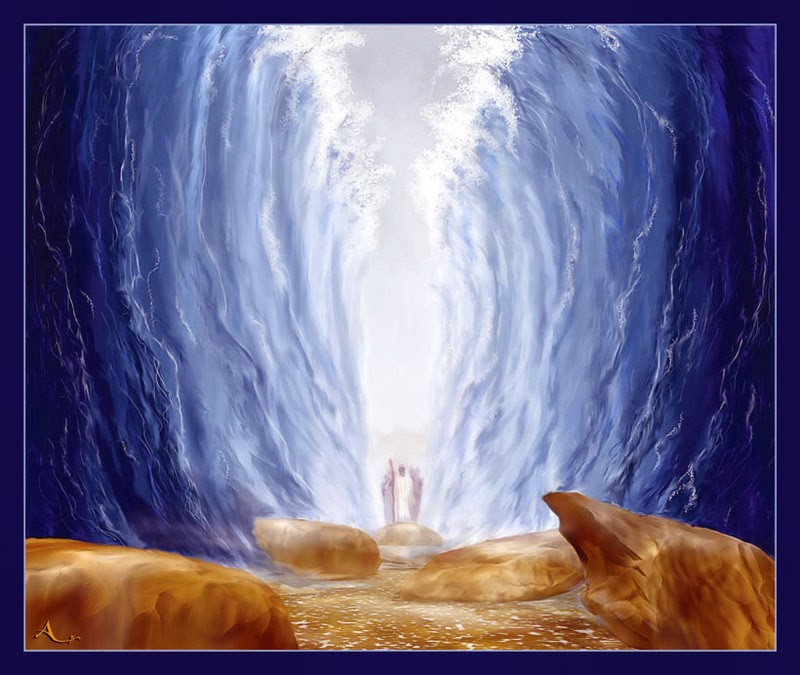
It would seem that the parting of the Red Sea was made possible long before Moses and the children of Israel stood on its' banks.  Because Moses chose to turn to God rather than remain in fear, God empowered him to accomplish his earthly task of leading Israel out of bondage.  This endowment of power had another purpose.  Through it and by it, God proved to Israel that He is a God of miracles.

What is the lesson in all of this for us?  When fear comes upon us, it distorts our reality.  Because of that distortion, we cannot see things clearly and are more than often not able to act to change the picture.  Most of the time we are not even aware that we have altered the reality in our minds.  We no longer see things as they really are.  At this point life becomes very bleak indeed.  In that bleak darkness however exists a flicker of light which can be ignited to disperse the darkness from us and make us able to act.  When we decide that we don't want to be incapacitated by darkness any longer and turn to God instead, we do two things: 1.  We dis-empower the adversary and 2. we enable God to perform miracles on our behalf which makes deliverance from our bondage imminent.  God is still a God of miracles which means that there is no situation in this life that He cannot deliver us from. When miracles fail to appear in our lives we either don't recognise them or do not ask for them with sufficient faith or it is not expedient for us to receive what we are asking. Sometimes even some repentance is needed on our behalf first.  In Mormon we read:

"And if there were miracles wrought then, why has God ceased to be a God of miracles and yet be an unchangeable Being?  And behold, I say unto you he changeth not; if so he would cease to be God; and he ceaseth not to be God, and is a God of miracles.

And the reason why he ceaseth to do miracles among the children of men is because that they dwindle in unbelief, and depart from the right way, and know not the God in whom they should trust." (Mormon 9:19,20)

I have had many revelations of God's miraculous power in my life.  I will recount one incident in my life which proves this point.  Following my divorce I struggled greatly to make ends meet as I worked to support my two children.  One week in particular with a few more days to pay day, I realised that the fuel in my car would not last.  I knelt down and prayed this one particular morning asking the Lord for $20 for fuel.  I then went to work leaving it in Lord's hands and putting it out of my mind until lunch time when my co-worker came to my desk and put $20 on it.  I asked what the money was for and he said he was coming back from lunch when he noticed $20 on the footpath.  He said he picked up the note and wondered what to do with it. He decided he didn't need it and as he did so I immediately came into his mind and he resolved to give the money to me.  There was no doubt in my mind that day who placed that $20 on the footpath where my co-worker would come across it.  And there is even less doubt in my mind who inspired him to give that bank note to me.  The value of that bank note was very small but the miracle to me was of enormous proportion.
It proved to me that there is little value in fear and much more to be gained from faith.


Fear is inverted faith.  When we have little faith, fear flourishes.  Being nourished by the word of God consistently increases our faith in God.  Reading and studying the scriptures enables us to understand God's dealings with his children, the how, why and when.  It also provides us with ample proof of his matchless power, ever present love and miracles he has wrought over the ages.  If he loves us still, like he loved people of old, he can part our Red Sea too and make the path straight for our deliverance.

The antidote to fear is faith.  Positive thoughts and spoken words affirm our faith and bring light into our understanding regarding our situation and trials we face.  One way to counteract negative thoughts which lead to worry which leads to fear and accompanying darkness is to use scriptural affirmations.  Familiarise yourself with positive phrases in the scriptures which have the power to elevate your ability to believe and say them out loud whenever you feel yourself sinking. Make one particular one your mantra. My favourite is: "...all things work together for good to them that love God" (Romans 8:28)


If you are standing on the banks of your Red Sea and are threatened with drowning, feeling overwhelmed with your life, do not despair.  To despair is to turn your back on God denying his power to rescue you from the depths of the sea and bring you to shore.  He can and will come to your aid if you put your trust in Him. He will flood your soul with hope and peace and assurance that all in your life is possible.  The extent of your faith and devotion to Him will determine the magnitude of the power He will bestow upon you.  Be faithful and do not deviate from your chosen course.  If you are travelling on the path of righteousness, do not forsake it. If you are not, come back.  God will honour your sacrifices and your commitment to Him.  He will dry your tears and carry your sorrows and make your burdens light.  "And He loveth those who will have Him be their God" (1 Nephi 17:40).  Raise your staff, wade in waist deep and 'see the salvation of the Lord' as He parts your Red Sea. Fear not for you are walking on dry ground.


Sunday, 19 January 2014

HOPES AND PROMISES


The other day I had an opportunity to spend a day with my 3 year old granddaughter.  Just she and I, together for the day, playing with abandon.  It always touches my heart that she wants to be with me and that we can have such a good relationship, that she trusts me to take care of her.  Before she was born I had decided that I wanted to be called Grandmummy.  My granddaughter though decided otherwise.  When she was 2 she declared that my name would be Damma.  I am convinced she brought this name with her from pre-existence.  This is the name her mother used to call her paternal grandmother when she started to speak. She could not pronounce Grandma so Damma it was for awhile but the name remained a special reminder in the family of my daughter's early life.

My daughter and her grandmother had a very special bond.  Her grandmother, my mother-in-law, was a wonderful person and a unique grandmother.  When I started to look forward to being a grandmother myself I hoped ardently that I would be a grandmother like her.  This special woman passed away while my daughter was still pregnant with her first child, my granddaughter Addy.  Before Addy was born her paternal grandfather had a dream about his mother who had passed away and in that dream saw her instructing a little girl about earth life.  We all knew Addy was going to be Addy before she even appeared.  I could not be more sure that my mother-in-law told Addy about the name 'Damma' and that Addy remembered it when the time came in her life to put a name to me.  I sometimes feel that this is a special message to me from beyond the grave.  Addy had never heard anybody else use this name and she can pronounce Grandma perfectly so I feel that this name could not have come from anywhere else. Such a simple thing but such a strong cord binding us together in this great adventure of mortality made possible by the plan of salvation.

When Abraham had a vision of the intelligences that were organized before the world was created he found himself standing among the 'noble and great' ones and was told by the Saviour that he was chosen before he was born. (Abraham 3:23)  Among these noble and great spirits Joseph Fielding Smith identified prophets of our dispensation whom he saw in his vision of the dead who he declared 'were reserved to come forth in the fulness of time to take part in laying the foundations of the great latter-day work....I observed that they were also among the noble and great ones who were chosen in the beginning to be rulers in the Church of God". (D&C 138:53-55)  These great spirits were 'prepared to come forth in the due time of the Lord to labour in his vineyard for the salvation of the souls of men' (D&C 138:56).  Joseph Smith taught:

"Every man who has a calling to minister to the inhabits of the world was ordained to that very purpose in the Grand Council of heaven before this world was.  I suppose I was ordained to this very office in that Grand Council" (TPJS, p 365)


How would you feel being one of the great spirits chosen to come to earth to do a specific job and one of great importance and magnitude?  Would you feel important?  Would you understand the gravity of your responsibility and live up to it every day?  How would you feel if you knew you were responsible for salvation of the souls of men?  What Joseph Smith said is true.  It is true of every one of us.  We have all been called to minister to the inhabitants of the world in one way or another.  Looking into my granddaughter's sweet face, I am convinced that I could not have a more important calling in life than that of being her grandmother.

As I considered our relationship the other day, I wondered what promises I had made to her in pre-existence.  I have always believed that we choose our parents but I never gave it much thought to grandparents and beyond.  Did we know each other as such back then?  My patriarchal blessing tells me that my time of coming to earth was set that I may fulfill the promise I made in my pre-existence and that I had fulfilled that promise by entering the waters of baptism.  It goes on to say that many of those spirits who were with me had rejoiced when that promise was fulfilled.  Could it be that those spirits were my ancestors and my posterity who depended on me to assist them in working out their salvation whilst in the flesh?  Were they watching me beyond the veil as I progressed through my life hoping against all hope that my promise will one day bear fruit?  I am a convert to the Church and by my conversion and acceptance of the truth, I have not only been instrumental in redeeming the dead in my family, I have also paved the path for my granddaughter to be born a child of the covenant.  This has given her a great start in life. If I continue faithful, my love, my example and what I can teach her will be the priceless legacy I will leave her when I am gone. Is this my work of any less importance than the one of 'the great and noble ones'?

We are not here just for ourselves.  I am certain we covenanted with one another through the bonds of love before the plan of salvation unfolded that we would contribute to the salvation of each other's souls.  I am certain our hearts were turned to one another and bonded through the promises that knitted our souls together.  It is not by chance that we have a responsibility whilst here to love and serve one another and to become 'saviours on mount Zion'.  When fulfilled, this responsibility in turn makes us like the Saviour, possessors of the pure love of Christ without which we cannot be saved.  (Moroni 7:46-48)


Contrast this pure love of Christ that binds us together to the self-serving objective of the adversary's plan which had no capacity to bring us together in love and unity.  Satan had only one goal, to exalt himself above everyone else.  He had no regard or love for any of us and even his dysfunctional plan to save us was for his own benefit and not ours.  His goal to draw away after him as many as he can is purely to make us as miserable as he is, his promise of eternal life based on a lie, a plan that could never work.  Why did so many in our pre-existent state fall prey to his empty promises?  Consider the following:

"When we talk about our relationship to the Savior and our redemption, we must begin with the pre-mortal life.  I think we often miss the real issue of the contention in the spirit world that eventually led to the War in Heaven.  We talk about it as though Lucifer was going to force everybody to obey.  Most people don't want to be forced.  As I see it, the real issue is that Lucifer would guarantee their salvation.  He promised salvation without effort, without excellence, without hard work, without individual responsibility.  That's the lie that he promulgated in the pre-earth councils.  That so-called shortcut to salvation captivated many gullible and lazy spirits.  They wanted something for nothing.  We have certain aspects in our life today where things are awkward.  Something for nothing - a free lunch, we sometimes call it - with certain kinds of subsidies which promise to guarantee the reward without the effort.  On that basis Lucifer led away many spirits."
(Robert J. Matthews, "The Price of Redemption", The 11th Annual Sidney B. Sperry Symposium - New Testament, January 29, 1983)


Redemption is not for the faint hearted and we know that we are not of such disposition because we chose Christ's plan which comes with a price.  Some of us can afford to pay more than others, some of us are stronger, more capable and some of us need help but none of us can make it alone.  Even the strongest of us need help to hold onto the iron rod at some point in our lives.  We all need succor, guidance, positive influence, inspiration, motivation, a righteous example, a kind word, to be loved, to be cherished. None of us can do without any of these and yet all of these are given and provided by another.  You would not be you without the people you have had in your life.  Both of my granddaughters have the same birthmark as I do on the back of their heads.  It makes me feel like this is evidence that they are mine but more than this physical proof of our kinship I hope that their spirits will bear resemblance to mine as I strive to be an example of faithfulness to God and show them the path to righteousness.  I feel as responsible for their spiritual welfare as I did for my children's.  I cannot afford to let go of the iron rod, small eyes are watching and small hearts hoping that I will not fail in my promises.


Whilst attending our new ward yesterday, my daughter was introduced in Relief Society with significant reference to her grandparents who are well known far and wide for their faithfulness and Church service. Her grandmother who I believe passed onto Addy the famous name of 'Damma', is highly regarded in the Church in Sydney by many saints who knew her.  My daughter whispered to me: "Gram and Grandpa are famous in the Church" and I whispered back: "Wherever you go, you will be associated with their good name. This is the legacy they have left for you".  I hope that one day Addy will be introduced somewhere as my granddaughter and that she will be proud of that fact.

Wednesday, 1 January 2014

THE LOVE OF GOD


Bethlehem, the town of Jesus' birth is also called The House of Bread. Bethlehem provided the surrounding region including Jerusalem with their entire supply of bread. It is by no accident that Jesus was born there because that is the origin of his mortal lineage and it is not surprising that later he would proclaim himself to be the bread of life.  I love symbolism and there is a lot of it surrounding Jesus' birth and life.


When Nephi, being the dutiful son that he was, inquired of God the meaning of the tree of life that his father had seen in a dream, an angel appeared to him to tutor him.  When the angel asked Nephi if he knew what the tree represented,  Nephi answered that it is the love of God, most desirable above all (2 Nephi 11:22,23).  Immediately following his answer he was shown a vision of the Savior during his mortal ministry.  It becomes very clear through Nephi's vision that the love of God is manifest to his children through the gift of his only begotten son.

Living on this side of the veil and experiencing the harshness of mortal life it is easy at times to feel unloved by God because he allows misfortune to befall us or we don't get in life what we want.  We wonder how He could possibly love us when we are in the depths of despair and need so much that we don't have.  All the while we are wondering where the love of God is for us, He is hoping against all hope that we would open our eyes and see that He could not give us greater proof of His love than He has already done so through His son.  Why would Jesus be the ultimate expression of God's love for us?  Because through him God is offering us the greatest gift he could possibly give us, the gift of eternal life.  This life is but a moment, a few years of school so to speak but eternity is forever.  For this reason God's greatest desire is not that we have everything in this life but in the next.

It has puzzled me that a lot of us, even members of the Church, don't quite grasp this principle.  In my reflection on this I am beginning to think that this is so because a lot of us don't quite understand who we really are.  Maybe I should rephrase that.  We don't quite FEEL who we really are.  If we truly felt and understood our divine origin and knew ourselves as first and foremost the offspring of God with a divine destiny we would wade through this life's gutters much easier.

When Moses had his experience with God sometime after the burning bush and before the Exodus, Jesus who appeared to him and spoke to him on behalf of the Father through 'divine investiture of authority' called him 'Moses, my son' on a number of occasions. God showed Moses all his creations and where man fitted in that plan. Moses who was brought up in Pharoah's court to believe that Pharoahs due to their birthright are gods, was astonished and said, 'Now, for this cause I know that man is nothing, which thing I never had supposed' (Moses 1:10).  As soon as he had said that,  the adversary appeared and immediately addressed him as 'Moses, son of man' to divert his attention from his spiritual and true identity and almost as an affirmation that man truly is nothing. God reappeared, however, and gave Moses the same vision all over again but this time he finished it with the greatest statement that was ever made:  "For behold, this is my work and my glory - to bring to pass the immortality and eternal life of man" (Moses 1:39).  What the Lord tried to say to Moses was that he was wrong, that 'man is the underlying and overriding purpose of all His work, that man's success constitutes his glory, that man is everything'. (Ted Gibbons, OT Lesson 1)

I became aware of three struggling young men over this Christmas period which has led me to think about this deeply and how the adversary seeks to cloud our true identity through the lense of this earth life.  The first young man is a son of a friend of mine who is inactive in the Church and struggling with a homosexual lifestyle.  He is angry that God has given him this to struggle with.  He feels he cannot be happy in or out of this lifestyle.  I suggested a few things but she answered that he is not yet ready to tackle 'overcoming' the problem, that he first needs to accept who he is.  I wasn't sure if she was suggesting that being a homosexual is who he truly is and that he needed to accept it but I replied with conviction that this is not who he is but what he is while he is immersed in this lifestyle.  Who he truly is is a son of God and he will not discover this spiritual origin looking for it in the world.  Instead of being heavily immersed in the Church to find himself and make sense of his burden, he is alienating himself further and fostering more and more resentment towards God.

The second young man is a returned missionary from my daughter's mission field.  He has not only gone inactive but has had his name removed from the records of the Church and proclaimed himself to be an athiest.  When my daughter asked him why he doesn't even believe in God let alone the Church, he replied 'I have no reason to believe in Him'.  I shuddered to hear this.  It is like an invitation for the universe to give him a reason to believe, a very painful reason.  I fear for that young man because I believe he will be brought down to his knees one day.  He was given to know the Savior and the truth that so many people are desperate to find and he has discarded it as a thing of naught.  The greatest love, the greatest gift the Maker of the Universe could possibly give us, the chance for eternal life with eternal happiness and glory.  I am hoping this young man will come to his senses one day.

The third young man is a close friend of my daughter's who was visiting his family for the holidays and struggling so badly beneath the crippling burden of negativity his father was hurling at him during his stay at home.  When he contacted my daughter he could barely breathe he was under so much stress and anxiety brought on by his father's verbal abuse.  He has been subjected to this kind of treatment all his life.  Now that he is an adult he is struggling to make something of himself because his sense of self worth is so damaged. His mind tells him what his father says about him is not right but his heart is working overtime trying to believe it.  My heart aches for this young man  because he has a father who loves him beyond his understanding who would never hurl such poisonous words at him that would damage his soul.  This father has given him something so great at his own cost so this young man would understand that he is worth so much that such a high price would be paid for his eternal welfare.

How do we get to know who we truly are so we can withstand this world that works so hard to tear us apart? The same way that Jesus found out who he was.  There is no possible way that Jesus would have become the savior of all mankind if he didn't find out who he truly was and what he had covenanted to do before this earth life even began. Luke tells us that 'Jesus increased in wisdom and stature and in favour with God and man' (Luke 2:52)  He also waxed strong in spirit and thereby was given precept upon precept until he had it all (Luke 2:40).  By the time he was 12  he was preaching in the temple. I am certain that the more the Savior studied the scriptures and the more he communed with his Father the quicker he learnt who he was. No doubt he had angelic visitations that assisted and ensured his spiritual growth.  I do not for one moment believe that the tools we have been given are any less than the Savior had at his disposal.  We have the scriptures, we have the open channel of prayer, we have the right to call upon angels to assist us and we have most importantly the gift of the Holy Ghost.  All these tools when used consistently ensure that we come to know God and our relationship to Him like Jesus did.


Because Jesus is the embodiment of the Father's love for us, the more we acknowledge Him as our Saviour and strive to live his teachings, the greater becomes our capacity to feel God's love for us.  The more we feel God's love, the greater our relationship with Him and the greater our conviction of our spiritual origin.  Once we have that conviction intact, it is so much easier to put this earthly life in perspective.  It also becomes easier to handle and understand our burdens and trials.  The alternative to not putting in this effort is to go throughout life filled with resentment, bitterness and suffering.  God cannot remove our trials from us and make this earthly life an easy ride, else what would be the point of being here?  What He can do is what He has done, provided the best possible way for us to be connected to Him and to feel His love.  This is what we should be reminded of every Christmas when our attention is being directed towards the Saviour's birth.

King Solomon went to great lengths to bring in 'living water' into Solomon's temple to wash away copious amounts of blood from animal sacrifices.  Blood signifies sin and living water symbolises Christ.  He is the living water, not just any water but water that gives and sustains life, life eternal.  The Saviour knew so well who he was when he was here.  In scriptures He proclaims himself to be The Great I Am.  Can you believe that's who he is when you read what he says about himself:

I am the bread of life (John 6:35)
I am the good shepherd (John 10:14)
I am the resurrection and the life (John 11:25)
I am the light of the world (John 8:12)
I am the way, the truth, the life (John 14:6)
I am the true vine (John 15:1)
I am the first and I am the last (Isaiah 44:6)
I am the Great I Am.

And who are we?  If He is the Great I Am and we are the offspring of God who come to God through His Son, then we are great too. He makes us so.  Make a list of all the things that you are but at the top of that list put I am a son/daughter of God and then see what other things come to mind following that statement.  I guarantee there will be more positive attributes than negative ones.  It's all a matter of perception and consistent focus.  Be that son or daughter of God you were born to be for this is who you are first and foremost.  All else is of little importance.  Live so that you are worthy to feel that love which is constant and which will feed your soul, which will bring you life eternal.