Showing posts with label #destruction. Show all posts

Friday, 9 January 2026

THE TEST


“You may wonder why we are not sharing the fun here on earth. That’s because we have been quarantined. We’ve been isolated for a special testing situation. Remember, that’s what the Lord told Enoch when he was talking about the world. He had created “worlds without number” and yet he told Enoch, “Among all the workmanship of my hands there has not been so great wickedness as among thy brethren.” (Moses 7:36) 

“So, in worlds without number, this is number one, the worst. This means when you are here, you are getting a real test.”   (Hugh Nibley, Old Testament and Related Studies [Deseret Book Co., Foundation for Ancient Research and Mormon Studies], 1986, 146)

He was one of us. He was great and mighty. He was in the bosom of the Father and in authority among us (D&C 76:25). He was also a liar and a murderer from the beginning (John 8:44). And he was full of pride and unrighteous ambition and when he fell the heavens wept over him (D&C 76:26).

He is now cast to this earth, a Thief who comes to steal, kill and destroy (John 10:10). He seeks to steal our spiritual identity, kill our faith in God and destroy our commitment to Christ, the source of our salvation, and this is his method of destruction:

HIS THREE DOCTRINES are: 1. No punishment for sin; 2. Nothing after death; 3. He does not exist.

HIS LIES THROUGH RATIONALISATION: 1. Just once won’t hurt; 2. No one will know; 3. Everybody is doing it.

HIS VALUE SYSTEM: 1. Selfishness; 2. Self-indulgence; 3. Immediate gratification.

HIS SALES TECHNIQUES: 1. Pacifying; 2. Flattering; 3. Lulling (see 2 Nephi 28:21-22)

HIS WORDLY ENTICEMENTS: 1. Power; 2. Popularity; 3. Praise.

I can see all these playing out in our society but there is something the Thief cannot do….he cannot overcome Him who came that we might have life, and that we might have it more abundantly (John 10:10)……the Saviour of all mankind, the Lion of Judah who keeps us in His care.


He was the Son of the Morning,

His pride yielded irreversible cost

In the beginning we sorely wept

When his soul was forever lost.


Like a thief in the night,

He now seeks to steal, kill and destroy.

He is the collector of ruined lives,

The Master of ravaged souls.


- CATHRYNE ALLEN 

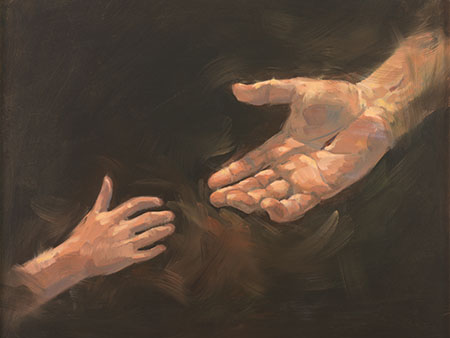
(Art: In God's Care by Greg Collins)

Friday, 12 February 2021

A TWO-EDGED SWORD


Those who read the scriptures will be very familiar with the expression of ‘the two-edged sword’. It is used as a metaphor for God’s word. To be precise, the Lord admonishes His people to give heed to His word, ‘which is quick and powerful, sharper than a two-edged sword’ as an opening to several chapters of the Doctrine & Covenants (6:2; 33:1; 14:2; 11:2).


For most of us in this day and age a sword is not within our frame of reference. Basically we can only relate to it by way of the movies we have seen. So what is a two-edged sword? Anciently, swords that were commonly used had only one edge. Obviously, someone with an acumen in warfare invented a two-edge sword which increased the effectiveness of the weapon. A two-edged sword could cut in any direction, no matter how the blow was struck. When you imagine the physical destruction such a sword can cause you can immediately understand what the Lord means when He says His word can ‘divide asunder both joints and marrow’. Bone marrow is crucial to physical life and I dare say, joints equally so. Thus we can assume that God’s word being like a two-edged sword, can bring about physical death. 


But there is more. Paul told the Hebrews that God’s word is ‘sharper than a two-edged sword, piercing even to the dividing asunder of soul and spirit’ because it is a ‘discerner of the thoughts and intents of the heart’ (Hebrews 4:12). All this means that God’s word has the power to destroy both physical and spiritual life of man. This will be most evident when He returns as John the Revelator saw that our of His mouth went a sharp two-edged sword (Revelation 1:16) symbolising the destruction of the wicked. 


What I want to focus mostly on is this. Besides being a symbol of destruction, the scriptures say the Lord’s word is also quick and powerful. In the King James Version of the Bible, the word ‘quick’ does not mean swift but rather ‘living’ or ‘alive’, as in ‘quickened by the Spirit’, which means to be given spiritual life. Thus, the word of God is quick and powerful because it is a source of life, energy, and power. It is also a part of the armour of God which dispels darkness (Ephesians 6:17; D&C 27:18). Thus the word of God not only destroys but also gives life. It all depends on the heed we give to it. 


When the Saviour was tempted to eat bread during his 40 day fast, He dismissed the temptation by proclaiming that ‘man shall not live by bread alone, but by every word that proceeds out of the mouth of God’ (Matthew 4:4)  Nephi and Alma spoke extensively about the word of God and what it can do for us (2 Nephi 32; Alma 32:28-43) and references to the eternal rewards are endless but I will tell you what it has done for me personally here and now.


From the time I was a teenager I used to suffer from periodical depression. At age 36 I became a serious student of the scriptures. Even as a single mother who was working full time, I would spend at least 1 hour a day studying the word of God. The time never seemed enough. Some months after I started, I noticed I was feeling incredibly good and I was no longer getting depressed. I was gaining spiritual life.  Every time I studied the scriptures I gained a portion of His Spirit, which healed my soul. I have not experienced depression for 25 years now. I am convinced that just as ‘the sword of His Spirit’ can destroy life, it can also destroy the maladies of both spirit and body and grant new life. When you consider that the Saviour created this world and gave us mortal life by the power of His word (John 1:1-4), this theory becomes a reality. It became mine.


- Cathryne Allen


(This post does not discredit medical attention deemed necessary by any individual for any physical or mental health issues)

Wednesday, 25 May 2016

A REBELLIOUS SON


There lived in Zarahemla about 120 B.C. a very wicked and idolatrous man who had power over many people to entice them to sin and who went about actively destroying everything his father had painstakingly worked for. This son was the very vilest of sinners, who prepared the way for the enemy of God to steal many souls and who sought to destroy the church of God. This man was the son of the prophet Alma, the only convert of the martyred Abinadi, who defied the wicked king Noah and converted and baptised many people in the waters of Mormon. Imagine the grief and sorrow to have your own son working to discredit your life's work. This was Alma the Younger. Because he was a son and called The Younger, many readers of the Book of Mormon have presumed that Alma the Younger was a youth when rebelling against his father and against God. Mormon however, identifies him as 'a man' (Alma 27:8,9), a well seasoned sinner, well practiced in his ability to create trouble, an apostate who made it his life's work to discredit the Church. It is very unlikely that Alma the Younger was a reckless hot headed youth when he was wreaking havoc. A hot headed youth is more concerned with pursuing his own self interests and rebellion than being involved in apostasy. Shortly after Alma the Younger is visited by an angel, his father Alma dies at the age of 82 (Mosiah 29:45). It would have been unlikely that Alma at this age had a son in his twenties. This would suggest that Alma was more likely to have been in his 40s at the height of his wickedness and ensuing repentance.

The question of Alma's age offers more insight into the severity of his sinful life. His sins were not trivial, but heinous and destructive, not only to himself but to others. His sins and the persecutions which he heaped upon the saints no doubt went on for years. These were not trivial sins easily washed away. One might wonder why the Lord waited so long to send an angel to Alma the Younger to turn him away from his destructive course. In Alma's story, however, we see that God has a purpose for each of us for Alma's conversion became the most powerful lesson about the effectiveness of the Atonement in all the works of scripture. Alma's conversion shows us that no matter how big the sin, the Atonement is bigger still. Not only was Alma exceedingly sinful, his ability to draw people to him and his power to convince them to follow his course would have filled him with enormous pride which would have hardened his heart to be in direct opposition to God, making repentance extremely difficult without God's intervention (expressed by Elder L. Tom Perry, source unknown). Alma was surely in Satan's clutches in every way. For such a vile sinner, there had to be a spectacular conversion. A conversion that would show what the Lord can make of us even when we seem to be beyond the point of no return, a conversion that would highlight not only the Saviour's mercy but the scope of His care and incomprehensible love. The extent and seriousness of Alma's sins can be seen in the recounting of his experience where he says he waded 'through much tribulation, repenting nigh unto death', being 'in the darkest abyss', his soul being 'racked with eternal torment' (Mosiah 27:28,29). Amidst all that anguish of soul, Alma describes his deliverance with an interesting word. He says he was snatched from eternal torment and everlasting burning. Imagine the Saviour's willingness to go to the fires of hell to deliver one of the vilest of sinners. Imagine the power to snatch someone from excruciating pain before they are consumed. What more powerful lesson can we learn from Alma's conversion than this?


"I remember reading about a fire fighter in the eastern United States who ran into a burning house to rescue several children from an arson-induced fire. While his colleagues battled the blaze to keep it from spreading to other structures in the neighborhood, this man dashed into the building again and again, each time emerging with a child in his arms. After rescuing a fifth child, he started into the inferno once more. Neighbors shouted that there were no more children in the family. But he insisted that he had seen a baby in a cradle, and he dove into the intensifying heat.

Moments after he disappeared into the fire and smoke, a horrifying explosion shook the building and the entire structure collapsed. It was several hours before fire fighters were able to locate their colleague's body. They found him in the nursery near the crib, huddled protectively over a  life-sized - and practically unscratched - doll.

I'm overwhelmed by that story. I'm touched by the fire fighter's courageous and selfless devotion to duty, and I'm thankful that there are men and women in the world who are willing to put their lives on the line for the sake of others.

As I think about such heroism, however, I'm reminded that the most heroic act of all time ever was performed in behalf of all mankind by the Son of God. In a very real sense, all of humanity - past, present, and future - was trapped behind a wall of flame that was fueled and fanned by our own faithlessness. Sin separated mortals from God (see Romans 6:23), and would do so forever unless a way was found to put out the fires of sin and rescue us from ourselves" (Elder M. Russell Ballard, Our Search for Happiness, p 11)


"Can a woman forget her sucking child,
that she should not have compassion on the son of her womb?
Yea, they may forget, 
yet will I not forget thee.
Behold, I have graven thee upon the palms of my hands;
thy walls are continually before me."

Isaiah 49:15,16


(I wish to acknowledge two sources of insights for this blog, namely: Maurine Proctor of Meridian Magazine who raised the question of Alma's age and Ted Gibbons for highlighting the word 'snatch', in their informative articles on The Book of Mormon Lesson #20, My Soul Is Pained No More)

Wednesday, 3 February 2016

BE YE SEPARATE


"Behold, it came to pass that I, Nephi, 
did cry much unto the Lord my God,
because of the anger of my brethren. 
But behold, their anger did increase against me, 
insomuch that they did seek to take away my life.
And it came to pass that the Lord did warn me, 
that I, Nephi, should depart from them and flee into the wilderness,
and all those who would go with me" (2 Nephi 5:1,2,5)

There are times when it is necessary to physically flee from evil, such as with Nephi and his followers who were told by God to separate themselves from that part of the family who chose not to believe in the warnings and the revelations of God. It must have deeply wounded Nephi's heart to have to guard against his own brothers who sought to take away his life but as always, Nephi obeyed the Lord in his instructions and removed himself and those who wanted to follow God (2 Nephi 5:6) from those who sought their destruction.

This separation was not only expedient for Nephi's temporal welfare but also for the spiritual welfare of his followers. Nephi records that because of their unwillingness to hearken to God's words, his brothers and their families were cursed by being cut off from God's presence (2 Nephi 5:20). As a sign of that cursing and to limit the spreading of more wickedness, the Lord caused "a skin of blackness to come upon them" (2 Nephi 5:21). Alma explained that the darkness of their skin was for the purpose of preserving the Lord's people, that in not mixing with the Lamanites, they would not 'believe in incorrect traditions which would prove their destruction' (Alma 3:7,8).


Like Nephites of old, there comes a time in our lives also when it becomes necessary for us to separate ourselves from certain people who would potentially become the cause of our destruction. In our politically correct world, we are constantly encouraged to accept and mix with people of all persuasions, beliefs and lifestyles and it is often done under the guise of 'love'. In our willingness to comply with this edict we sometimes confuse the world's admonition for acceptance of people of all walks of life with the Lord's commandment to love one another. This erroneously leads us to become involved with people who live lives in direct violation of God's commandments. The danger that lies in this involvement is that the seeds of their beliefs and behaviour eventually gets sown into our own belief system and dilutes the strength of our commitment to follow Christ and His teachings. From there it can become a slippery slide as we start to put ourselves in places we should not be in and in which it becomes easy to behave in similar fashion to our non-Christian friends. I concede the difficulty exists for many families who are caught in the predicament where some children choose to follow paths that are not in accordance with the Church and its' laws. In my opinion, the emphasis there should always be on the parents' and siblings' love for them rather than acceptance of their lifestyle. The world would have us believe in the correctness of 'support' of ones' children no matter what their choices are but this is clearly not compatible with the teachings of the gospel. As followers of Jesus Christ we are commanded to uphold His teachings and none else.

Often times we come to believe that we should keep company with those not of our religious persuasion for purposes of converting them to the truth or helping them overcome their worldly ways and addictions. In those instances, we need to make sure that we ourselves are strong enough for such a path and that the person we are trying to help is serious about change. If we innocently put ourselves in places where the Holy Ghost would not keep us company, we go unprotected against the powers of darkness which seek to destroy us. It is in these mists of darkness that Satan has power to lead us by the neck with a flaxen cord until he binds us with his strong cords forever (2 Nephi 26:22). Notice how the leading away from righteousness starts with one cord but the further you are led away the cords magnify until they become a strong rope that cannot be broken, ever. For this reason Alma wisely admonishes us: 'come ye out from the wicked, and be ye separate, and touch not their unclean things' (Alma 5:57). The more we touch, the more contaminated we become until worldly things become a part of us and we can no longer separate ourselves from them.

On a lesser scale, we should also be aware of those people around us who drain our spiritual and emotional energy by their constant negativity, criticizing, complaining and lack of faith. Sometimes it becomes necessary, after all you can do, to distance yourself from such friends for the sake of your own mental health. I was a participant of such an experience once when I was going through a period of diminished faith. The friend I was being a drain on let me know very diplomatically that she could not bear my melt downs along with her own challenges. This was the greatest thing that she could have done for me because not only did it make me assess the strength of my faith but it helped me see the importance of uplifting and nurturing others instead of being a burden to them. It also made me see that I was not being true to my convictions and the knowledge I possessed about the character of God. In other words I was not being true to myself, to who I professed to be and to my testimony. If the person you are seeking to correct is not blinded by pride and ego, they will take your correction on board and use it to their advantage. If not, they will depart from you. It is important for all of us to know that nobody wants to be with someone who is high maintenance. There is a difference between needing temporary support through trials and being an ongoing concern. In all situations though it is important to have resilience and a trust in God who is our true deliverer from predicaments.


"And when the disciples saw him walking on the sea,
they were troubled, saying, It is a spirit;
and they cried out for fear.
But straightway Jesus spake unto them, saying,
Be of good cheer; it is I; be not afraid.
And Peter answered him and said, Lord, if it be thou,
bid me come unto thee on the water.
And he said, Come. 
And when Peter was come down out of the ship,
he walked on the water, to go to Jesus.
But when he saw the wind boisterous, he was afraid;
and beginning to sink, he cried, saying, Lord save me."
(Matthew 14:26-30)

Peter walked on the stormy sea with eagerness towards the Saviour until he directed his gaze elsewhere. The minute he did so, he could see the wind whipping up the waves around him and he lost his focus. If he had kept looking at the Saviour he would not have begun to sink. Lucky for Peter he cried out immediately and he was rescued forthwith. So it is with us. We must focus on the Saviour at all times and if we so much as begin to sink we need to cry out 'Lord save me' but if we wait until we sink to the bottom the Saviour will no longer be within our view and we will not have sufficient faith to cry out for help. The Lord can rescue us from the deepest ocean and the deepest sea but He can become lost from our sight forever if our vision is obscured by the watery depths. At that point we run the risk of becoming lost. May we stay on the surface of life's stormy seas keeping the Saviour always within our sight. We, the children of the covenant, do not belong in the depths of the sea, drowning in the ways of the world. May we separate ourselves from its' ways never losing sight of our divine destiny.


"Therefore, fear not, little flock; do good; let earth and hell
combine against you, for if ye are built upon my rock,
they cannot prevail.
Look unto me in every thought; doubt not, fear not."
(D&C 6:34,36)


Wednesday, 13 January 2016

IN THE HEART OF WILDERNESS


There lived on the fringes of Jerusalem in 600 BC a rich, bold and resourceful merchant, a God fearing man by the name of Lehi. This man, under God's direction prophesied of Jerusalem's demise and destruction, a city whose wickedness was so great that God did not only send one prophet to call them to repentance, but as many as seven, Lehi being among them as well as Jeremiah, Ezekiel, Nahum, Habukkuk, Zephaniah and Zechariah.

Lehi's prophetic calling came in 600 B.C., a time in history when Jerusalem was flourishing not only in prosperity but also in idolatry, immorality and corruption. And simmering below the pulse of the industrious and prosperous Jerusalem lay political unrest which would ultimately punish Israel and enslave those who stoned the prophets. In 600 B.C. Jerusalem was under Babylonian domination. Sitting on Judah's throne was Zedekiah, an appointed puppet king, who unwisely with most of Judah's leadership, formed an alliance with Egypt with plans to overthrow the Babylonian rule. Jeremiah warned against this alliance knowing full well that Egyptians could not back their show of power with physical resources but Zedekiah refused to listen. When Lehi brought his message of doom prophesying that Jerusalem will be destroyed and its inhabitants carried away to Babylon (1 Nephi 1:13,18), the people were outraged and considered him along with Jeremiah and other prophets unpatriotic and guilty of treason. Their solution to this offence was that Lehi had to die (1 Nephi 1:20).

When the call came to leave Jerusalem and establish a colony of higher moral standards than the apostate Jerusalem, Lehi, not needing time to prepare, did not hasitate. The Lord had been preparing him his whole life for such an experience, both temporally and spiritually. According to His foresight, the Lord had strategically placed Lehi in the tribe of Manasseh, which of all tribes lived the farthest out in the desert, on the outskirts of Jerusalem. Lehi, therefore became familiar with the dessert and as a merchant came to know the Egyptian culture. He had even given two of his sons Egyptian names and taught them to write in reformed Egyptian. Lehi was also spiritually sound. He knew full well what the God of Israel had done for his people and the wilderness they had to traverse to get to the promised land and he taught this to his children. Nephi often recounted Israel's wilderness experience to his brethren to bring them to the remembrance of their roots and to give them courage. : "Nephi consciously understood that his family was re-enacting a spiritual pattern....[and reminded his brethren of it frequently].....The Mormon pioneers, crossing the American wilderness, called themselves the Camp of Israel and were also aware they were following a pattern laid down before them....In spiritual history, the place of refuge is the wilderness, idealized by Israel as the place to commune with God. Certain profound lessons are learned in the wilderness, especially our complete dependence on God for it is a trackless, difficult place where our own resources prove not to be enough. The wilderness experiences in scripture are for cleansing and clarifying, and it is only after a people has experienced the marrow-deep challenges of the wilderness that they are ready to inherit a promised land" (Maurine Proctor, All Things According to His Will, Meridian Magazine).

Even though Lehi and his family were favoured of God and spared Jerusalem's destruction, they needed the experience of the wilderness to establish a righteous branch of Israel in another land. For this reason Lehi and his family travelled by the banks of the Red Sea for nine whole years before Nephi received instruction to build a ship. If the wilderness is a spiritual oasis where one finds God, this had to be true of this band of followers who had to be taught by what power they were inheriting the promised land. And they did find God in many ways but in one most extraordinary way. They found him in a tree.


Approximately a year before the command to build a ship, Lehi, had a very memorable dream in which he beheld an even more memorable tree, the tree of life. When Nephi, being the dutiful son that he was, inquired of God the meaning of the tree of life that his father had seen, an angel appeared to him to tutor him.  When the angel asked Nephi if he knew what the tree represented,  Nephi answered that it is the love of God, most desirable above all (2 Nephi 11:22,23). Immediately following his answer he was shown a vision of the Savior during his mortal ministry. It becomes very clear through Nephi's vision that the love of God is manifest to his children through the gift of His only begotten Son thus the tree becomes the symbol of Jesus Christ. Why a tree? Because a tree bears fruit and fruit is something you eat and something you eat becomes a part of you. In other words, you are what you eat. It transforms your very system. What we eat spiritually also transforms us, even to the point of rebirth. This rebirth places us on the path to eternal life. Alma claims that if we plant the word, which is compared to a seed, into our hearts and nurture it, it "shall take root; and behold it shall be a tree spring up into everlasting life" (Alma 32:41).

The symbol of the tree "converges all the meaning of the gospel. It was the tree of life that stood in the Garden of Eden and nourished Adam and Eve. This was a place of unity with each other and with the Lord. After they fell, eating the fruit of a forbidden tree, they came into a world of duality, division, separation from God. The only way to be at-one again with the Lord comes from the events that took place on another tree - the cross, through Christ's atonement and resurrection. Some legends even claim the cross was constructed from a branch of the tree of life. Symbolically, at least, this is true" ("The Vision of the Tree of Life, Meridian Magazine, December 14, 2015)


So it is with us. We all need a wilderness if we are to truly know God. The Lord wants us to find Him in the rough terrain, in the scorching desert, in the endless roads that we might know by whose hand we are led to 'the goodly land'. As prepared as Lehi was, his capacities were not enough. Hence the Liahona to point the way to the most fertile parts of the land where they could hunt for their survival (1 Nephi 16:14-30). It is good to be equipped with a bow but it is the hunt that the Lord provides that makes the hunter.

Every true disciple of Jesus Christ will experience 'a wilderness' before they get to their promised land. What promised land?: "Your promised land. Your new Jerusalem. Your own little acre flowing with milk and honey. Your future. Your dreams. Your destiny. I believe that in our own individual ways, God takes us to the grove or the mountain or the temple and there shows us the wonder of what His plan is for us" (Elder Jeffrey R. Holland, Cast Not Away Therefore Your Confidence, Ensign March 2000, p 10). We do not need to travel the rocky path to the land of milk and honey alone for the Lord has promised "....mine angels shall go up before you, and also my presence, and in time ye shall possess the goodly land" (D&C 103:17, 19-20). The barren landscape of our wilderness will serve as a testing ground that will refine us, change us and enoble us if all the lessons are learnt and all obstacles overcome with the help of Him who desires to see the journey completed to the end. And when the moments of doubt and uncertainty would question the worthiness of that journey, we must be like that faithful, bold and resourceful merchant from the outskirts of Jerusalem who stood on the banks of the Red Sea, with no ship in sight, proclaiming: "I have obtained a land of promise" (1 Nephi 5:5).


Wednesday, 25 November 2015

THE BOOK OF HOPE


Some two thousand years ago, during the bleakest period of Church history, there was on the island of Patmos an exile, a prophet and an apostle of the Lord Jesus Christ, the last apostle alive, all others having been killed before him. And to that rocky island prison, on a particular Sunday came the glorified, exalted Christ to the apostle whom He called 'The Beloved'. "Heralded by the trumpet-blast of the godly voice and standing in the midst of seven golden candlesticks symbolic of the seven branches of the church in Asia was the Saviour. Some fifty or sixty years before He had hung in agony on the cross and had been laid in the dark recesses of a borrowed tomb. Now he stood in blinding, blazing glory before John: "I am he that liveth, and was dead", he declared, "and, behold, I am alive for evermore" (Revelation 1:18)" (The Life and Teachings of Jesus and His Apostles, p 449)

So overcome was John that he fell to the earth as though dead but the Saviour touched Him and told him not to be afraid but to write down the revelation which he was about to receive for the seven branches of the Church who were facing life-threatening persecutions. "They knew the wrath of a government intent on enforcing the policy of emperor worship. They knew the clutch of fear at the approaching sound of Roman legionaires. By the time of Patmos, according to the traditions that have come down to us, Peter had been crucified, Paul beheaded, Bartholemew skinned alive, Thomas and Matthew run through with spears. John was the only surviving apostle (an apostle who would survive it all and never taste of death); all the others had died violently because of their faith. By the time of Patmos, the history of the Church included the lining of Nero's colonnade with crucified Christians and the savagery of the mobs screaming for blood in the Coliseum and the Circus Maximus." (The Life and Teachings of Jesus and His Apostles, p 449).


The revelation which John the Beloved received is known to us as The Book of Revelation. There are many scholastic views of the book which offer explanations as to its' meaning. Some argue that the book needs to be considered with a non-prophetic view, that all that is contained therein pertains to the past, meaning John's day, referring to the clash between the Church and the Roman Empire. Others however, claim that the Book needs to be considered with a solely prophetic view and that the symbols within it are to be seen as future predictions of all the great events of history. Viewed either way, people throughout Christendom have found the Book of Revelation hard to understand. Joseph Smith has said, however, that "the Book of Revelation is one of the plainest books God ever caused to be written" (Teachings, p. 290). One can wonder how that can be so considering the extensive use of symbolism used by John when describing his vision. The clue to its plainness lies in the very heading of this book. Because The Book of Revelation was received by revelation, it can also be best understood through revelation. Thankfully, as Latter-day Saints, we not only have personal revelation to rely on for understanding of this book but also revelation given to latter-day prophets: "Thanks be to the interpretive material found in sections 29, 77, 88 and others of the revelations in the Doctrine and Covenants; plus the revisions given in the Inspired Version of the Bible; plus the sermons of the Prophet; plus some clarifying explanations in the Book of Mormon and other latter-day scripture; plus our over-all knowledge of the plan of salvation - thanks be to all of these things.....the fact is that we have a marvelously comprehensive and correct understanding of this otherwise hidden book" (Bruce R. McConkie, Doctrinal New Testament Commentary, 3:431).

The greatest purpose and meaning of The Book of Revelation is that it is a book of hope. It's main purpose is not history but prophecy. This is evident in the fact that the Book covers the history of the earth's 6 thousand years only briefly whereas it expounds on the period of the Millenium in lengthy detail. What does this have to do with hope? The Book of Revelation gives us hope in that Millenium reign when evil, "in all of its power and wickedness, shall be put down once and for all" (The Life and Teachings of Jesus Christ and His Apostles, p. 444). This knowledge would have given great hope to the saints who were witnessing the decline of the Church and the beginning of the Great Apostasy but it is of even greater value to us because it assures us that the forces of great evil which are gaining momentum in our day will one day be destroyed and come to an end. The Book of Revelation highlights the conquest of evil and that God is still over all and will triumph in the end, which triumph will cause all His creations to worship Him with glory and praise. The Book of Revelation presents the greatest contrast between the Saviour's first coming to earth and the second. Whereas the first time he was despised and rejected of men, when all this is over and the earth is rolled together as a scroll, even the earth will sing His praise and honour His name (Rev 4:9-11, 5:14, 11:17, 16:5).


The hope of true followers of Jesus Christ, and the hope referred to in John's revelation should be to gain eternal salvation in the kingdom of God. Moroni tells us that if we have no hope we must be in despair (Moroni 10:22). An absence of hope for something better than this telestial life would surely suppress any incentive to repent, deplete the power of endurance, entice fear and diminish belief needed to overcome the natural man. The Book of Revelation gives us hope that all these things are possible. In it John sees Satan as a red dragon driving a woman with a child (The Church) into wilderness (apostasy) (Rev 12). As the woman rises again out of the wilderness John records 'the dragon was wroth with the woman, and went to make war with the remnant of her seed, which keep the commandments of God, and have the testimony of Jesus' (Rev 12:17). This is a frightful depiction of our day which would leave us, the members of the Church, to the buffetings of Satan if we had no hope that we can fight the fierceness of the battle that we are engaged in: "Yet, of all people, we as Latter-day Saints should be the most optimistic and the least pessimistic. For while we know that 'peace shall be taken from the earth, and the devil shall have power over his own dominion', we are also assured that 'the Lord shall have power over his saints, and shall reign in their midst' (D&C 1:35-36) (Ezra Taft Benson in CR, Oct. 1974, p. 90).

No one can read the concluding chapters of Revelation without feeling the hope that John felt as he looked forward to our day. It is somewhat appropriate that the Saviour would give him this glorious vision considering he was to live to witness incredible calamities, wars, pestilence, wickedness and the Great Apostasy. It might also be appropriate for us to assume that this vision was given to the beloved apostle, who would never taste of death, out of love so that the hope of the triumphant ending would enable John to endure everything preceding the Millenium when 'the dragon, that old serpent, which is the Devil, and Satan' will be bound for a thousand years enabling a period of peace for those who will dwell with Christ in paradisiacal glory' (Rev 20:2). One would have to wonder what kind of chain it would have to be to bind the Prince of Darkness and what kind of bottomless pit could contain him? To believe that such a thing could ever happen means for us to believe that we are more powerful than him because we have kept our first estate. Because Satan is a spirit only, all his power is derived through spiritual means from those who live on this earth clothed in earthly tabernacles, meaning us. His power is added upon from spiritual energy that we create. We make him powerful by creating spiritual energy of darkness through sin or powerless by creating spiritual light through righteousness. Since the Saviour is the Light of the World, Satan is the opposite, the Prince of Darkness. The chain he will be bound with and the bottomless pit he will be cast into as referred to in the Book of Revelation are terms symbolic of righteous living of those who will qualify to live during the Millenium (see Eldred G. Smith in CR, Apr. 1970, p 142 and 1 Nephi  22:26). In other words, because of people's righteousness, there will be no spiritual darkness and therefore Satan's power will dissipate.


Righteous living proceeds from a committed heart of true followers of Jesus Christ. It does not come from complacency that some of us in the Church are familiar with: "The abundant life is a spiritual life. Too many sit at the banquet table of the gospel of Jesus Christ and merely nibble at the feast placed before them. They go through the motions - attending their meetings, perhaps glancing at the scriptures, repeating familiar prayers - but their hearts are far away. If they are honest, they would admit to being more interested in the latest neighborhood rumors, stock market trends, and their favourite TV show than they are in the supernal wonders and sweet ministerings of the Holy Spirit. Do you wish to partake of this living water and experience that divine well springing up within you to everlasting life? Then be not afraid. Believe with all  your hearts. Develop an unshakable faith in the Son of God. Let your hearts reach out in earnest prayer. Fill your minds with knowledge of Him. Forsake your weaknesses. Walk in holiness and harmony with the commandments. Drink deeply of the living waters of the gospel of Jesus Christ" ( Joseph B. Wirthlin, The Abundant Life, Ensign, May 2006).

Being merely Church members is not enough, we must build the spiritual core within us which will enable us to stand when the mighty winds of apostasy descend upon us. Then no imperfect leadership in the Church can offend us, no transpired event in Church history will sway us, no Church teaching we do not understand will cause us to give up. If we are built on the spirit of prophecy and an unshakable testimony of  Christ, we will withstand any pressure to cave and any temptation to sin and seek justification for same through some imperfection that we insist we have found in the Church for such imperfections only serve as great stumbling blocks that obscure our vision from perfectly seeing the Saviour of all mankind. With an absence of fear, being filled with hope and armed with righteousness and faith we can defeat and bind the enemy who seeks our destruction and pave the way for Him who will 'wipe away all tears from [our] eyes' (Rev 21:4) and with whom we can live during the Millenial reign of peace and happiness. It is therefore, our duty here and now to 'drink deeply of the living waters of the gospel of Jesus Christ' that we might have reason to hope for a better world, a world where 'there shall be no more death, neither sorrow, nor crying, neither shall there be any more pain: for the former things are passed away' (Rev 21:4).


".....for we have a labor to perform whilst in this tabernacle of clay,
that we may conquer the enemy of all righteousness....."
(Moroni 9:6)


Tuesday, 17 November 2015

ABSENCE OF FEAR


"Legend has it that one day a man was walking in the desert when he met Fear and Plague. They said they were on their way to a city to kill 10,000 people. The man asked Plague if he was going to do all the work. Plague smiled and said, 'No, I'll take care of only a few hundred. I'll let my friend Fear do the rest'."   -  Author unknown


During some of the toughest persecutions experienced by the saints in the meridian of times Apostle Paul wrote tirelessly to the Church exhorting the members to faithfulness and endurance. During his second imprisonment in Rome and just prior to his martyrdom, Paul wrote his second epistle to Timothy which stands as 'one of the great monuments to faith and hope in the face of loneliness and adversity' (The Life and Teachings of Jesus and His Apostles, p 375). One of the most profound things he said in this letter had reference to fear: "For God hath not given us the spirit of fear; but of power, and of love, and of a sound mind" (2 Timothy 1:7). This statement should become the creed by which we, the saints of this dispensation, live by because we live in a world filled with turmoil, uncertainty, calamities and strife. We who are living during the winding up scenes of this earth's 6,000 years of time are living during the best and the worst of times. Before the Saviour comes again to personally reign for a thousand years we will experience some of the most intense trials of all dispensations that will drive fear into the hearts of all who will stand as witnesses of such times. Discoursing on the signs that will precede the Second Coming, the Saviour described the condition of our day: "And they shall hear of wars, and rumours of wars....for nation shall rise against nation, and kingdom against kingdom, there shall be famines, and pestilences, and earthquakes, in divers places" (JSM 1:28,29).

This scripture is a very accurate description of our world today for "nations and kingdoms and peoples are at war all over the globe. The D&C 45 version of this discourse says that men "will take up the sword (or its modern equivalent) one against another" (vs 23). We see this as people fight among their own without regard to any living person; and this, according to Christ, is due to the hardening of their hearts. There will be commotions and desolations as we just read that will come in the form of famines, pestilences, disasters and earthquakes. Such events have increased dramatically in just our lifetime. The D&C version also indicates that these wars and catastrophes will increase until "the whole earth shall be in commotion" which will cause "men's hearts to fail them" (vs 26). We already see the beginning of a general feeling of hopelessness, despondency, depression and despair among many in the world today. This, for instance, is one of the primary purposes of terrorists - to strike a feeling of fear and hopelessness in others - and this will only increase" (Larry D. Keeler, If Ye Are Prepared, Ye Shall Not Fear (Now Is the Time to Prepare), p.3). Like the civilizations of old we allow and even foster 'secret combinations' within our societies which drive fear into the inhabitants of the whole earth. These are our modern day 'Gadianton Robbers' who seek power by inducing fear for the purpose of controlling countries and nations in upholding Satan's plan of destruction of the plan of salvation.


Perilous times equal fear. For this reason the Saviour chose to make the signs of the times known to us who follow His teachings. He said He did so for the 'elect's sake' (JSM 1:29), 'elect' meaning those who have taken upon themselves His name through the covenant of baptism. In His infinite mercy, the Saviour wanted us to have hope of the promises He has made so that we would not be troubled and fearful of the present: "Be not troubled, for, when all these things shall come to pass, ye may know that the promises which have been made unto you shall be fulfilled" (D&C 45:35). In other words, instead of fearing the calamities, rejoice that the end is fast approaching and the promises of something better are about to be fulfilled. Here are a few priceless promises made to the faithful who watch for the signs of His coming:
  1. We can have peace in the midst of turmoil of the world and live without fear.
  2. We can be assured that in the coming destruction of the world, we will be caught up to escape the baptism of fire for it is written 'that in the last days, two shall be in the field, the one shall be taken and the other left' (Matt 24:40-41).
  3. We can be assured a place in His Kingdom after this life, which He promised when He said to His disciples: "In my Father's house are many mansions: I go to prepare a place for you" (John 14:2)
An absence of fear equals a brighteness of hope. Hope and fear cannot co-exist for one will always dispel the other. If we choose not to fear, should we not hope for something better? Considering the bleakness of today's world, can we not rejoice when contemplating the promise of eternal life in Christ's Kingdom of which John the Beloved said: "And I saw a new heaven and a new earth: for the first heaven and the first earth were passed away; and there was no more sea. And I John saw the holy city, new Jerusalem, coming down from God out of heaven, prepared as a bride adorned for her husband. And I heard a great voice of of heaven saying, Behold, the tabernacle of God is with men, and he will dwell with them, and they shall be his people, and God himself shall be with them, and be their God. And God shall wipe away all tears from their eyes; and there shall be no more death, neither sorrow, nor crying, neither shall there be any more pain: for the former things are passed away" (Rev 21:1-4). Can we not in the absence of fear, have an abundance of hope in the Prince of Peace who can indeed dry all tears from our eyes and give us splendour and glory after the valley of shadow and death?


The greatest promise of all that we have been given is to receive the Second Comforter while still in mortality. The Prophet Joseph Smith has said that this is a reality for every faithful and worthy Latter-Day Saint who continues to humble himself before God; who hungers and thirsts after righteousness; and who lives by every word of God. Once a person has proven through his faithfulness that he will serve God at all cost, the Saviour Himself will come to Him and even manifest the Father to him, "and the Lord will teach him face to face" (Teachings of the Prophet Joseph Smith, p. 150-151, 298). Can we not be lifted up above fear when we hear the Saviour's divine promise such as this: "I will not leave you comfortless: I will come to you....I will love [you], and will manifest myself to [you]....and my Father will love [you] and we will come unto [you] and make our abode with [you] (John 14:18, 21, 23). This promise is, firstly, that the Son and the Father will visit us in person; and secondly, that we can receive from Him an assurance while still in mortality that we will be exalted. This divine promise is given even though we are not yet perfect. This promise means that the Lord knows the innermost desires of our hearts and will assure us divine tutoring beyond the grave that will qualify us for exaltation. Joseph Smith himself received this promise: "For I am the Lord thy God, and will be with thee even unto the end of the world, and through all eternity; for verily I seal upon you your exaltation, and prepare a throne for you in the kingdom of my Father, with Abraham your father" (D&C 132:49)

What could we possibly fear if we had an assurance of exaltation and if we knew the Saviour was bringing with Him at His appearing the fulfillment of all His wondrous promises? No earthquake, no flood, no act of terrorism could possibly consume us with fear. We are children of the promise, the elect of the covenant, who have everything to hope for. We are here but for a moment; a moment of learning, a moment of faith, a moment of preparation. As we witness the fulfillment of the signs of the times may we be propelled to urgent preparation to meet our Maker and may we be like John the Beloved,to whom the Saviour gave a glorious vision of the Second Coming and following which He said: "Surely, I come quickly", meaning quickly after all has been fulfilled and to which John simply replied: 

"Even so, come, Lord Jesus"
(Rev 22:20)


A special thanks to my good friend Larry D. Keeler from whom I learnt most of what I posted here and his insightful talk entitled "If Ye Are Prepared, Ye Shall Not Fear" on which this post was based.

Wednesday, 27 May 2015

WHEN HE COMES AGAIN


"As Samuel poured oil on the head of Saul and anointed him to be captain over the Lord's inheritance........as he also poured oil on David and anointed him in the midst of his brethren.....and as Zadok took an horn of oil and anointed Solomon........so Mary of Bethany poured costly spikenard from her alabaster box upon the head of Jesus, and also anointed his feet, so that the next day, the ten thousands of Israel might acclaim him King and shout Hosanna to his name" (Bruce R. McConkie, Mortal Messiah Book 3, p 327)

As Jesus left his beloved village of Bethany and approached Jerusalem, He stood on the Mount of Olives, overlooking the splendor of the city and wept. As he wept, he lamented, "If thou hadst known...the things which belong unto thy peace! but now they are hid from thine eyes" (Luke 19:42) for the people were 'divided into conflicting and contending sects, each professing more holiness and righteousness than the other and all closing their eyes to the truth' (The Life and Teachings of Jesus and His Apostles, p. 140). After all that He had done, all that was left to Him was to weep for the city which was too late to save.

Jesus entered Jerusalem riding 'lowly, upon an ass', not a symbol of humility but the symbol of Jewish royalty (McConkie Mortal Messiah Book 3, p 338), for it was His right to do so as the descendant of King David to whom the throne truly belonged. As His disciples, 'the children of the kingdom' (JST Matt. 21:13)  shouted hosannas to His name and proclaimed Him king for the first and only time of His mortal ministry, Jesus entered the Herodian splendor of the city. Not even the accolades which they heaped upon Him would have comforted Him as He contemplated their impending doom. What a strange Messianic triumph that was. On one hand they hailed Him as the one who could save but on the other they refused the salvation. With hope of deliverance from Roman rule pulsating in the heart of the glittering, golden Jerusalem, with its' imperial mantle of proud towers, a city regarded as a wonder of the world, who could have foreseen its' destruction? Just one, the one who sat upon 'the colt of an ass'.


Following His triumphal entry into Jerusalem, Jesus once again cleansed the temple of the 'den of thieves', the chief priests who saw themselves as the guardians not only of the temple but of 'the whole structure of Jewish religion. They glutted themselves on the profits from temple business, and so the temple was not just the source of their favoured social position (which they coveted so jelously) but also the source of their incomes - more, their fortunes' (The Life and Teachings of Jesus and His Apostles, p. 143). . During the first cleansing of the temple, Jesus referred to it as 'my Father's house' (John 2:16). This time, upholding his kingly welcome into the city, Jesus referred to it as 'my house' (Matt 21:13). One can only imagine the seething in the vengeful hearts of those who plotted His death upon hearing such words for Jesus' declaration of His messiahship was pure blasphemy to their ears. When the purging was over, those who accepted His declaration and believed Him to be the promised Messiah gathered around Him to receive the fruits of His ministry. There, in His house, surrounded by those who believed in Him Jesus once again healed the blind and the lame, an exquisite symbol of the spiritually blind and lame He came to save.


Jerusalem paid dearly for rejecting and crucifying their God. As they left Jerusalem, Jesus gave the Olivet Discourse to His disciples where He predicted the sacking of Jerusalem by saying that not 'one stone will be left upon another' (21:6) and that the desolation of which Daniel spoke (Daniel 9:27) would be fulfilled. Jesus also told them that this destruction would come in their day and warned that the righteous should flee when they see the signs of its' coming. Less than 40 years after His death Titus descended on Jerusalem with his Roman legions and leveled the city to the ground but not before Jerusalem had endured unimaginable suffering through oppression and famine which saw women eating their own children as prophesied by Moses (Deut 28) and witnessed by Josephus (The New Complete Works of Josephus, The Jewish War, p 893). The destruction was so brutal that 'hunger exceeded human endurance; blood flowed in the streets, destruction made desolate the temple; 1,100,000 Jews were slaughtered; Jerusalem was ploughed as a field; and a remnant of a once mighty nation was scattered to the ends of the earth. The Jewish nation died, impaled on Roman spears, at the hands of Gentile overlords' (McConkie, DNTC, 1:644-45). Only the righteous were spared, the saints who dwelt in Jerusalem at the time had heeded Jesus' warning and had fled, guided by revelation, to Pella in Perea.

Why is it important for us to know about the destruction of Jerusalem? Because the destruction which will befall the wicked at the time of His Second Coming will be akin to what the Jewish nation endured in 70 AD. History will repeat itself because the world is still rejecting the Saviour, stoning the prophets and disregarding the word of God. During His Olivet Discourse Jesus spoke of the last days and the signs of His coming: "All the desolation and waste which attended the former destruction of Jerusalem is but prelude to the coming siege......In the coming re-enactment of this 'abomination of desolation', the whole world will be at war, Jerusalem will be the center of the conflict, every modern weapon will be used, and in the midst of the siege the Son of Man shall come, setting his foot upon the mount of Olives and fighting the battle of his saints (Zech. 12:1-9). Speaking of these final battles which shall accompany His return, the Lord says: 'I will gather all nations against Jerusalem to battle; and the city shall be taken, and the houses rifled, and the women ravished; and half of the city shall go forth into captivity, and the residue of the people shall not be cut off from the city'. However, the final end of the conflict shall be different this time than it was anciently. 'Then shall the Lord go forth', the prophetic record says, 'and fight against those nations, as when he fought in the day of battle. And his feet shall stand in that day upon the mount of Olives....and the Lord shall be king over all the earth' (Zech. 14). (McConkie, DNTC, 1:659-60)


During the Olivet Discourse Jesus told His disciples that when He returns one will be destroyed and one will be left. The two He spoke of were the wicked and the righteous. Those that shall remain on the earth and not be destroyed will be those who are honest and upright and who are so living that they would at least inherit terrestrial kingdom at the time of resurrection. As the Millenium will reflect the terrestrial glory, those who are living by telestial standards will not be able to remain on earth. Those of the telestial world are: 'sorcerers; adulterers; false swearers; those who oppress the hireling, the widow, and the fatherless in their wages; those who lead men away from the truth; those who do not fear God; members of the true Church who do not pay an honest tithing; they that work wickedness; and the proud. All these, he says, shall be as stubble when the day comes that shall burn as an oven. (Mal. 3:4; D&C 64:23-25). (McConkie, DNTC, 1:669)

Jesus wept when He reflected on the destruction of Jerusalem. Will He lament over us as He did over Jerusalem before he unveils His face? Will He weep over His saints who had abandoned their covenants and gone after the pleasures of the world? Will He sorrow over the lost sheep that have not been found? Will His heart break over those who profess to know Him but are found with empty oil lamps and regrets they are too late to rectify? When the comfort zone is ended it will be too late to put up the necessary defenses and watchtowers against the evils of the world. The day of preparation will be past and some of us will be found wanting. We live in the day preceding His return, the day of wars and rumors of wars, famines, pestilences and earthquakes, the day when iniquity is abounding causing the love of men to wax cold. These are all Saviour's predictions found in the scriptures. He has described His Second Coming as 'the great and dreadful day of the Lord' (D&C 110:16), dreadful for those who are in the clutches of iniquity but great for those who are seeking after righteousness and who are waiting with anticipation for the day of the Lord when all His promises shall be fulfilled. The question begs to be asked, are you scared or are you excited?


When He comes again, He will come as the Lord of Lords and King of Kings and He will seek out His own that He might dry the tears from their eyes and embrace them in the arms of His love. A God of power, a God of majesty, a God of glory, but most of all, a God of love.