Showing posts with label #pride. Show all posts

Sunday, 26 July 2026

HUMILITY 3


It seems I cannot stop writing about this subject.

My close friend commented on one of my posts recently and pointed out how well it was done. I replied: “Of course it was because I’m a super-duper writer, a scriptorian and a spiritual giant!!! And the humility is off the charts!!!”  

We both laughed but the reality is that I AM a good writer because I went to the University and obtained a Bachelor of Arts in English; I AM a scriptorian, a miniature one but nevertheless….because I have studied the scriptures intently for the past 30 years; and I AM a spiritual giant because I have a gravitational pull towards the truth and anything of the spirit. I live for all three so I should by all means excel in all three.

Let me explain why this is important to me. I have come to my 60s feeling very inadequate about myself. I have written before about the reality of my upbringing in poverty in a socialist country. I was brought up with an ingrained idea that I am not as good as my friends who came from better households because their parents belonged to the communist party and were privy to jobs others could never get. Added to this was my generational poverty from ancestors who lived under the feudal system with overlords who subjected them to the idea that they can never rise above servitude. All this had an impact on me.

Fast forward to the age I became a member of Christ’s Church and His avid disciple at the age of 18. Since then my eyes have been opened to who I am and who I have always been as I have studied the teachings of the Church and the scriptures, endured many trials and difficulties which afforded growth and learning, and have had many revelations and insights into my pre-earth life and my character. I am daring to trust that I am much more than I was raised to believe.

I wrote in a previous post about the Saviour’s necessity to proclaim who He is, and to make His godly attributes and traits known, so that we can have faith in His saving power. Never at any time when I have read the scriptures did I get the impression that He was doing so out of pride. He was simply saying, this is who I am, believe in me.

We should, like Him, follow suit in recognizing our innate qualities and our growth. Most especially, following Christ and having a close relationship with Him, should lift us higher than our earthly flaws and humanity. We need to stand on higher ground so that we are able to lift others, like He has done. Humility should be just another attribute that we can be endowed with as we strive to become like Him.

Paul who called himself ‘the least of the apostles’ and the ‘chief of the sinners’ (1 Cor 15:9; 1 Timothy 1:15), became the greatest missionary in history because he knew who made a new person out of him and therefore he could say: “…but by the grace of God I am what I am” (1 Cor 15:10)

Humility springs in my heart

Like a well overflowing

With life giving water;

It quells the pride of my soul

And helps me see

I could never be the Me;

But for Thy grace

And Thy devotion

To make of me what   

I am meant to be. 

- CATHRYNE ALLEN 

Friday, 24 July 2026

HUMILITY 2


When Moses went up to Mount Sinai for the second time with new plates the Lord descended in the cloud, and stood with him there and proclaimed His name:

“And the Lord passed by before him, and proclaimed, The Lord, the Lord God, merciful and gracious, longsuffering, and abundant in goodness and truth. Keeping mercy for thousands, forgiving iniquity and transgression and sin….” (Exodus 34:4-7)

There is real significance in this. When God restores or renews covenants, He reveals himself by confirming His impeccable character so His people can know Him, trust Him and follow Him. In other words, He is saying, this is who I am, who you are covenanting with. It is meant to build faith in people and invite them back into a real relationship with Him. In this instance, Israel had broken the covenant by worshipping the golden calf.

The Gospel of John records Christ’s proclamations of who He is which identifies Him as the Saviour of all mankind. These proclamations are known as the “7 I AMs:

·         I am the bread of life (6:31,51)

·         I am the light of the world (8:12)

·         I am the door of the sheep (10:7,9)

·         I am the good shepherd (10:11,14)

·         I am the resurrection and life (11:25)

·         I am the way, the truth and the life (14:6)

·         I am the true vine (15:1,5)

I have often been amazed at the confidence with which Jesus proclaimed Himself as the Messiah. The Jews expected Him to come in the clouds of glory, not through the stench of a stable. Judging Him to be a mere mortal led some to say that He was mad because of these proclamations (John 10:20) and some that he was possessed of a devil (John 8:48; 8:52; Mark 3:22; Luke 11:15). But imagine if He didn’t openly proclaim what He was like and what He had to offer as the Saviour of the world. Who would have had faith in Him if He held back and denied His attributes and characteristics and His role in the human experience? How blind the people of Jesus’s time were not to see that His confidence was grounded in humility and not pride.

Sometimes we are reluctant to vocalise our good qualities for fear that people will consider us prideful. Martin Luther said: “True humility does not know that it is humble. If it did, it would be proud from the contemplation of so fine a virtue.” I do not completely agree with this statement.  We are told that humility is the mother of virtues and rightly so but I wonder if we know how to properly appreciate it for our benefit.

There is one person we should affirm our humility to and that is ourselves. There would have to be a day when our trials and obedience have humbled us enough to be able to say to ourselves: I am humble enough to be corrected, I am humble enough to admit I am wrong, I am humble enough to be teachable, I am humble enough to be chastised, I am humble enough to receive instruction, to be taught, to receive help, to apologise, to correct a wrong, to make restitution when I have caused damage. I love a person who can say, “when I’m wrong, I’m wrong”….We should be able to acknowledge humility within us when it is for our benefit and the benefit of our fellowman.

The Book of Mormon tells us that humility before God will grant us these four things (Mosiah 4:12-13):

·         We will be filled with the love of God;

·         We will grow in knowledge of Him’

·         We will retain a remission of our sins;

·         We will love our fellowman

We want this, don’t we? So the commitment should be: I choose to be humble enough to believe in a higher power than myself, to be taught about Him, to obey Him, to amend my ways and recognize I am no better than my fellowman. That’s humility – minimizing self-importance and finding a healthy place for it on your priority list.

One man in the scriptures who knew full well who he was, what he became and by what power he got there was Paul who said: “For I am the least of the apostles, that am not meet to be called an apostle, because I persecuted the church of God. But by the grace of God I am what I am…..” (1 Corinthians 15:9,10). In other words, I was wrong, I was humble enough to repent and accept salvation from Him who saved me from the jaws of hell. That’s humility. 

- CATHRYNE ALLEN 

Wednesday, 29 October 2025

LOWLY IN HEART


I viewed recently some documentaries of past ruling monarchs of Europe and England. I was amazed at what devastation privileged birth can achieve. These men were out of control, spoilt, immoral and some died excruciating deaths. I could see one fiend of hell that was behind it all and that was PRIDE.

For a while now I have been pondering about the lowliness of mortality, compared to our pre mortal home. These documentaries contributed to my understanding how bringing us down to the lowliest plane of existence guarantees that we develop a ‘lowly heart’, an antidote to pride, an emotion most destructive to godliness. How Lucifer could not see that this is what robbed him of glory is beyond me. One thing he can see though: that he can destroy others by it.

I think of the Saviour’s condescension from His godly throne to the lowly, dusty roads of Galilee, devoid of riches, prestige and luxury, and I can see why ‘none is acceptable before God save the meek and lowly in heart’ (Moroni 7:44). If He can come down from His throne to the lowliest station of life, beginning with His birth, He certainly has a right to tell us: “Take my yoke upon you, and learn of me; for I am meek and lowly….” (Matthew 11:29). You cannot have a more-lowly birth than one in the stench of a stable. That’s a triumph over pride if ever I saw one.

And imagine a God who created this earth willing to sit on a donkey to fulfil the Messianic prophecy: “Rejoice greatly, O daughter of Zion; shout, O daughter of Jerusalem: behold, thy King cometh unto thee: he is just, and having salvation; lowly, and riding upon an ass, and upon a colt the foal of an ass.  (Zechariah 9:9)

What other more spectacular proof could the creator of worlds without number have given to the unbelieving? Think about all the proof He did give them such as His miracles which failed to convince the powerful and mighty.  His lowliness, however, should have been a sure sign that He fulfilled the prophecy that the Messiah would be a king who arrives humbly and peacefully, a king who is the servant of all.

This is meekness, this is greatness, that the Saviour of mankind would subject Himself to God’s requirement that ‘none is acceptable before God, save the meek and lowly in heart’, including Him (Moroni 7:42-44).

I stood in the shadow

of Your heart today

And saw obedience to the

Father there;

I saw the Son You are and more

I saw the God that I adore

And I stand in awe…..


- CATHRYNE ALLEN 

(Art: Living Water by LDS Book Store)


Wednesday, 6 November 2024

DIVINE HUMILITY


One of the greatest lessons the Saviour taught when He established His Church in the meridian of time was one of humility. This is something we need to take note of especially in the Church.

There was something of a hierarchy in my mission field. It was like a ladder of progression which was deemed by us as success. We all felt important when we were elevated to higher positions. The progression of success went like this: becoming a senior companion, district leader, zone leader, assistant to the President, a member of the ‘power team’.

It makes us feel good when we are recognized and utilized for our abilities. Sometimes too good. The downside of the hierarchy is that it makes others that don’t make it to these stations feel like they are less.

My Mission President realized he needed to teach us young kids in the Church the danger of authority that was placed on us. He often referred us to D&C 121:39 which points out that authority can lead to ‘unrighteous dominion’. Such is the danger of pride.

Over the years I have witnessed some pretty prideful priesthood leaders in the Church and some very humble ones too. Authority comes with danger and an opportunity. Pride is he danger and humility is the opportunity.

The Saviour said in that scripture that it is ‘the nature and disposition of every man’ to get carried away with authority so He endeavoured to give us a lesson in humility that we should never forget.

At the last supper, the Saviour washed the feet of the apostles. I believe it is a priesthood ordinance practiced by the Twelve of the Church to this day. No doubt it is meant to remind them that they are servants and of humility the Saviour exercised when He did so. The lesson is that he who is the master is the servant of all.

This, however, is the greatest lesson the Saviour taught by washing of the feet. When He explained the ordinance to His disciples and said, “the servant is not greater than his lord, neither he that is sent greater than he that sent him”, He was speaking about himself (John 13:16). He that was sent was Jesus and He that sent Him was God the Father.

Such was the humility of Christ who sought the honour and glory of His Father. Never at any time did He seek to elevate himself above the God who was above Him. Think about this and compare it to Lucifer who was once in authority in the presence of God, and who sought to dethrone them both (D&C 76:25-26; Isaiah 14:12-20).

Is there a greater humility than the Saviour of the world? Think of the power within His grasp that was never used for self when He walked upon this earth. Think of the power He had to walk off that cross and save himself. Think of the pride He never succumbed to. This is the God we worship, this is the God we love, this is the God we follow……and follow we should to the ends of the earth.


- CATHRYNE ALLEN 

(Art: Greatest Among You by Yongsung Kim)


BEING WEAK PART 2


Some months ago I wrote a post about total dependence on Christ. One woman was outraged. She said I was ‘making’ people reliant on someone they can’t even see. She also said she doesn’t need to depend on anyone because she is strong enough to do anything herself.  


Consider the greatest reason for putting us in the condition of weakness in mortality: "I give unto men weakness that they may be humble" (Ether 12:27). The Saviour then proceeds to say that if we humble ourselves before Him, meaning if we come to Him with a realisation that we need His help, He will grant us strength through His grace to overcome our weaknesses.


The weak state of mortality is designed to humble us and strip us of pride. It is designed that way so that we will come to Christ for our salvation.  And so that we will become like Him, devoid of pride.


We cannot become gods even with the least degree of pride in us. Consider a god without humility. It means He would be full of pride instead. Pride seeks to elevate the one above the others.


If God the Father was full of pride, He would not seek to elevate His children to His station so that they could possess all the riches of eternity that He Himself has. If He was full of pride, He would seek to keep it all to himself because pride only takes care of oneself.


The status and power of godhood cannot endure if it is contained by one person. The role of a god is to ‘bring to pass the immortality and eternal life of man’ (Moses 1:39). That’s the ultimate power that no one else but a god can have. Without exalting his children to the status of godhood, God would fail to be a god.


This is where Satan misunderstood what it means to be a god. Consider his pride when he volunteered to save us. His intent was to do so by exalting himself whilst Christ’s intent was to exalt others. Christ’s exaltation began in the hour of His humility when He said: “Here am I, send me” (Abraham 3:27).


If you exalt yourself in this life through pride, you cannot be exalted on high. Salvation and exaltation comes through humility (Matt 24:12; D&C 101:42; 112:3; 124:114; Alma 4:12,13). Our hour of exaltation begins when we become like the Saviour, devoid of pride. The first step in that direction is our climb to the top of the hill of Calvary……


I carried my cross to the foot of Calvary,

While you carried yours to the top.

I cried bitter tears over the injustices of my life,

While you bled valiantly for all that was lost.

I carried my hurts like a badge

So scornfully proud and spiritually poor,

While you rose to the heights of your exalted throne;

Perfected, ennobled and infinitely more.

You are so high

And I am so low;

I consent to climb to Calvary’s top,

I consent to be lifted to Thy throne.


- CATHRYNE ALLEN 

(Art: In Humility by Greg Collins)

Thursday, 17 October 2024

THE POWER OF CHOICE


I continue to be amazed by the tolerance and longsuffering of our God. How patiently He waits for us to turn ourselves around, to make the right choice, to forsake our path to destruction. How it must pain His merciful heart when that right choice that would lead us to our better end never eventuates!

Reflect on how the principle of the Saviour’s longsuffering played out in Nephites’ time. Their demise and unfortunate end did not happen in 400 A.D. but in 360 A.D. when they made the choice that guaranteed their end. Between 327-50 A.D. the Saviour suffered their wickedness and spared them three times granting them three victories over the Lamanites through which they could recognize His protection (Mormon 2:16,25,27). It did not work.

The second chance came by peace. According to the Mosaic observance of the Jubilee year which happened every 50 years, the land was allowed to rest and was restored to its original inherited line of ownership (see Leviticus 25). During the three hundred and forty ninth year, heading into the Jubilee year, a 10 year peace treaty was made between the Nephites and the Lamanites as the land of their inheritance was divided (Mormon 2:28,29).

During the ten years of peace Mormon was commanded by the Lord to call the people to repentance so they can be spared when the time of peace ended (Mormon 3:1,2). Mormon did so but the people did not recognize that ‘it was the Lord that had spared them, and granted unto them a chance for repentance’ (v 3). What could have been a quite time of contemplation and retrospection, turned into a comfort zone of negligence and pride.

Even though they were granted three more victories over the Lamanites, they still refused to repent ‘boasting in their own strength’ (Mormon 3:13).  From there their thirst for killing headed them into the direction of death as they ‘delighted in the shedding of blood continually’ (v 8,10; 4:11).

And so in 360 A.D. the Lord declared that the Nephites ‘shall be cut off from the face of the earth’ (Mormon 3:15). It was not that they had exhausted the Saviour’s abundance of mercy but that they had made a choice from which there was no return. When we make a choice and intently pursue it to the end, we eventually reap its reward.

As it happened with the Nephites, very often we don’t recognize our opportunities and chances for repentance. And very often we don’t realise that there is such a thing as a point of no return. Mormon realized 40 years before the end that ‘the day of grace was passed’ with his people and the story was finished (Mormon 2:15). Nephites had learnt the worst lesson of all: that it is possible for time to run out as the Spirit of God will not always strive with man (D&C 1:33).

This is the lesson we can take away from this sad part of history, the day of repentance can pass: “…..sin is intensely habit-forming and sometimes moves men to the tragic point of no return…As the transgressor moves deeper and deeper in his sin, and the error is entrenched more deeply and the will to change is weakened, it becomes increasingly near-hopeless, and he skids down and down until either he does not want to climb back or he has lost the power to do so” (President Spencer W. Kimball, The Miracle of Forgiveness, [1969], p 117)

Did Your heart break

As on the cross You hung

Knowing many lambs will go astray?

Did you know they will reject

Your blood and all You had to pay?


And still You hoped

And still You sorrowed

Over godly well-known fears

For all they’ll have to suffer

To pay the ransom for

Your sacred tears.

- CATHRYNE ALLEN 

(Art: Gentle Saviour by Greg Collins)

Sunday, 7 May 2023

PERFECTION PERSONIFIED


There lived in the town of Bethany, two miles east of Jerusalem, two sisters by the name of Martha and Mary. They and their brother Lazarus were three of the most intimate friends Jesus had on earth. Because of them, Bethany was a place of refuge for one so widely misunderstood, unaccepted and ultimately rejected. Imagine what restraint Jesus had to exercise not to rush to this town after He received this devastating news from the two sisters: “Lord, behold, he whom thou lovest is sick” (John 11:3). The restraint would have been difficult knowing He could spare the sorrow and anguish of the sisters He loved by healing their brother. Nevertheless, it was exercised because Lazarus was destined to be a part of the Saviour’s ultimate miracle which would glorify Him and solidify the testimony of His divinity in the hearts of the believers. The miracle of bringing Lazarus back from death was one through which Jesus would prove that He was ‘the resurrection and the life’ (v 23). 


Now consider this….. He, who knew that Lazarus was dead without receiving news of his death (v 11-14) could have known also where he was laid, yet when He arrived in Bethany, He enquired as to the location (v 34); He who calmed the sea of Galilee could have easily by His word removed the stone of the sepulchre but instead He asked others to do it (v 39); He who could reunite spirit and body could also have freed bound Lazarus from the graveclothes by His word but instead He requested those present to do so (v 44). The Saviour was never about showmanship because He was devoid of pride. In no instance of His life, did He unnecessarily use the superhuman powers He possessed. His divine energy was only ever used as a testament of His divinity and for the benefit of others. The balance between His divine Sonship with all its inherent powers and His humility is beyond admiration. The perfection of His character is transparent in all holy writ but most obvious in the New Testament through which we get but a fraction of His mortal life (John 21:25). Through this most spiritually charged record we see: the man, the dedicated Son, the Saviour, the Redeemer, the God….we see perfection personified. 


The raising of Lazarus from death was a nail in the Saviour’s coffin. From then on He was destined for the cross (John 11:53). The cross that would herald to the world, and not just the plains of Judea: “I am the resurrection and the life: he that believeth in me, though he were dead, yet shall he live” (v 25). 


 - CATHRYNE ALLEN


(Art: I Am the Resurrection by Liz Lemon Swindle)


Tuesday, 10 April 2018

THE WEAKNESS IN US


I have always considered my weaknesses to be my curse. I imagine this is the case for most people who seek after perfection. After all, who likes to feel 'weak' instead of strong? I have never dreamed that my weaknesses are in fact the key to not only my strength but the key to my eternal destiny.

I come from generations and generations of poor, struggling and oppressed peasants whose core belief was that life is extremely hard. Because of this background I grew up believing the same and hate to say that I have not yet arrived at the point of total appreciation for my mortality. Because of the inter-generational beliefs and weaknesses that have been passed onto me, I have made choices in life which have made my life rather difficult. And because of my upbringing, I have the tendency to gravitate towards the insidious habit of complaining. I am aware of it, I sometimes try to justify it and most of the time I try to correct it but I invariably fail to eradicate it. I have concluded this is one of my thorns in the flesh. One of these days I will give it a badge. Of course not all weaknesses are as subtle as this one. 

Some people consider weaknesses to be personality traits whilst others believe  they were given to us that we might learn through them and grow. Whereas it is true that through them we learn the exercise of free will and accountability, their primary purpose is far greater than all that. The true purpose of our weaknesses is so that we will develop humility. The Lord Himself said "I give unto men weakness that they may be humble" (Ether 12:27). Then he proceeds to say that if we humble ourselves before Him, meaning if we come to Him, He will grant us strength through His grace to overcome our weaknesses. So why humility? Why didn't He ask something else of us so we would quality for His help? The obvious reason would be because humility means absence of pride. The proud do not accept that they even have a problem let alone that they can't lick it themselves. So humility brings us to Christ, the well of all perfection, for our improvement and refinement.

There is however, one other greater reason. Humility is a giant step towards godhood. Without it, it is impossible to get there. Think about it. Consider a god without humility. It means He would be full of pride instead. The downfall of pride is that pride seeks to elevate you above others whereas godhood seeks to elevate others to the station that you yourself are at. If God the Father was full of pride and devoid of humility He would not seek to elevate His children through the sacrifice of His Son to His station so that they could possess all the riches of eternity that He Himself has. When you and I become gods, we will not be blinded by the infinite power and riches and want to keep them for ourselves, we will instead desire the same for our children. This is where Satan misunderstood what it means to be a god. The status and power of godhood cannot endure if they are contained by one person, they can only endure if they are added upon by other gods. The Saviour Himself has said, "This is my work and my glory, to bring to pass the immortality and eternal life of man" (Moses 1:39). So you see, our glory adds to God's glory. Without exalting his children to the status of godhood, God could not be a god.

So what are we to do with our weaknesses? Do we shrug our shoulders and embrace the way we are, not assuming responsibility? Do we cave under their heavy burden and give up, thinking it is beyond us to change? For those of us who want to excel, there is a way. When the Saviour said, "I would that ye should be perfect even as I" (3 Nephi 12:48)' He was giving us a very big clue as to how we can reach that perfection. All who believe in Him and follow Him inherit the right of access to His own perfection. We can become perfect by virtue of His perfection through the power of the Atonement. We can call upon this power to make us even as He is, so that we will know that it is by His grace that we are saved, after all we can do.....(2 Nephi 25:23)


"By the grace of God I am what I am"
1 Cor 15:10


Wednesday, 25 May 2016

A REBELLIOUS SON


There lived in Zarahemla about 120 B.C. a very wicked and idolatrous man who had power over many people to entice them to sin and who went about actively destroying everything his father had painstakingly worked for. This son was the very vilest of sinners, who prepared the way for the enemy of God to steal many souls and who sought to destroy the church of God. This man was the son of the prophet Alma, the only convert of the martyred Abinadi, who defied the wicked king Noah and converted and baptised many people in the waters of Mormon. Imagine the grief and sorrow to have your own son working to discredit your life's work. This was Alma the Younger. Because he was a son and called The Younger, many readers of the Book of Mormon have presumed that Alma the Younger was a youth when rebelling against his father and against God. Mormon however, identifies him as 'a man' (Alma 27:8,9), a well seasoned sinner, well practiced in his ability to create trouble, an apostate who made it his life's work to discredit the Church. It is very unlikely that Alma the Younger was a reckless hot headed youth when he was wreaking havoc. A hot headed youth is more concerned with pursuing his own self interests and rebellion than being involved in apostasy. Shortly after Alma the Younger is visited by an angel, his father Alma dies at the age of 82 (Mosiah 29:45). It would have been unlikely that Alma at this age had a son in his twenties. This would suggest that Alma was more likely to have been in his 40s at the height of his wickedness and ensuing repentance.

The question of Alma's age offers more insight into the severity of his sinful life. His sins were not trivial, but heinous and destructive, not only to himself but to others. His sins and the persecutions which he heaped upon the saints no doubt went on for years. These were not trivial sins easily washed away. One might wonder why the Lord waited so long to send an angel to Alma the Younger to turn him away from his destructive course. In Alma's story, however, we see that God has a purpose for each of us for Alma's conversion became the most powerful lesson about the effectiveness of the Atonement in all the works of scripture. Alma's conversion shows us that no matter how big the sin, the Atonement is bigger still. Not only was Alma exceedingly sinful, his ability to draw people to him and his power to convince them to follow his course would have filled him with enormous pride which would have hardened his heart to be in direct opposition to God, making repentance extremely difficult without God's intervention (expressed by Elder L. Tom Perry, source unknown). Alma was surely in Satan's clutches in every way. For such a vile sinner, there had to be a spectacular conversion. A conversion that would show what the Lord can make of us even when we seem to be beyond the point of no return, a conversion that would highlight not only the Saviour's mercy but the scope of His care and incomprehensible love. The extent and seriousness of Alma's sins can be seen in the recounting of his experience where he says he waded 'through much tribulation, repenting nigh unto death', being 'in the darkest abyss', his soul being 'racked with eternal torment' (Mosiah 27:28,29). Amidst all that anguish of soul, Alma describes his deliverance with an interesting word. He says he was snatched from eternal torment and everlasting burning. Imagine the Saviour's willingness to go to the fires of hell to deliver one of the vilest of sinners. Imagine the power to snatch someone from excruciating pain before they are consumed. What more powerful lesson can we learn from Alma's conversion than this?


"I remember reading about a fire fighter in the eastern United States who ran into a burning house to rescue several children from an arson-induced fire. While his colleagues battled the blaze to keep it from spreading to other structures in the neighborhood, this man dashed into the building again and again, each time emerging with a child in his arms. After rescuing a fifth child, he started into the inferno once more. Neighbors shouted that there were no more children in the family. But he insisted that he had seen a baby in a cradle, and he dove into the intensifying heat.

Moments after he disappeared into the fire and smoke, a horrifying explosion shook the building and the entire structure collapsed. It was several hours before fire fighters were able to locate their colleague's body. They found him in the nursery near the crib, huddled protectively over a  life-sized - and practically unscratched - doll.

I'm overwhelmed by that story. I'm touched by the fire fighter's courageous and selfless devotion to duty, and I'm thankful that there are men and women in the world who are willing to put their lives on the line for the sake of others.

As I think about such heroism, however, I'm reminded that the most heroic act of all time ever was performed in behalf of all mankind by the Son of God. In a very real sense, all of humanity - past, present, and future - was trapped behind a wall of flame that was fueled and fanned by our own faithlessness. Sin separated mortals from God (see Romans 6:23), and would do so forever unless a way was found to put out the fires of sin and rescue us from ourselves" (Elder M. Russell Ballard, Our Search for Happiness, p 11)


"Can a woman forget her sucking child,
that she should not have compassion on the son of her womb?
Yea, they may forget, 
yet will I not forget thee.
Behold, I have graven thee upon the palms of my hands;
thy walls are continually before me."

Isaiah 49:15,16


(I wish to acknowledge two sources of insights for this blog, namely: Maurine Proctor of Meridian Magazine who raised the question of Alma's age and Ted Gibbons for highlighting the word 'snatch', in their informative articles on The Book of Mormon Lesson #20, My Soul Is Pained No More)

Tuesday, 10 June 2014

SAUL, THE REBELLIOUS


"For rebellion is as the sin of witchcraft, and stubbornness is as iniquity and idolatry. Because thou hast rejected the word of the Lord, he hath also rejected thee from being king". (1 Samuel 15:23)

Even though rejected by His people as their king (1 Sam 8:7), the Saviour, whose mercy knows no bounds, ever honouring man's free-agency, ensured that the king that was appointed over Israel was the best that could be found (1 Sam 9:15,16), so He chose Saul, 'a choice young man' for 'there was not among the children of Israel a goodlier person than he' (1 Sam 9:2). By all accounts Saul, a Benjamite, was the perfect candidate for the first king of Israel. When he was chosen, Saul was: obedient (1 Sam 9:3), diligent and reliable (1 Sam 9:4), full of faith (1 Sam 9:10), humble (1 Sam 9:21, 10:16, 10:22) and forgiving (1 Sam 10:27, 11:13). It took Saul just two years to lose who he was and become a proud, vindictive man with exaggerated opinion of his power and importance. Through his disobedience he repeatedly showed lack of faith in God and disregard for following God's instructions with exactness. From this disobedience grew pride and from pride came reliance on his own wisdom and power to solve problems. You might say the power 'went to his head'.

Saul is the perfect example of someone who makes serious blunders when they rely on their own wisdom and importance rather than relying on God in matters that really matter. Saul's blunders were not just blunders but outright disobedience that cost him the throne and the kingdom the Lord had given him to rule. There were two acts of disobedience that were proportionate to the cost Saul paid for his disobedience. The first involved Israel's long standing warfare with the Philistines. The Lord chose Saul for the express purpose of saving Israel 'out of the hand of the Philistines' (1Sam 9:16). When he had reigned over Israel for two years, Philistines had 'gathered themselves together to fight with Israel' (1Sam 13:5) yet again. Their army was so formidable that Saul's men scattered in fright into caves and thickets and in rocks and in high places and in pits (1Sam 13:6). Saul watched as his army diminished from 3,000 to 600 men. He waited seven days for Samuel to come as he indicated he would, to offer a burnt offering ensuring success in battle. As Samuel showed no signs of appearing Saul decided that as he was king he would take matters into his own hands by offering the burnt offering himself. Not only was this a grievous sin as he did not hold the priesthood authority to do so, but he clearly showed no trust in God that He would assure Israel's victory no matter what. So Saul decided to trust in himself instead. As Samuel appeared and  asked him what he had done, Saul offered a feeble excuse that many of us offer when caught in the act of disobedience. He said 'I forced myself' (1 Sam 13:12). In other words, my hand was forced, the Philistines twisted my arm. This sounds like a lot of us who blame others for the choices that we make.

His second major act of disobedience occurred when Samuel sent him on a mission to destroy the Amalekites. There was no ambiguity or complexity in the instructions given to Saul: "Now go and smite Amalek, and utterly destroy all that they have, and spare them not; but slay both man and woman, infant and suckling, ox and sheep, camel and ass" (1 Sam 15:3). One could understand if he had perhaps spared the children but "Saul and the people spared Agag (the king), and the best of the sheep and of the oxen, and of the fatlings, and the lambs, and all that was good and would not utterly destroy them: but everything that was vile and refuse, that they destroyed utterly" (1 Sam 15:9). What was his excuse for not obeying with exactness? Saul thought he knew better than the Lord and reasoned with Samuel, "We kept the best of the animals for sacrifice and the rest we have utterly destroyed" (1 Sam 15:17). In other words, we thought we would do one better than what the Lord commanded so "we almost kept the commandment". Samuel's reply was classic, "Behold, to obey is better than sacrifice" (1 Sam 15:22). The Lord would rather have the obedience than excuses which would in the end have to come to repentance. Saul's excuses did not end there, he went on to blame the people who 'took of the spoil' (1Sam 15:21) "because he feared the people and obeyed their voice" (1 Sam 15:24). This is not a leader who would master a kingdom and lead others to God for he feared the people more than he feared God. Much like our politicians who want to please the people so they would be kept in power. And much like us today who like Saul offer excuses all day long as to why we 'almost' kept the commandments: someone twisted my arm, I thought this would be better, I didn't want to offend my friends, I almost obeyed.


Saul stands in sharp contrast to his son Jonathan and his friend David. Both of the youths surpassed Saul in their faith in God of Israel and they acted according to that faith. Fearless, Jonathan attacked Philistines' garrison of 20 men with just his armour bearer and slaughtered them sending trembling amongst the people and caused the earth to quake (1 Sam 14:12-15). His reasoning? "....there is no restraint to the Lord to save by many or by few" (1 Sam 14:6). In other words, it doesn't matter who many the Lord has to work with, the power is His and He'll get it done. Even before he charged at the garrison, he knew the victory was assured and that if the Lord worked with them, the two of them could defeat the entire Philistine army for he said to his armour bearer: "Come up after me: for the Lord hath delivered them into the hand of Israel" (1 Sam 14:12).

David, a mere shepherd boy, already chosen by God and anointed by Samuel to be the next king, was amazed, like Jonathan, that the army of the living God could fear anything. When sent to the Israelite camp by his father to deliver victuals to his brothers who served in Saul's army, David witnessed Goliath proposing a single combat with Israel. David's courageous response to the fear that was gripping skilled soldiers around him was one of derision: "For who is this uncircumcised Philistine, that he should defy the armies of the living God?" (1 Sam 17:26). When his brother accused him of pride rather than recognizing his bravery, David responded valiantly: "Is there not a cause (in Israel)?" (1 Sam 17:29). Where did David get such courage? Firstly, he was very skilled with the sling. "In defense of his father Jesse's flocks he had taken down a bear and a lion. The sling was a deadly weapon in the ancient world: it was said that the secret weapon of Hannibal of Carthage was his 1,000 Spanish slingers who could spray an enemy with bullets from a hundred yards. Saul probably knew the power of the sling, or he would not have allowed David to put the entire kingdom in jeopardy in single combat with Goliath. David was prepared for this encounter". (Breck England, Old Testament Lesson 22, Meridian Magazine). So David was skilled to take down Goliath but his fundamental source of courage was his trust in the Lord. His retort to Goliath who was offended that a mere youth was sent to slay him affirmed that faith: "Thou comest to me with a sword, and with a spear, and with a shield: but I come to thee in the name of the Lord of hosts, the God of the armies of Israel, whom thou has defied" (1 Sam 17:45).


Back in the beginning before Saul became king, when he was a 'choice young man', as a tall, strapping youth, he was sent out one day by his father to find his lost donkeys (1 Sam 9:3). Saul searched with his servant but could not find them anywhere. When he was just about to return home, his servant told him that Samuel the prophet lived nearby and that they should seek him out for advice and help (1 Sam 9:6). So Saul went to Samuel and thereby fulfilled the Saviour's promise of the previous day that He would send Samuel the man who should be king (1 Sam 9:15,16). This story has great meaning. In ancient Near East "kings were often depicted as riding donkeys. In its stubborn refusal to do its master's will, the donkey symbolized the king's errant subjects - and therefore the necessity for a strong royal hand. The stubbornnes and disobedience of Israel were legendary. They had already in a sense rejected the kingship of the Lord by demanding a mortal king, so it is appropriate that the Lord sent a man like Saul to seek out the 'donkeys' - that is, to corral them and rule them. It is also appropriate that Saul should ask for the prophet's help to find them." (Breck England, Old Testament Lesson 22, Meridian Magazine).  If Saul had only lived true to the symbolism of this incident in his life he would not have lost his throne. Instead Samuel's warning to the people rang true as he failed in his stewardship. One thing he did do well though. He proved that there is only one true king worth following. This true King entered the holy city of Jerusalem riding on a donkey a week before the Crucifixion. A great crowd laid palm leaves before Him symbolizing submission to royalty. By this they acknowledged in Him the great King who would master Israel as a man masters the stubborn animal he rides. The symbolism of the Lord riding upon a donkey was not lost on the people of Jerusalem and it should not be lost on us for He truly is the King of Kings and Lord of Lords.


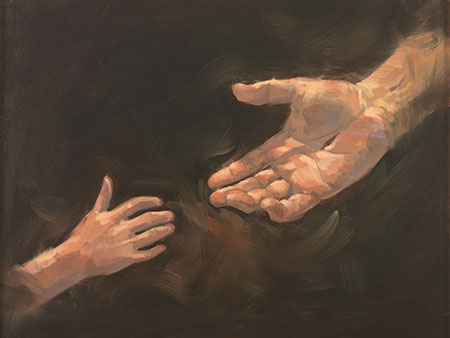
Like Saul, if we are not ever vigilant, we stand to lose the throne by our disobedience. The Lord has said: "To him that overcometh will I grant to sit with me in my throne, even as I also overcame, and am set down with my Father in his throne." (Rev. 3:21) We stand to gain the whole splendor of eternity by being obedient. If we have erred, all is not lost for there is hope. The Lord stands with his hand outstretched, in His never failing mercy, willing to take us back: "For all this His anger is not turned away but His hand is stretched out still" (Isaiah 10:4) We have been bought with a great price for our worth is great in the sight of God. If you have wandered, know that you are loved still. He awaits and beckons: "Be faithful and diligent in keeping the commandments of God, and I will encircle thee in the arms of my love". (D&C 6:20)