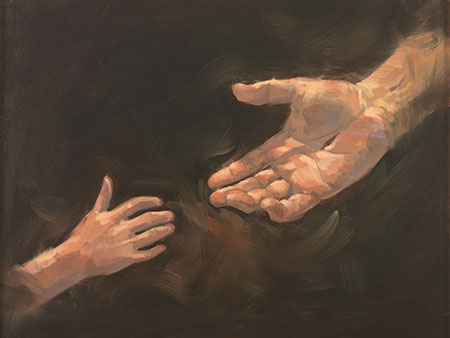
Tuesday, 21 June 2016

YE ARE THE LIGHT OF THE WORLD PART 2


"Wherefore, be faithful.....succor the weak,
lift up the hands which hang down, 
and strengthen the feeble knees."

D&C 81:5


"On one occasion, as a missionary in Tonga, I received word that a missionary was very ill on a somewhat distant island. The weather was threatening, but feeling responsible, and after prayer, we left to investigate the situation. Extra heavy seas slowed our progress, and it was late afternoon before we arrived. The missionary was indeed very ill. Fervent prayer was followed by administration, during which the impression came very strongly to get him back to the hospital on the main island, and to do it now! The weather had deteriorated, but the impression was strong - 'Get back now' - and one learns to obey the all-important promptings of the Spirit. There was much concern expressed about the darkness, the storm, and the formidable reef with its extremely narrow opening to the harbor. Some found reasons to stay behind; but soon eight persons had boarded the boat.

No sooner had we made our commitment to the open seas than the intensity of the storm seemed to increase seven-fold. As the sun sank, so did my spirit seem to sink into the darkness of doubt and apprehension. I found my spirit communing with the spirit of the father of an afflicted child in the New Testament, as he exclaimed, 'Lord, I believe; help thou mine unbelief'. (Mark 9:24) As we rolled and tossed closer and closer to the reef, all eyes searched for the light that marked the opening - the only entry to our home. Where was it? Then I heard the chilling sound of the waves crashing and chewing against the reef! It was close - too close. Where was that light? Unless we hit the opening exactly, we would be smashed against the reef. It seemed that all the elements were bent on our total destruction. Our eyes strained against the blackness, but we could not see the light.

At the heights of this panic, I looked at the captain - and there I saw the face of calmness - the ageless face of wisdom and experience - as his eyes penetrated the darkness ahead. Quietly his weather-roughened lips parted, and without moving his fixed gaze and just perceptibly shifting the wheel, he breathed those life-giving words, "Ko e Maama e" (There is the light). I could not see the light, but the captain could see it. And I knew he could see it. Those eyes, long experienced in ocean travel, were not fooled by the madness of the storm or were they influenced by the pleadings of those of lesser experience to turn to the left or to the right. Soon we were in the protected harbor. We were home. Then and only then did WE see through the darkness that one small light - exactly where the captain had said it was. Had we waited until we ourselves could see the light we would have been smashed to pieces. But trusting in those experienced eyes, we lived.

And so the great lesson: There are those who, through years of experience and training, and by virtue of special divine callings, can see farther and better and more clearly - and can and will save us in those situations where serious injury or death - both spiritual and physical - would be upon us before we ourselves could see."  (Elder John H. Groberg, There Is The Light, Ensign Nov 1976)


It's a wonderful thing to bring yourself back into the presence of God but it is a powerful thing to bring with you another; one who was sick or lost or unbelieving; someone on whom your life had an impact, someone who needed your leadership and guidance. It is true that we are here to work out our own salvation but the mandate issued by the Saviour that we love one another as He has loved us (John 13:34) suggests that this is not our only responsibility. What exactly did the Saviour mean by this admonition? If the gesture of love was merely a poetic notion He would have just said, "Love one another". When the Saviour added 'as I have loved you' He meant that our love should be the source of salvation to one another as His was and is to us. The Saviour's love was undoubtedly the motivating force behind His infinite sacrifice, the sacrifice that culminated in salvation for all mankind.

Just as in this life, in our pre-mortal state we were all at differing stages of emotional and spiritual growth. Bruce R. McConkie taught that due to man's free agency in pre-existence 'the spirits of men were not equal. They may have had an equal start, and we know they were all innocent in the beginning; but the right of free agency which was given to them enabled some to outstrip others, and thus, through the eons of immortal existence, to become more intelligent, more faithful, for they were free to act for themselves, to think for themselves, to receive the truth or rebel against it." (Bruce R. McConkie, Doctrines of Salvation, 1:58-69, Book of Mormon Student Manual, p 192). This hypothesis suggests that some of us came here more spiritually developed than others, meaning our spirits are endowed with individual and unique gifts, talents and strengths. It also means that some of us are more susceptible to truth. What this doesn't mean is that those more developed are more worthy when we measure the worth of a soul. It simply means that those of us who are stronger have the responsibility to bring back with us those that are weaker; those who are sick and feeble and oppressed; and those who have perhaps had such spiritually and emotionally debilitating experiences in life that they have been rendered incapable to survive mortality alone. This goes beyond an occasional charitable casserole dropped of at the door. It goes as far as being actively invested in saving someone who needs to be saved. Our uniqueness ensures that we, like the captain in the above-mentioned story, have the power to get another through the storm, the storm that induces fear, alienation, loss of vision, despondency and despair. We each have something that someone else needs and when we stand on higher ground, we have the responsibility to lift another to stand alongside us.


When Ammon recounted the success of their missionary labours to his brothers he gave all credit to the Saviour claiming that He has saved their brethren the Lamanites from everlasting darkness and destruction and brought them into His everlasting light and salvation and now that they were saved they were encircled about with 'the matchless bounty of His love' (Alma 26:15). This matchless bounty of love was brought to godless Lamanites through the selfless efforts, anguish and afflictions of four brothers who could not bear the thought that one soul should be lost (Mosiah 28:3). And neither could the Saviour for He has loved us with a love unsurpassing; a love unfeigned; a love that is endless; a love that has suffered for all.


Sunday, 29 May 2016

A LESSON IN SELF-FORGIVENESS


In his day, Alma the Younger became a living testament of the Saviour's power of deliverance.  Not because He forgave him for his sins and saved him from spiritual death, which He certainly did, but because He freed him to become a great man.

After Alma came out of his three days of torment he immediately began to preach of Christ's mercy and His power to save. So much was he consumed with the fervor of saving souls and making amends for his wickedness that he laboured amidst 'much tribulation, being greatly persecuted by those who were unbelievers, being smitten by many of them' (Mosiah 27:32). In other words, Alma got busy following his forgiveness and he got busy doing good. Nowhere in the scriptures does it say that he moped around and agonised over his past sins and felt bad about himself.   How was Alma, a seasoned sinner who persecuted the saints and sought to destroy the Church of God not feeling guilty about what he had done? When recounting his experience to his son Heleman, he informs him of an extremely important end result of forgiveness that He received from the Saviour when he called upon His mercy: "And now, behold, when I thought this, I could remember my pains no more; yea, I was harrowed up by the memory of my sins no more" (Alma 36:19). When he awoke from his spiritual ordeal he proclaimed: "My soul was racked with eternal torment; but I am snatched, and my soul is pained no more" (Mosiah 27:29).

One of the definitions of the word 'harrow' in the dictionary, is 'distress of mind' or to 'disturb painfully'.  What Alma is saying when he speaks of his experience is not that he forgot his sins but that the memory of them no longer distressed him and that the Saviour took away the painful state of mind these sins are capable of inducing.  And why did He do that?  Surely, Alma, having been one of the 'very vilest of sinners' (Mosiah 28:4) deserved to feel bad about what he did for longer than three days.  But Alma did feel bad.  He suffered the godly sorrow asked of every repentant sinner, an intense sorrow, a sign of a broken heart and a contrite spirit, which cast him into the very 'gall of bitterness' (Alma 36:18).  Obviously the Saviour didn't require more than that of Alma.  He did not require him to live in the past by beating up on himself for what he did.  What He did require of Alma was for Alma to become a great man.  A man who would be an instrument in His hands to convince others of His great power to save.

Alma, who once went about with the intent to destroy the Church became Alma who led the Nephite armies in battle, who sat naked with Amulek in dungeons, who was spat upon by the unrepentant, who dumbfounded an anti-christ, who baptised thousands of souls unto repentance (Alma 4:4,5), who the Lord in the end took up unto himself (Alma 45:19).  Alma certainly did become that great man that the Lord needed.


The true sign of repentance is never just forsaking one's sins but allowing the purifying power of the Holy Ghost to create 'a new man in Christ' within us and with this new man becoming a profitable servant of God.  This is true fruits of repentance.  The sons of Mosiah and Alma understood that just forsaking their sins was not enough but that good works should follow their repentance. In Ammon's own words: "Yea, he that repenteth and exercises faith, and bringeth forth good works, and prayeth continually without ceasing - unto such it is to know the mysteries of God; yea, unto such it shall be given to reveal things which never have been revealed; yea, and it shall be given unto such to bring thousands of souls unto repentance, even as it has been given unto us to bring these our brethren unto repentance." (Alma 26:22)

Out of all of his labours, none is greater than Alma's continual attempt to convince people of Christ's power of deliverance.  He did this through whatever means he could, even willing to suffer extreme physical hardship to be able to teach this principle to others.  We read in Alma chapter 8: "And Alma went forth and also Amulek, among the people, to declare the words of God unto them; and they were filled with the Holy Ghost. And they had power given unto them, insomuch that they could not be confined in dungeons; neither was it possible that any man could slay them; nevertheless they did not exercise their power until they were bound in bands and cast into prison.  Now, this was done that the Lord might show forth his power in them" (Alma 8:30,31). The significance of this cannot be lost on us for the deliverance from physical bondage of Alma and Amulek was not only useful to demonstrate God's power but it served as a metaphor for spiritual deliverance that the Saviour is capable of.


When you look at Alma and his life, do you see a broken man with a past or do you see a powerful prophet of the Lord?  If you are still 'harrowed' up by your past sins, you are missing the person that you could be.  If you believe you are no good, the Lord can make nothing of you.  In this state you are no good to anyone, not to yourself, not to God, not to your fellowman.

If you consider yourself a bad person because of your past and do not possess inner peace, you will eventually start seeking that peace elsewhere.  And some things and places you may end up in on that search have the potential to take away your focus and to distance you from God. When we seek peace in wrong places we tend to attract situations and people that end up confirming to us our belief that we are not good enough. When that confirmation comes, it is just a matter of time before we return to our former sins. Instead of becoming powerful as a result of forgiveness, we become powerless giving over our power to our former sins. We then fall short of true repentance.

If self-forgiveness has not closed the circle of your repentance, you will continue to be 'harrowed up' by your sins and peace will elude you. In examining Alma's life it is plain to see he acquired that peace in two ways.  The first was by acknowledging Jesus Christ's mercy and power to deliver him from the anguish of his soul.  The second was being anxiously engaged in the Gospel.  It is not enough to just stop doing the wrong things.  This does not invite the spirit into your personal spiritual space so it can heal you.  Abstaining from your sins is only the beginning of repentance.  What comes after is what brings about the change of heart and gives you lasting peace. It is nourishing the seed of faith and cultivating the spirit that matters just as much as forsaking of the sin, if not more. Sins create spiritual wounds.  Like all wounds, they need to be healed (see Elder David A. Bednar's talk, We Believe In Being Chaste, Ensign May 2013). The body has a natural ability to heal physical wounds but spiritual healing can only happen spirit to spirit.


"The precise nature of the test of mortality, then, can be summarized in the following question: Will I respond to the inclinations of the natural man, or will I yield to the enticings of the Holy Spirit and put off the natural man and become a saint through the Atonement of Christ the Lord (see Mosiah 3:19)? That is the test. Every appetite, desire, propensity, and impulse of the natural man may be overcome by and through the Atonement of Jesus Christ" (David A. Bednar, We Believe in Being Chaste, Ensign May 2013). Herein lies hope. Herein lies our potential to become. Herein lies our salvation.

If you have repented of your sins but can't let go of them, you are giving them more power than you are giving God. The adversary wants nothing more than for your sins to continue to have power over you, even after you have forsaken them.  But that power is really yours and only you can decide how it will be used.  Your forgiveness is not complete until you leave your remorse, like Alma, on the altar of repentance. The power of the Atonement can complete this process.  Believe in it, trust it, ask for it.  The Lord has work for you to do and He is waiting.


Wednesday, 25 May 2016

A REBELLIOUS SON


There lived in Zarahemla about 120 B.C. a very wicked and idolatrous man who had power over many people to entice them to sin and who went about actively destroying everything his father had painstakingly worked for. This son was the very vilest of sinners, who prepared the way for the enemy of God to steal many souls and who sought to destroy the church of God. This man was the son of the prophet Alma, the only convert of the martyred Abinadi, who defied the wicked king Noah and converted and baptised many people in the waters of Mormon. Imagine the grief and sorrow to have your own son working to discredit your life's work. This was Alma the Younger. Because he was a son and called The Younger, many readers of the Book of Mormon have presumed that Alma the Younger was a youth when rebelling against his father and against God. Mormon however, identifies him as 'a man' (Alma 27:8,9), a well seasoned sinner, well practiced in his ability to create trouble, an apostate who made it his life's work to discredit the Church. It is very unlikely that Alma the Younger was a reckless hot headed youth when he was wreaking havoc. A hot headed youth is more concerned with pursuing his own self interests and rebellion than being involved in apostasy. Shortly after Alma the Younger is visited by an angel, his father Alma dies at the age of 82 (Mosiah 29:45). It would have been unlikely that Alma at this age had a son in his twenties. This would suggest that Alma was more likely to have been in his 40s at the height of his wickedness and ensuing repentance.

The question of Alma's age offers more insight into the severity of his sinful life. His sins were not trivial, but heinous and destructive, not only to himself but to others. His sins and the persecutions which he heaped upon the saints no doubt went on for years. These were not trivial sins easily washed away. One might wonder why the Lord waited so long to send an angel to Alma the Younger to turn him away from his destructive course. In Alma's story, however, we see that God has a purpose for each of us for Alma's conversion became the most powerful lesson about the effectiveness of the Atonement in all the works of scripture. Alma's conversion shows us that no matter how big the sin, the Atonement is bigger still. Not only was Alma exceedingly sinful, his ability to draw people to him and his power to convince them to follow his course would have filled him with enormous pride which would have hardened his heart to be in direct opposition to God, making repentance extremely difficult without God's intervention (expressed by Elder L. Tom Perry, source unknown). Alma was surely in Satan's clutches in every way. For such a vile sinner, there had to be a spectacular conversion. A conversion that would show what the Lord can make of us even when we seem to be beyond the point of no return, a conversion that would highlight not only the Saviour's mercy but the scope of His care and incomprehensible love. The extent and seriousness of Alma's sins can be seen in the recounting of his experience where he says he waded 'through much tribulation, repenting nigh unto death', being 'in the darkest abyss', his soul being 'racked with eternal torment' (Mosiah 27:28,29). Amidst all that anguish of soul, Alma describes his deliverance with an interesting word. He says he was snatched from eternal torment and everlasting burning. Imagine the Saviour's willingness to go to the fires of hell to deliver one of the vilest of sinners. Imagine the power to snatch someone from excruciating pain before they are consumed. What more powerful lesson can we learn from Alma's conversion than this?


"I remember reading about a fire fighter in the eastern United States who ran into a burning house to rescue several children from an arson-induced fire. While his colleagues battled the blaze to keep it from spreading to other structures in the neighborhood, this man dashed into the building again and again, each time emerging with a child in his arms. After rescuing a fifth child, he started into the inferno once more. Neighbors shouted that there were no more children in the family. But he insisted that he had seen a baby in a cradle, and he dove into the intensifying heat.

Moments after he disappeared into the fire and smoke, a horrifying explosion shook the building and the entire structure collapsed. It was several hours before fire fighters were able to locate their colleague's body. They found him in the nursery near the crib, huddled protectively over a  life-sized - and practically unscratched - doll.

I'm overwhelmed by that story. I'm touched by the fire fighter's courageous and selfless devotion to duty, and I'm thankful that there are men and women in the world who are willing to put their lives on the line for the sake of others.

As I think about such heroism, however, I'm reminded that the most heroic act of all time ever was performed in behalf of all mankind by the Son of God. In a very real sense, all of humanity - past, present, and future - was trapped behind a wall of flame that was fueled and fanned by our own faithlessness. Sin separated mortals from God (see Romans 6:23), and would do so forever unless a way was found to put out the fires of sin and rescue us from ourselves" (Elder M. Russell Ballard, Our Search for Happiness, p 11)


"Can a woman forget her sucking child,
that she should not have compassion on the son of her womb?
Yea, they may forget, 
yet will I not forget thee.
Behold, I have graven thee upon the palms of my hands;
thy walls are continually before me."

Isaiah 49:15,16


(I wish to acknowledge two sources of insights for this blog, namely: Maurine Proctor of Meridian Magazine who raised the question of Alma's age and Ted Gibbons for highlighting the word 'snatch', in their informative articles on The Book of Mormon Lesson #20, My Soul Is Pained No More)

Tuesday, 3 May 2016

YE ARE THE LIGHT OF THE WORLD PART 1


"Ye are the light of the world.
A city that is set on a hill cannot be hid.
Neither do men light a candle,
and put it under a bushel,
but on a candlestick;
and it giveth light unto all
that are in the house."

- Matthew 5:14-15


"Some years ago, I was stuck on a crosstown bus in New York City during rush hour. Traffic was barely moving. The bus was filled with cold, tired people who were deeply irritated - with one another; with the rainy, sleety weather; with the world itself. Two men barked at each other about a shove that might or might not have been intentional. A pregnant woman got on, and nobody offered her a seat. Rage was in the air; no mercy would be found here. 

But as the bus approached Seventh Avenue, the driver got on the intercom. 'Folks', he said, 'I know you've had a rough day and you're frustrated. I can't do anything about the weather or traffic, but here's what I can do. As each one of you gets off the bus, I will reach out my hand to you. As you walk by, drop your troubles into the palm of my hand, okay? Don't take your problems home to your families tonight - just leave 'em with me. My route goes right by the Hudson River, and when I drive by there later, I'll open the window and throw your troubles in the water. Sound good?

It was as if a spell had lifted. Everyone burst out laughing. Faces gleamed with surprised delight. People who'd been pretending for the past hour not to notice each other's existence were suddenly grinning at each other like, is this guy serious?

Oh, he was serious.

At the next stop - just as promised - the driver reached out his hand, palm up,and waited. One by one, all the exiting commuters placed their hand just above his and mimed the gesture of dropping something into his palm. Some people laughed as they did this, some teared up - but everyone did it. The driver repeated the same lovely ritual at the next stop, too. And the next. All the way to the river.

We live in a hard world, my friends. Sometimes it's extra difficult to be a human being. Sometimes you have a bad day. Sometimes you have a bad day that lasts for several years. You struggle and fail. You lose jobs, money, friends, faith, and love. You witness horrible events unfolding in the news, and
you become fearful and withdrawn. There are times when everything seems cloaked in darkness. You long for the light but don't know where to find it.

But what if you are the light? What if you're the very agent of illumination that a dark situation begs for?

That's what this bus driver taught me - that anyone can be the light, at any moment. This guy wasn't some big power player. He wasn't a spiritual leader. He wasn't some media-savvy 'influencer'. He was a bus driver - one of society's most invisible workers. But he possessed real power, and he used it beautifully  for our benefit.

When life feels especially grim, or when I feel particularly powerless in the face of the world's troubles, I think of this man and ask myself, What can I do, right now, to be the light? Of course, I can't personally end all wars, or solve global warming, or transform vexing people into entirely different creatures. I definitely can't control traffic. But I do have some influence on everyone I brush up against, even if we never speak or learn each other's name. How we behave matters because within human society everything is contagious - sadness and anger, yes, but also patience and generosity. Which means we all have more influence than we realize.

No matter who you are, or where you are, or how mundane or tough your situation may seem, I believe you can illuminate your world. In fact, I believe this is the only way the world will ever be illuminated - one bright act of grace at a time, all the way to the river."

- Elizabeth Gilbert, author or Eat, Pray, Love and The Signature of All Things


I cannot read this story of the thoughtful bus driver without getting emotional. As Elizabeth Gilbert said, a bus driver is one of society's most invisible workers and yet, to me at least, he possessed more power on that rainy, dreary night than any military leader who conquers nations. Why? Because he lightened people's loads with as little as the palm of his hand. No weapon, no gadget, no instrument, just the palm of his hand. Often we think we are not skilled enough to lift another, to light the path at their feet, to carry their burdens. We often live from day to day wrapped up in a cloud of self interest full of our own problems, troubles, fears, burdens, responsibilities and pressures. We are told in the scriptures that in our day 'men's hearts shall fail them' and the love of men shall wax cold' (D&C 45:26,27). We see evidence of this all around us in public, where courtesy is denied and chivalry is dead. We have forgotten where we came from and who we are and most importantly we have forgotten the mandate that we could be and should be a light in this dreary world. We have forgotten we are our brother's keeper. In the midst of our own troubles and responsibilities, this charge may seem overwhelming but in reality it does not require much more of us than human kindness, a loving gesture, a smile - in short: a connection, an exchanged energy, a bonding with other human beings who are with us in this vale of tears. 

None of us is an island. We all need approbation, human contact, acceptance, understanding. We need someone to say: I see you, you exist. None of us need to do mortality alone, and we shouldn't do it alone. Consider another story from Elizabeth Gilbert:


"Back in 2002, I went away by myself for ten days to a tiny fishing island in the middle of Indonesia. It was the farthest-away place I could find on the map, and all I wanted right then was to be as far removed as possible from all that I knew. My life was a mess. My life, in fact, looked like a dropped pie; everything was on the floor in pieces. I was going through a bad divorce, and in the process I was losing a husband, losing a house, losing money, losing friends, losing sleep, losing myself. So I took myself to this little island 10,000 miles from home, where I rented a small bamboo hut that cost a few dollars a day. My plan was to spend ten days in silence and isolation. I hoped that making myself small and quiet would heal me. I guess what I really wanted was to disappear, and this island seemed the perfect place for it. There was no Internet, and I had no access to a phone. Transportation consisted of fishing boats, or wooden carts pulled by skinny ponies. Here, surely, I could hide from the world. 

Soon, I fell into a routine, Every day, I would walk twice around the perimeter of the entire island - once at dawn and again at dusk. While I walked, I would try to meditate, but usually I ended up arguing with myself, or ruminating over my life's many failures as I fell apart into tears. As for the rest of the day, I believe I slept a lot. I was awfully depressed. I hadn't brought any books with me to disappear into. I didn't swim: I didn't sunbathe; I barely ate. I just executed my two walks a day, and the rest of the time I hid in my hut and wished the sadness out of me.

There were a few other tourists on the island, but they were all romantic couples and they mostly ignored me - I was a skinny, hollow-eyed, solo woman who talked to herself and gave off a freaky vibe. The local fishermen also looked right through me whenever I walked by. Maybe I actually was vanishing from the material world. I certainly felt that way. But there was one woman who saw me - and that changed everything. She was a local fisherman's wife, and she lived in a tiny shack on the other side of the island. Like all the locals, she was Muslim. She dressed modestly, with a head scarf. She seemed to be in her mid-thirties, though she had spent a lifetime in the sun so her age was hard to determine. She had a chubby little toddler who was always crawling about and playing at her feet.

The first morning I walked by her house, the woman looked up from her work in her scrubby subsistence garden and smiled at me. I smiled back, as best I could manage. After that, she always seemed to be standing outside her house when I passed - once at dawn and again at dusk. After a while, it seemed like she was waiting for me to come by. She was my only point of human contact in the world, and her mere recognition of my existence made me feel slightly less lonely. Once, I glanced back at her, and I saw that she was still looking after me, her hand shading her eyes. She was keeping an eye on me, is what it felt like.

On my eighth night on the island, I got terribly sick. It could have been food poisoning, or contaminated drinking water - or maybe it was just that I had finally reached the bottom of my grief and everything bad was coming out of me at last. I was shaking and feverish, vomiting and scared. It was terrifying to be so isolated and so ill. Also, the generators weren't working that night; there was no light. I remember crawling toward the bathroom in the darkness for the tenth time and wondering, 'Why did I come here, so far away from anyone who cares about me?'

I stayed in bed all the next day, shaking and sweating and dehydrated. I had a dreadful thought that I might die on this island all alone, and that my mother would never know what happened to me. That evening, after sundown, there was a knock on the door. On trembling legs, I walked and opened it. It was the woman from the other side of the island - the fisherman's wife. She din't speak English, and I don't speak Bahasa, but it was clear that she was checking on me and that she was worried. When she saw my condition, she looked even more worried. She put up a finger, like: Wait. Less than an hour later, she was back. She brought me a plate of rice, some chopped-up herbs, and a jug of fresh water. She came into the shack and sat on the side of my bed while I ate every bite of this healing food. I started crying. She put her arm around me, and I folded myself into her as if she were my own mother - even though we were almost the same age. She stayed with me for about an hour, until I was composed. She didn't say a word: she just sat with me, arms around me, as if to say: I see you. You exist. I will stay with you. I will make sure you are safe.

Only after she had departed did I have the clarity to piece together what must have happened. This stranger had come to find me because she'd noticed that I had missed both my morning and my evening walks, and she could clearly see: something is not right with this one. And because this was her island - her territory - and because she knew I was alone, she took it upon herself to look after me. She, who had so little to share, made me her responsibility and took the risk of reaching out.

The distance I had traveled may have been vast (10,000 miles from home), but the distance she traveled was vaster (all the way across the island, to knock on a stranger's door) and the kindness of her actions opened my heart to awe and amazement. And that's when I realized that my entire impulse had been dead wrong. I needed the exact opposite of isolation; I needed connection. This stranger had seen my need, and she had offered fellowship."


We are the light of the world. A light that transcends language, nationality, race, class. A light that speaks to all who belong to the human race. A light which was placed within us when we left our heavenly home. May we remember to keep it burning as we traverse the shores of mortality in hopes of saving a drowning soul.


Brightly beams our Father's mercy
From his lighthouse ever more,
But to us he gives the keeping
Of the lights along the shore.

Dark the night of sin has settled;
Loud the angry billows roar.
Eager eyes are watching, longing,
For the lights along the shore.

Trim your feeble lamp, my brother,
Some poor sailor, tempest tossed,
Trying now to make the harbor,
In the darkness may be lost.

Let the lower lights be burning,
Send a gleam across the wave.
Some poor fainting, struggling seaman
You may rescue, you may save.

- Philip Paul Bliss

Wednesday, 30 March 2016

PRESS ON


"Wherefore, ye must press forward with a steadfastness in Christ,
 having a perfect brightness of hope, 
and a love of God and of all men. 
Wherefore, if ye shall press forward, 
feasting upon the word of Christ, 
and endure to the end, 
behold, thus saith the Father: 
Ye shall have eternal life."

- 2 Nephi 31:20


I had a disheartening conversation with a friend the other day who advised me she no longer attends Church. During the course of the conversation she revealed that her life has become such a burden to her that her only hope lies in sudden death. As my tears flowed and as I urged her to put herself in God's hands and to trust that He will make something better of her life, her reply was that God doesn't really care and when she was doing the right things it didn't make any difference. She said she had lost hope for a better life here and in eternity. Unfortunately this friend has zig zagged between obedience and disobedience all her life. Her lack of consistency has undermined her power of endurance and enhanced her expectation of lasting happiness and perfection in this life, which in reality is a futile pursuit. In expecting fulfillment here and now she has totally overlooked the fact that this life is not only 'a growing season' but also our testing ground.

The design of mortality is such that it should motivate us to look forward to perfection in the next, not to wile away our days in frustration blaming God that we are not lying on a bed of roses or cursing Him because we cannot 'take happiness in our sins' (Mormon 2:13). This friend and some others who have crossed my path have expressed to me that they wonder if they had ever really chosen godhood as their eternal destination. They feel that they were somehow forced to choose it because the alternative would not have been such an attractive outcome. They whine about the unfairness of having to choose between godhood and damnation and ask why they were not allowed to stay where they were, sitting on a fence, not choosing either. All of a sudden godhood has become a price too high to pay and they rationalize that they never really wanted it anyway. But the funny part is that they did, as all of us did, way back in our "beginning". We were never ever forced into anything.


To better understand the exercise of our agency in relation to this life we need to know the true meaning of 'the beginning': "After revealing to Abraham that there are infinite, uncreated intelligences, God showed him that some of the intelligences 'were organized before the world was' (Abraham 3:22). If our individual intelligences have agency it must have been our choice to be organized into our first estate.....Our 'beginning' was the moment we chose to have our intelligences 'added upon' by being born into the spirit world......our spirit bodies were conceived by our Heavenly Parents to house our uncreated intelligences. We are gods in embryo, with the full potential to mature and to become like our Celestial Parents.....The gospel is the 'everlasting gospel', not only because its effects are everlasting, but because it has always been in place, from eternity....It is the 'hope of eternal life, which God, who cannot lie, promised before the world began' (Titus 1:2)" (B. Grant Bishop, M.D., The LDS Gospel of Light, pp108-111). I venture to say that there might have been some intelligences who did not choose to be 'added upon' and chose to remain as they were.

This is not taught as gospel doctrine but it makes sense to me that we chose godhood "in the beginning", when we were yet only intelligences, and with it the process of being born first spiritually and then physically. The alternative would have been lack of free agency. The plan for godhood had to be in place prior to the spirit world so the innate agency of our intelligences would be respected. It could not have been a random act for Heavenly Father to have created numerous amounts of spirit children and then had to decide what to do with them! Godhood was not a drummed up plan that gave us 'something to do' but rather a plan that has always existed, based on free agency. If Heavenly Father was once a mortal like we are now, then His purpose was always to gain exaltation, have eternal increase and provide the way for His children to gain the same. That is certainly the plan for us also as has been revealed through modern-day revelation and scripture. As Lorenzo Snow once put it: "As man now is, God once was; as God now is, man may become" (Teachings of Presidents of the Church: Lorenzo Snow, 2011, Chapter 5: The Grand Destiny of the Faithful). The understanding that we decided in the very beginning that we wanted godhood should be enough for us to press on, however, 'the greatest gift of God' does not seem to mean much to some of us who focus too intently on happiness here and now. The seeming ease of telestial life is simply too hard for some of us to resist so we keep looking down instead of up for pursuit of lasting joy and fulfillment.


Joseph Smith taught that "the fundamental principles of our religion are the testimony of the Apostles and Prophets, concerning Jesus Christ, that He died, was buried, and rose again the third day, and ascended into heaven; and all other things which pertain to our religion are only appendages to it" [Teachings of Presidents of the Church: Joseph Smith (2007), 49]. So basically, the Saviour's death and resurrection should be the main focus of our religion. Why would that be? Because the Saviour's resurrection brings about immortality and immortality brings about a 'fulness of joy'. According to the following scripture we cannot have this fulness in this life: "For man is spirit, the elements are eternal, and spirit and element, inseparably connected, receive a fulness of joy. And when separated, man cannot receive a fulness of joy" (D&C 93:33,34). Right now we are not inseparably connected, we are very much in that fragile state of being where death is imminent. Thus the principle of resurrection "gives us the strength and perspective to endure the mortal challenges faced by each of us and by those we love, such things as the physical, mental, or emotional deficiencies we bring with us at birth or acquire during mortal life" (Dallin H. Oaks, Resurrection - The Beginning of Immortality, Ensign March 2016, p 80)

When we are not staying on the 'strait and narrow path' with a goal to endure by 'passing the points of breaking without breaking' (Neal A. Maxwell), we are not valuing eternal life. Some of us are of the opinion that the price to pay for such a life is far too high but is the telestial life, without the sustaining power of Christ, easier to live than the life of obedience that the gospel demands of us? In short, the former exacts hardship while the latter asks for endurance, endurance that is made possible with Christ's sustaining power: "Enduring to the end means that we have planted our lives firmly on gospel soil, staying in the mainstream of the Church, humbly serving our fellowmen, living Christlike lives, and keeping our covenants. Those who endure are balanced, consistent, humble, constantly improving, and without guile. Their testimonies are not based on worldly reasons - they are based on truth, knowledge, experience, and the Spirit" (Joseph B. Wirthlin, in CR Oct 2004, p 107; or Ensign Nov 2004, p 101)

It is not enough for us to experiment living the gospel from time to time to see if we will be blessed for it. Pressing forward and enduring to the end requires consistent coming unto Christ through a life of obedience. It is only this consistent effort that brings us to the point of conviction that will see us to the end. This point of strength makes endurance possible and thins the veil to the point where we can develop a desire for what is on the other side of it. It is something one cannot obtain overnight. It is a reward for nourishing faith, foregoing self-gratification and standing firm on the testing ground. When my friend pointed out to me that I have basically nothing much to show for my years of endurance and adherence to the gospel, I reflected on what I do have and concluded that the way I have come to feel about the Saviour after 40 years of cultivating my seed of faith is the greatest treasure I could possibly own and one that I would not trade for all the riches of this life. I felt saddened that my friend was only looking at my temporal blessings as a measure of my personal success. Sometimes I fear that we are like spoilt children wanting to be rewarded for every little thing we do right when in reality God has already done more for us than we can ever repay. He owes us nothing. This earth was created for our sake and the Saviour atoned for our sake, all out of the goodness of His heart and His mercy. We cannot possibly expect more. The path to eternal life has been paved. It is up to us to tread it. But we are not alone. He is there, ever waiting, ever wanting, ever hoping that we will come to Him. His arm of mercy is extended. He is ever ready to encircle us in the arms of His love. In them there is safety, in them there is joy, in them there is life eternal. Press on.


Yes, my fretting, frowning child,
I could cross the room to you more easily,
But I've already learnt to walk so I make you come to me.
Let go now, there, you see!
Oh, remember this simple lesson child,
And when in later years you cry out with tight fists and tears,
Oh help me God please!
Just listen and you'll hear a silent voice,
I would child, I would, but it's you, not I, who needs to try
Godhood.

-  Carol Lynn Pearson


Wednesday, 9 March 2016

LOVE, MERCY AND THE OLIVE TREE


There was a prophet in Israel by the name of Zenos who was martyred for his testimony (Helaman 8:19) of whom the Bible does not speak. We know of this prophet because of the brass plates which were taken to the land of the Americas with Lehi and his colony in 600 B.C. Nephi used the prophecies of Zenos extensively in his ministry among his people because Zenos testified largely concerning this broken off branch of the tribe of Joseph 'who were a remnant of his seed', meaning Zenos was of the tribe of Joseph himself (3 Nephi 10:15,16). The significance of this prophet was expressed by Bruce R. McConkie: "I do not think I overstate the matter when I say that next to Isaiah himself - who is the prototype, pattern, and model for all the prophets - there was not a greater prophet in all Israel than Zenos. And our knowledge of his inspired writings is limited to the quotations and paraphrasing summaries found in the Book of Mormon".

So important did Nephi and his brother Jacob consider the prophecies of Zenos that Jacob painstakingly engraved Zenos' allegory of the olive tree onto the small plates of Nephi which Mormon included in the Book of Mormon. Why is this parable with its' complexities and intricacies which makes readers skip Jacob 5 so important? Because not only is it the greatest parable ever recorded, it, in and of itself stamps the Book of Mormon with authenticity and truth for no mortal man, without the inspiration of God, could have written it. It not only proves that Zenos was a prophet but it is clear proof that Joseph Smith was a prophet too and that he translated the Book of Mormon through the power given him of God. Once you study this parable you become convinced that Joseph Smith could never have written the Book of Mormon.


One can get totally lost in Israel's captivating history and divine destiny studying the allegory of the olive tree in Jacob chapter 5. However, if studied carefully one cannot miss the central theme of this parable which is the Saviour's enduring mercy, long-suffering and loving care of His covenant people. Whilst it is not my wish to overshadow the importance of Israel's history contained within this allegory, it is my intention to focus on the Saviour and how he relates to us individually within this parable. Firstly, it is important to understand why Zenos used the olive tree as a powerful symbol of God's love and relationship with the house of Israel. The olive tree is an evergreen, meaning its' leaves do not seasonally fade or fall. They are continually rejuvenated through scorching heat or winter cold. This tree, however, needs constant cultivation or it becomes wild and unruly and easily corrupted. It requires long and patient cultivation for it to bear fruit, usually eight to ten years. It is however a sturdy tree which produces new shoots from apparently dead roots. Its' gnarled trunk gives an impression of travail, endurance and ancient life. Because of the unique quality of this tree Elder Jeffrey R. Holland affirmed that "no symbol could serve more powerfully and profoundly of God's expansive, constant, redeeming love - including especially the love represented in the gift of his Only Begotten Son- than does the olive tree." (Elder Jeffrey R. Holland, Christ and the New Covenant, p 163-64)

In the allegory of the olive tree, the Saviour is represented as the Lord of the vineyard. Unlike the "householder, which planted a vineyard" and then "let it out to husbandmen, and went into a far country" (Matt 21:33), He labours in His vineyard Himself. He does not sit back and watch others do the plucking, pruning, digging and grafting. He also grieves, preserves, laboures, watches and tends to the vineyard constantly. His frantic efforts to ensure the divine destiny of the House of Israel, as represented by the olive trees in His vineyard, can be seen through repetitious declarations of His love and long-suffering: His desire to preserve the vineyard is mentioned in the parable 11 times; at least 15 times the Lord expresses His desire to bring the vineyard and its' harvest 'unto my own self'; 8 times He says 'it grieveth me to lose the trees of my vineyard'; and 3 times He asks with anguish, weeping, 'what could I have done more for my vineyard?' After he recounts the allegory of the olive tree to his people, Jacob exclaims: "....how merciful is our God unto us, for he remembereth the house of Israel, both roots and branches; and he stretches forth his hands unto them all the day long...O then, my beloved brethren, repent ye, and enter in at the strait gate, and continue in the way which is narrow, until ye shall obtain eternal life, O be wise; what can I say more?" (Jacob 6:4,11,12). What indeed?


We, like the olive tree, need constant cultivating so that we do not become wild and unruly and easily corrupted. To yield good fruit, a tree must have good roots. When the roots are weak, the branches grow faster than the strength of the roots can sustain them and the tree eventually becomes too weak to keep standing  and dies (Jacob 5:47-48). This is cleverly expressed in the following poem:

The tree
At the church next door to me 
Turned up its roots and died
They had tried 
To brace its leaning,
But it lowered
And lowered,
And then there it lay -
Leaves in grass
And matted root in air,
Like a loafer on a summer day.

"Look there",
Said the gardener,
"Short roots - all the growth went up -
Big branches - short roots".

"How come" I asked.
"Too much water.
This tree had it too good.
it never had to hunt for drink."

Especially in thirsty times,
My memory steps outside
And looks at the tree
At the church next door to me
That turned up its roots and died.

- Carol Lynn Pearson

Sometimes we think we need a life of ease, as the tree in this poem had, and that this kind of life will in the end magically produce bountiful fruit. But this is not the design of mortality. In His efforts to ready us for final judgment and make us fit for eternal life the Lord will use His gardening skills on each one of us individually. He will prune and dig about and nourish and often times such treatment will be uncomfortable as is illustrated by the following:

"On my way to visit the Jameses the other evening, I saw a wheat field that appeared to be greener and taller than the others. Thinking about it for a while, I concluded that occasionally some loving farmer drives over the field with his tractor and dumps manure all over it. I thought, 'My, it's just like life. Here we are minding our own business, growing our little hearts out. We're really quite green, somewhat productive and very sincere. When out of the blue, life deals us a dirty one, and we're up to our eyebrows in manure. We, of course, conclude that life as we have known it has just ended and will never be the same again. But one day, when the smell and the shock are gone, we find ourselves greener and more productive than we have been'. Unfortunately, no matter how often we go through these growing experiences, we are never able to appreciate the sound of the tractor or the smell of the manure." (Harold W. Wood)


We can sometimes be like the tree that stood right next to a church and didn't go 'hunting' therein for what it needed to sustain and strengthen its roots. Some of us are not willing to work on our roots even though we want the fruit (eternal life): "It seems that some [Latter-day Saints] among us have this same problem; they want bountiful harvests - both spiritual and temporal - without developing the root system that will yield them. There are far too few who are willing to pay the price, in discipline and work, to cultivate hardy roots" (President Spencer W. Kimball, in CR Oct 1978, p 113 or Ensign, Nov. 1978, p 74-5). Grounding ourselves in the gospel of Jesus Christ by nourishing the seed of faith through the word of God is our part in our individual cultivation. This is our hunting ground. If we hunt here we can be assured of hardy roots which will enable us to endure the trials and afflictions of this life without abandoning the strait and narrow path which leads to eternal life. May of us feel that strengthening the roots is far too hard and we opt for the seeming ease of telestial life. This is however, not what God wants for us eternally and so He expends all his energy and effort to bring us back to Him over and over again. And anything less than eternal life is not what we wanted long ago when the morning stars sang together and all the sons of God shouted for joy. We were among that happy throng and our voices were heard singing praises to Him who has all the love, all the mercy, all the long-suffering and all the power to one day bring us home.


Wednesday, 2 March 2016

A MODEL OF OBEDIENCE


Imagine having a son who never questions your wisdom and follows your counsel and guidance with exactness, never wavering. Imagine having a son who does not think your ideas are outdated and your dreams foolishness. A son who is willing to follow you to the ends of the earth and who respects your patriarchal leadership within the family. Imagine a son who never shirks from what you ask of him no matter how hard the task. One who has complete trust in God and never deviates from his commitment to Him. A son who knows his limitations and strengths yet never allows pride to lift him higher than his fellow beings. This was Nephi.

What a delight this man must have been to his parents. Lehi would never have succeeded in putting his foot on the promised land if it were not for his obedient son. Besides the physical requirements of such a journey which were beyond Lehi in his later years, such as obtaining the brass plates, hunting for food and building a ship, one other instance stands out to prove this theory. When Nephi broke his bow and the family were facing dire consequences from want of food, even his father began to murmur against God together with the rest of the family (1 Nephi 16:20). It must have looked to Nephi like the whole enterprise of this little colony was at peril of falling apart giving way to mutiny if his father lost focus so Nephi chose to be proactive and mend the situation. He made a bow of wood and proceeded to ask his father where he should go to hunt (1 Nephi 16:23). It would have been so easy for Nephi to step in right there and then and take over as the leader of his family. After all, he came up with the solution and he brought the relief. He was showing initiative as a leader. Nephi, however, knew that the journey to the promised land had to be under the leadership of him who first received the revelation and he also knew that all credit for guidance and deliverance had to be given to God (1 Nephi 16:29), so he asked his father where he should go to hunt. How useless Lehi would have felt had his son undermined him by taking matters into his own hands. Instead Nephi placed him back on the path of leadership and repentance before the Lord. So Nephi not only provided his father with physical support but a spiritual one also.


Perhaps in no other way was Nephi more Christ-like than in the principle of obedience. What enalbled Nephi to be so completely obedient to a god who did not spare him from hardships and perils of life? Nephi himself gives us the answer to this question: 'to follow God, one must want God'. Early in Nephi's record he states plainly that he sought to understand the mysteries of God and that this seeking alone bore such fruit that he had no desire to rebel against his father or against God (1 Nephi 2:16). Knowing God and having God in our lives therefore is the first step towards the ability to be obedient. The second most important thing that Nephi did was make God his partner in life. This he did by swearing with an oath when he had to accomplish difficult tasks, such as obtain the brass plates. On more than one occasion Nephi uttered the words "As the Lord liveth" cementing his determination to achieve the desired end. Elder Bruce R. McConkie explained the significance of this statement:

"This matter of swearing with an oath in ancient days was far more significant than many of us have realised. For instance: Nephi and his brethren were seeking to obtain the brass plates from Laban. Their lives were in peril. Yet Nephi swore this oath: 'As the Lord liveth, and as we live, we will not go down unto our father in the wilderness until we have accomplished the thing which the Lord hath commanded us' (1 Nephi 3:15). Thus Nephi made God his partner. If he failed to get the plates, it meant God had failed. And because God does not fail, it was incumbent upon Nephi to get the plates or lay down his life in the attempt." (Elder Bruce R. McConkie, C.R. April 1982, pp 49,50)

Hugh Nibley's explanation of the significance of the words of the oath helps us understand further Nephi's seriousness of this partnership:

"....the oath is the one thing that is most sacred and inviolable among the desert people: 'Hardly will an Arab break this oath, even if his life be in jeopardy,' for 'there is nothing stronger, and nothing more sacred than the oath among the nomads,' and even among the city Arabs, if it be exacted under special conditions. But not every oath will do: to be most binding and solemn an oath should be by the life of something, even if it be but a blade of grass; the only oath more awful than 'by my life' or (less commonly) 'by the life of my head,' is the wa hayat Allah, 'by the life of God,' or 'as the Lord liveth'....." (Collected Works of Hugh Nibley, Vol. 5, Part 1, p 103-104)

Nephi was true to his word in making God his partner. He demonstrated this over and over again as he showed his dependence on Him: "..... no one on the trip was asked to do more than Nephi - he obtained the plates, made a bow, foraged for food, scrambled to mountaintops to pray, made plates and built a ship. Yet he intimately came to know that all he could do was not enough, for 'it is by grace that we are saved, after all we can do' (2 Nephi 25:23). In the wilderness, when the righteous come face to face with their limitations, they see that God is there to take up the slack."  (Scot and Maurine Proctor, BOM Lesson 5 "Hearken to the Truth and Give Heed Unto It", Meridian Magazine, January 19, 2016). Part of being dependent on God means to have trust in Him and Nephi did just that. He was not spared or excused from any difficulties of the journey that were suffered by his brothers. On the contrary, he had more of them. What Nephi did learn through these difficulties was the Lord's power of deliverance (1 Nephi 1:20, 17:3, 18:16, 18:11). The examples throughout his life are endless and because of them he was able to exclaim: "O Lord, I have trusted in thee and I will trust in thee forever" (2 Nephi 4:34).


In his father's dream of the tree of life, Nephi partook of the fruit which symbolises the love of God. When Nephi enquired of the Lord the meaning of the tree of life an angel appeared to tutor him. He asked him if he knew what the tree represented. Nephi answered that it was 'the love of God which sheddeth itself abroad in the hearts of the children of men' (1 Nephi 11:22). Immediately following his answer Nephi saw a vision of the Son of God and his ministry among mortal men. From this we can conclude that God's greatest love for us is manifested through His Son Jesus Christ. Nephi understood this and was therefore able to say: "...the Lord hath redeemed my soul from hell; I have beheld his glory, and I am encircled about eternally in the arms of his love" (2 Nephi 1:15). To me there is a deeper meaning in this. Because of his willingness to follow Christ and his acceptance of the Atonement I believe that Nephi was endowed with the Saviour's ability to be obedient. This is true for all of us. How do we know this? Because Isaiah said so: "For he giveth power to the faint; and to them that have no might he increaseth strength" (Isaiah 40:29). With God as his partner Nephi could not fail in anything for "if God be for us, who can be against us?" (Romans 8:31).


Because of Nephi's obedience he kept company with angels and saw the Saviour (1 Nephi 2:16, 2 Nephi 11:2) in fulfillment of His promise to the ends of the earth: "...If a man love me, he will keep my words: and my Father will love him, and we will come unto him, and make our abode with him" (John 14:23). Nephi taught his people that the Saviour, needing no baptism, fulfilled all righteousness by being baptised to witness to the Father 'that he would be obedient unto him....' (2 Nephi 31:6,7). Elder Bruce R. McConkie once said that "righteousness is not simply the absence of evil or impropriety; it is the active seeking of the mind and will of the Father and compliance to that will". To the Saviour, doing the Father's will was everything. Luke tells us that as Jesus grew to manhood He 'increased in wisdom and stature and in favour with God and man' (Luke 2:52). Jesus found favour with God because of His obedience. Nephi knew the Saviour through close association and no doubt his life's quest was to follow in His footsteps. The more he followed, the more empowered he became to be like the Master himself. May we be like Nephi who at the end of his record, summed up the integrity of his character in three most profound words found in scripture:

'I must obey' 

 (2 Nephi 33:15).