Showing posts with label #fellowmen. Show all posts

Sunday, 20 July 2014

TO RESCUE AND TO SAVE


After a few of the usual Sunday hymns, the church's pastor stood up, walked over to the pulpit and, before he gave his sermon that evening. briefly introduced a guest minister who was in the service that evening.  In the introduction, the pastor told the congregation that the guest minister was one of his dearest childhood friends and that he wanted him to have a few moments to greet the church and share whatever he felt would be appropriate for the service. With that, an elderly man stepped up to the pulpit and began to speak:

A father and a son, and a friend of his son were sailing off the Pacific coast when a fast approaching storm blocked any attempt to get back to the shore. The waves were so high, that even though the father was an experienced sailor, he could not keep the boat upright and the three were swept into the ocean as the boat capsized. 

The old man hesitated for a moment, making eye contact with two teenagers who were, for the first time since the service began, looking somewhat interested in his story. The aged minister continued with his story.

Grabbing a rescue line, the father had to make the most excruciating decision of his life - to which boy he would throw the other end of the life line. He only had seconds to make the decision. The father knew that his son was a Christian and he also knew that his son's friend was not. The agony of his decision could not be matched by the torrent of waves. As the father yelled out. "I love you son!", he threw the life line to his son's friend. By the time the father had pulled the friend back to the capsized boat, his son had disappeared beneath the raging swells in to the black of night. His body was never recovered.

By this time, the teenagers were sitting up straight in the pew, anxiously waiting for he next words to come out of the old minister's mouth.

The father knew his son would step into eternity with Jesus and he could not bear the thought of his son's friend stepping into an eternity without Jesus. Therefore, he sacrificed his son to save the son's friend. How great is the love of God that he should do the same for us. Our Heavenly Father sacrificed His only begotten Son so that we could be saved. I urge you to accept His offer to rescue you and take a hold of the life line He is throwing out to you.

With that, the old man turned and sat back down in his chair as silence filled the room. Within minutes after the service ended, the two teenagers were at the old man's side. "That was a nice story", politely stated one of the boys, "but I don't think it was very realistic for a father to give up his only son's life in hopes that the other boy would become a Christian."

"Well, you've got a point there," the old man replied, glancing down at his worn Bible. A big smile broadened his narrow face. He once again looked up at the boys and said, "It sure isn't very realistic, is it? But I'm standing here today to tell you that story gives me a glimpse of what it must have been like for God to give up His Son for me. You see, I was that father and your pastor is my son's friend."

- Author Unknown


The Father gave us the perfect example of sacrifice when He sent His only begotten Son so that we might through Him be saved. Such a sacrifice might be unfathomable to our finite minds but to Him, sacrificing the one that all might be saved was worth the momentary pain. Imagine as a parent standing to lose all your children to eternal death never to feel their presence again. By not sacrificing one, the Father stood to lose us all. This was unthinkable to Him who desires not only to save us but to make us equal to Him in might, power and glory. As a parent you want the very best for your children; the best house, the best job, the best companion, the best situations in life, and most of all you want them to be happy. Does your heart not break when your children are suffering? You want to save them from the dangers and harshness of this world and so you want to give them everything to ensure their well being and happiness. What we can give our children though is not even a tenth of a tenth compared to what the Father can give us. Paul said to the Corinthians that "....eye hath not seen, nor ear heard, neither have entered into the heart of man, the things which God hath prepared for them that love him." (1 Corinthians 2:9)

If God so loved us that He would sacrifice his only begotten Son, should we not love one another "...for he that loveth another hath fulfilled the law" (Romans 13:8).  This law was decreed by Him who has also loved us with a perfect love which enabled His sacrifice for the souls of men for "greater love hath no man than this, that a man lay down his life for his friends" (John 15:13). The Son, "having finished his preparations unto the children of men" (D&C 19:19), having saved them from the depths of the deep, has charged us to love and save one another, for if we labour all our days and save even one soul, how great shall be our joy with him in kingdom of our Father (D&C 18:15).


Brightly beams our Father's mercy
From His lighthouse evermore,
But to us He gives the keeping
Of the lights along the shore.

Dark the night of sin has settled;
Loud the angry billows roar.
Eager eyes are watching, longing,
For the lights along the shore.

Trim your feeble lamp, my brother;
Some poor sailor, tempest-tossed,
Trying now to make the harbor,
In the darkness may be lost.

Let the lower lights be burning;
Send a gleam across the wave.
Some poor fainting, struggling seaman
You may rescue, you may save.

- Philip Paul Bliss, 1838-1876


Thursday, 19 June 2014

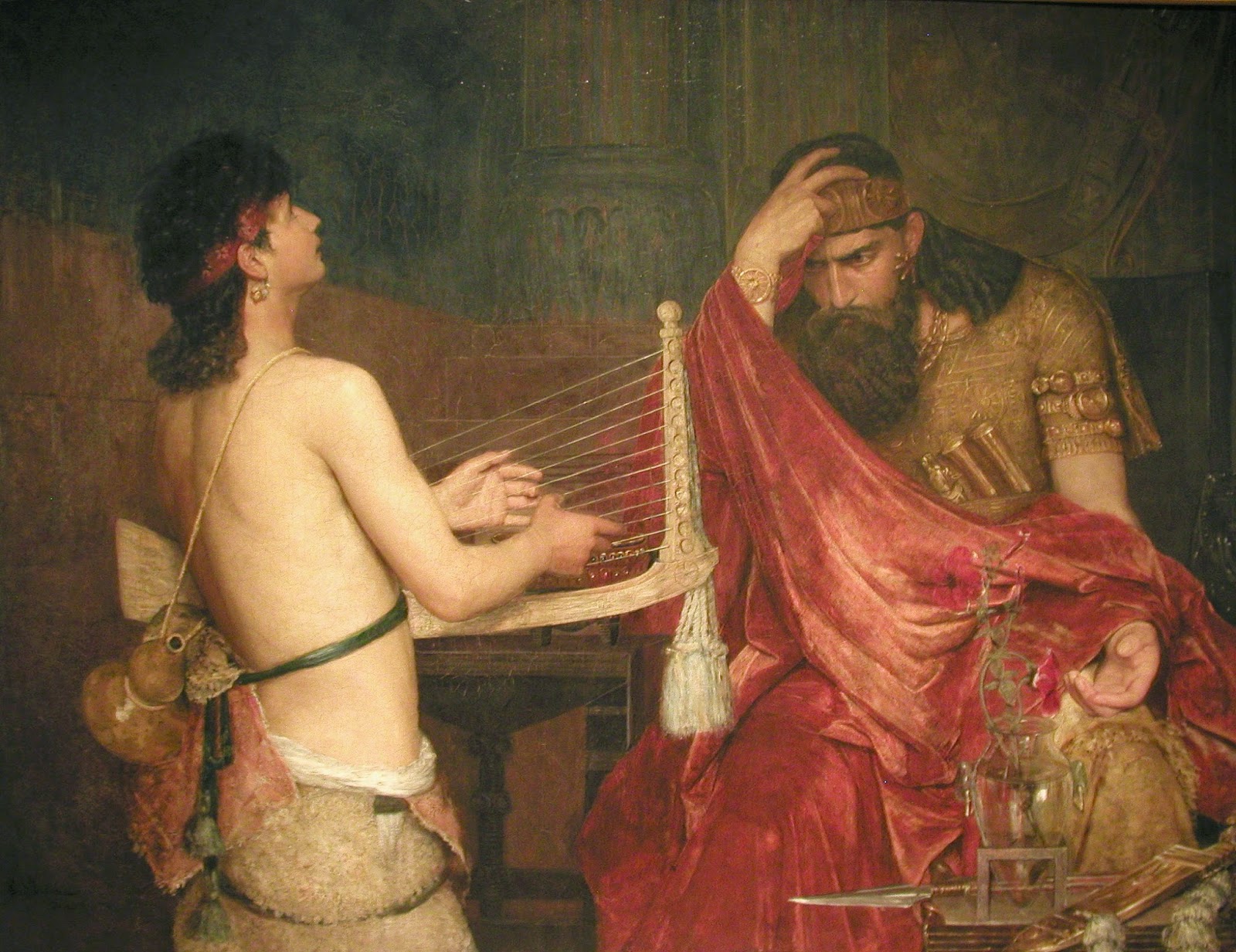
THE MADNESS OF SAUL


This is a very sad story of a fallen king who allowed jelousy to corrupt his heart and who invited the forces of evil to torment his soul. Having already lost God's favour through disobedience, Saul, the first king of Israel, continued on the down hill slide to self-destruction. Saul, who was born great and was above all Israel in stature and goodness ended up a bitter man not worthy of his kingdom and feared by all, even his family.

David having found favour with the king of Israel by slaying Goliath, was taken away from his family and installed into the king's household. So impeccable was his behaviour that he was beloved by all Judah and Israel (1 Sam 18:16). And so obedient was he to any task that he was given by the king that Saul placed him in charge of his army (1 Sam 18:5). It naturally followed that David had great success in his battles with the Philistines and Saul was soon overshadowed by his popularity (1 Sam 18:6,7). Saul perceived this popularity as a threat to himself and his kingdom. In his mind, praise for another somehow diminished him in the eyes of the people. Saul, who had everything, who was the king of Israel, chosen by God, under whose command armies moved, who had all power and influence in the land, wanted more. From the moment Saul heard the women chanting "Saul hath slain his thousands, and David his ten thousands" (1 Sam 18:7), he hated David and became exceedingly jelous of him (1 Sam 18:8,9).


Saul's good qualities and his ability to rule with wisdom were totally subverted as he allowed jelousy to consume him. What would seem a rather harmless emotion became a deadly murderous obsession. He makes it his life mission to kill David even risking the life of his son Jonathan (1 Sam 20:33) and willing to annihilate a whole city (1 Sam 23:10) to accomplish his purpose. How did Saul come to sink so low? Armies could not have toppled him if he had remained righteous. Only one person had the power to destroy him and that person was himself. Jelousy, a seemingly harmless emotion proved to be not so harmless after all. The scriptures record that Saul came to be overcome by an evil spirit continually (1 Sam 18:10, 19:9). Through the life of Saul we can see the author of all jelousy and envy, he who sought to elevate himself above all else, not wanting anyone to have what he had. The father of all lies would have us believe that somebody else's greatness diminishes our own and that blessings others receive means blessings taken away from us. He convinces us so well that self-seeking is the path to abundance and therefore happiness. Elder Holland cites one observer who summed this up well:

"In a world that constantly compares people, ranking them as more or less intelligent, more or less attractive, more or less successful, it is not easy to really believe in a (divine) love that does not do the same. When I hear someone praised, it is hard not to think of myself as less praiseworthy; when I read about the goodness and kindness of other people, it is hard not to wonder whether I myself am as good and kind as they; and when I see trophies, rewards, and prizes being handed out to special people, I  cannot avoid asking myself why that didn't happen to me." (Meridian Magazine, "The Lord Be Between Thee and Me Forever", p 2)

What leads us to these assumptions and feelings of want? Elder Holland elaborates:

"As others seem to grow larger in our sight, we think we must therefore be smaller. So unfortunately, we occasionally act that way. How does this happen, especially when we wish so much that it would not? I think one reason is that every day we see allurements of one kind or another that tell us what we have is not enough. Someone or something is forever telling us we need to be more handsome or more wealthy, more applauded or more admired than we see ourselves as being. We are told we haven't collected enough possessions or gone to enough fun places. We are bombarded with the message that on the world's scale of things we have been weighed in the balance and found wanting. Some days it is as if we have been locked in a cubicle of a great and spacious building where the only thing on the TV is a never-ending soap opera entitled Vain Imaginations." (Elder Jeffrey R Holland, Meridian Magazine, "The Lord Be Between Thee and Me Forever", p. 2)


Opposite to Satan's plan to make us greedy and self-absorbed is the Saviour's plan to nurture in us the ability to become Zion people. A Zion person seeks the welfare of others and not just his own. A Zion person is one that is bound in love to his fellow beings. A very good example of this comes from the same story as Saul. It is the friendship and bond of love between his son Jonathan and David, the future king of Israel. Where his father sought to slay David, Jonathan sought to preserve his life. Jonathan was the next in line to the throne and his father warned him that as long as David lived, his kingdom will not be his (1 Sam 20:31). Jonathan however, was more interested in being faithful than in being a king. He shows that faithfulness through his friendship with David by saying: "....the Lord be between thee and me forever" (1 Sam 20:23). Whereas Saul, in cahoots with an evil spirit, seeks to take away David's life, Jonathan fueled by his faithfulness to God, seeks to preserve it. Jonathan and David share a common bond of faithfulness which binds them in friendship and love forever. Because of this bond of love, they seek each other's welfare rather than their own. The only author of such love can be God. David too shows his faithfulness to God by resisting an opportunity that delivers Saul into his hands and refuses to take his life reasoning that Saul is anointed of the Lord and that there is no evil nor transgression in his hand and would therefore not commit such wickedness (1 Sam 24:6,11,12). Had David murdered Saul in the cave in which he found him asleep he would have obtained the kingdom through the evil design of murder and not be given it by the hand of the Lord. If that had been the case, that would have been the beginning of David's demise. He could have rid himself of Saul and his dogmatic murderous pursuit forever but he would also have succumbed to the same hatred and evil that came to possess the heart of Saul and would therefore become lost.  David was more interested in respecting and loving the Lord than in self-seeking and because of it he became the next king of Israel.


What blessings that come from serving others will we miss out on if we engage ourselves in self-seeking and elevating ourselves above our fellowman? Whether it is being better, having better or doing better than someone else, it is all the same. It all leads to pride which robs us of the godly nature which we need to be of benefit to our fellowman. Self-seeking has no future. It is of this world only for in celestial kingdom there will be no one that is more or has more than someone else. It will be a perfect existence with equality of heart and mind and possession. The only children of God who will be able to abide this existence will be those who love others as themselves. This is what we are here to learn most of all, to love. Without this love we cannot pass through the gates of eternity and have eternal life with God. The author of this love beckons us to follow Him and to 'pray unto the Father with all the energy of heart, that we may be filled with this love, which he hath bestowed upon all who are the true followers of his Son..." (Moroni 7:48).

Thursday, 20 March 2014

JOSEPH, THE PROTOTYPE


In early Christian Syriac literature there are 56 comparisons of Joseph's life with Christ's.  They are incredibly explicit and clearly developed and formulated by historians determined to show Joseph as a Type of Christ.  Throughout centuries, Christians have mainly hailed Joseph for his sexual purity turning him into an icon of strength and example to us all.  There are many more lessons, however, that we can learn from his life but even more so from his character which makes him a perfect prototype of the Saviour. Besides his impeccable self control, what I admire most about Joseph is his regard for his fellowman , no doubt born out of Christ like compassion that was central to his character. Out of this compassion was born his willingness to serve his fellowman and his willingness to forgive.   Both of these traits are essential for us to develop in order to be saved in the kingdom of God.

Careful reading of Joseph's servitude in Egypt makes us come to the conclusion that Joseph did not rise to authority by deviousness or self serving tactics but by being mindful of his fellowman which endeared people to him.  I imagine it was not only the fact that the Lord was with him but also his disposition to care about people that made people trust him.  For this reason Potiphar was willing to put all his affairs into his hands (Gen 39:4); the keeper of the prison was willing to put all prisoners into his charge (Gen 39:22); and Pharoah was able to commit all of Egypt into his administration (Gen 41:41).  Even though Pharoah gave credit to God for making Joseph wise enough to interpret his dreams, he surely would have known of Joseph's character and reputation which would have come before him, otherwise he would not have trusted that Joseph's interpretation of his dreams came from God.

I am certain that Joseph's attitude was to be the best of whatever he had to be in whatever circumstances. When he was a slave in Potiphar's house he must have made up his mind to be the best slave he could possibly be.  For this reason he came to the attention of the master of the house and for this reason God made him prosper.  The same was probably true when he was flung into prison.  I imagine when he found himself there, he determined that he was going to be the best prisoner he could possibly be and do whatever he could to alleviate the suffering of his fellow prisoners, to help others bear their burdens, 'to succor the weak, lift up the hands which hang down, and strengthen the feeble knees' (D&C 81:5).

When Joseph was in charge of the prisoners, one day he noticed that the butler and the baker were sad (Gen 40:5,6).  Think about this.  They are in prison.  Should they be leaping about being merry instead? Obviously Joseph being in charge, had tried his best to make the conditions as pleasant as they could possibly be for the inmates, to maximise their peace and joy as much as he could, under difficult conditions, so of course it matters to him that two of those inmates are sad.  He obviously cares about their well being. And this attitude of caring works for his highest good as the butler and the baker confide in him and reveal their dreams to him.  And dreams of course, are Joseph's specialty.  Do you think if Joseph was a tyrant prison keeper, looking out only for himself, he would have secured for himself a release from prison through the butler of the king of Egypt?  Instead of being a tyrant, Joseph was a loving man of God who inquired of his inmates: "Wherefore look ye so sadly today?" (Gen 40:7,8)  This one question speaks volumes about Joseph.  This one question was also his path to freedom.


Just as Joseph sought to rescue the physically captive from their emotional burdens, Jesus came to rescue the spiritually captive who languished in prisons of sin and pain, "...to bind up the broken-hearted, to proclaim liberty to the captives, and the opening of the prison to them that were bound..." (D&C 138:42).  The scriptures are replete with accounts of Christ's compassion towards those he served, healed and even raised from the dead.  The man who proclaimed himself to be 'the resurrection and the life' (John 11:25) wept when brought to Lazarus' tomb, not because he sorrowed that Lazarus had died as witnesses supposed but because he had compassion for those whose hearts were breaking.  He knew where Lazarus was,  and was he not in a far better place than here?  It was out of his compassion for his broken-hearted sisters that he brought Lazarus back to life.  For was he not 'a man of sorrows, and acquainted with grief'? (Isa 53:3)

"Now when he came nigh to the gate of the city, behold, there was a dead man carried out, the only son of his mother, and she was a widow: and much people of the city was with her.
"And when the Lord saw her, he had compassion on her, and said unto her, Weep not.
And he came and touched the bier: and they that bare him stood still.  And he said, Young man, I say unto thee, Arise."  (Luke 7:11-14)

Jesus' compassion was not only for this widows's tears but for the hardships she would live with on daily basis had she been left without a son to take care of her. In the day and age where women were totally dependent on men and where a woman without a husband looked towards her son to care for her, this widow whose son had been taken away from her too was facing a very bleak future.  The Saviour knew and he acted and he saved.
"While he yet spake, there cometh one from the ruler of the synagogue's house, saying to him, Thy daughter is dead; trouble not the Master.
"But when Jesus heard it, he answered him, saying, Fear not: believe only, and she shall be made whole.
"And when he came into the house, he suffered no man to go in, save Peter, and James, and John, and the father and the mother of the maiden.
"And all wept, and bewailed her: but he said, Weep not; she is not dead, but sleepeth". (Luke 8:49-56)

Twice, before he raised Jairus' daughter, the Saviour addressed the parents first for he had concern for them and their sorrow.  The daughter was raised from the dead and Jesus was able to bind the broken-hearted.


Joseph's love for his family activated his ability to forgive his brothers for selling him into a strange land to endure years of hardship and servitude.  The Old Testament Pseudepigrapha which comprises the ancient Jewish and Jewish-Christian documents, tells that Joseph had such high regard for his brothers despite what they had done, that he repeatedly affirmed to the Ishmaelites that he indeed was a slave because he didn't want to bring disgrace upon them:

"For my brothers know how much my father loved me, yet I was not puffed up in my thoughts.  Even while I was a child I had the fear of God in my heart, for I understood that all things pass away.  I did not arouse myself with evil design, but honoured my brothers, and out of regard for them even when they sold me I was silent rather than tell the Ishmaelites that I was the son of Jacob, a great and righteous man.
As I was going with the Ishmaelites, they kept asking me, "Are you a slave?" and I replied, "I am a slave out of a household", so as not to disgrace my brothers.  The greatest of them said to me, "You are not a slave, even your appearance discloses that." (James H. Charlesworth, Ed., The Old Testament Pseudephigrapha, Testaments of the Twelve Patriarchs, p. 822)

We should be able to relate to Joseph who was taken away from his family that he loved. Would he not want to be reunited with them? Would he let his lack of forgiveness stand in the way of that reunion?   Joseph wept and embraced his brothers and he forgave to the point that he tried to convince them that it was not their fault, but that the Lord brought him to Egypt to save them all  (Gen. 45:5).

Jesus, like Joseph is the 'birthright' son, the first born of the Father, the rightful heir of all that the Father has but Celestial Kingdom can be a lonely place without the ones you love, and He has loved us and wanted us there with him.  Just as Joseph's love for his family activated his ability to forgive his brothers,  Jesus' love for us activates his ability to forgive us of our sins.  We too have been 'taken'.  This telestial life is our Egypt and our slavery.

"In a sense we are all captive 'in Egypt".  Because of the idolatry of Egypt and because it was the place of Israel's captivity, the prophets of old used the land of Egypt as a symbol for the telestial world in which we now live.  The entire world today is a spiritual Egypt, 'the land of our affliction', in captivity to the 'god of this world' (2 Cor 4:4) who is Satan.  The Apostle John spoke of this world as 'spiritual Egypt' because here the Lord was crucified (Rev 11:8)."


The spiritual Egypt we are in has only one Saviour.  Jesus, like Joseph of old, offers forgiveness and the bread of life from which we never need to experience a famine.  When Joseph sent for his father and the rest of the family to join him in Egypt, the Lord told Israel that he need not fear to go to Egypt 'for I will there make of thee a great nation; I will go down with thee into Egypt; and I will also surely bring thee up again" (Gen 46:2-4).  The Saviour descended 'into Egypt' to bring us up again if we are faithful.  We miss the mark if we don't recognise the prototypes when we study the scriptures, who can turn our hearts to Him who can quench our thirst with living water and appease our hunger with the bread of life.  Joseph is one such prototype of the Saviour and his power to save.  We too can be prototypes to our children and their children as we walk in the footsteps of Him who knows the way out of 'Egypt' and into eternal life.


Tuesday, 4 February 2014

WHAT'S IN A NAME?


My patriarchal blessing cites two significant blessings connected with my name. In the first instance it says my children will grow up to bless and honour my name and in the second it says that my name will always be known among the faithful.  These two blessings are of course predicated upon my faithfulness.  I desperately want both of them.  The first one because it means my faithfulness will have an influence on my children and in some way be instrumental in their salvation and the second because I do truly desire to be known as a faithful follower of Christ.  When I read The Book of Mormon and come across Mormon boldly proclaiming, "Behold I am Mormon and I am a disciple of Jesus Christ...", my heart yearns to say this of myself with the same confidence and boldness with which Mormon did.  So when my patriarchal blessing tells me that I will be known as one of the 'faithful' I know that there will be evidence enough to that fact otherwise I would not be numbered among them.  

Whilst attending our new ward recently, my daughter was introduced on a number of occasions with significant reference to her grandparents who are well known far and wide for their faithfulness and Church service. Her grandmother, who has passed away,  is highly regarded in the Church in Sydney by many saints who knew her. I have heard her name mentioned often in different wards I have attended since her death. It makes me so grateful that my children are associated with her good name. I believe this is the greatest legacy she has left to her grandchildren.  It is my desire that I will leave a good name to my children also.   Adversely, I would be devastated if my name was an embarrassment to them in any way.  So much is associated with the name we bear: our reputation, what kind of life we created, the caliber of the person we have been, our good works, people's perception of us, how loved we are, how much we have helped others and how well we have treated them.  The influence, whether bad or good, is far reaching.

As Church members we are largely known by two significant names: Mormons and Christians.  Some members of the Church resent being called Mormons because more often than not, this name overshadows the fact that we are Christians to the rest of the world.  However, the rest of the world doesn't know Mormon like we know him.  Mormon is my favourite prophet of the Book of Mormon. The obvious reason being is that he is a writer. The other reason is that in my opinion Mormon was one of the most Christ like people to have ever graced this earth. For that reason, being called Mormon to me is just about the same as being called a Christian.  


Mormon was faithful to the latter in one of the most evil societies that have ever existed. A people who were so wicked that the Holy Ghost was entirely withheld from them (Mormon 1:14); who 'willfully rebelled against their God' (Mormon 1:16); who, in their extremities 'cursed God and wished to die' (Mormon 2:14); who were consumed with revenge (Mormon 3:9-10); who forcibly deprived women of their virtue, killed them, and 'devoured their flesh like unto wild beasts' (Moroni 9:10).  After much unsuccessful effort to turn the society of such evil doers around to repent and trust in God you would think Mormon would be justified in wishing God's justice to come upon them.  But this was not in Mormon's nature.  Mormon knew God and how merciful He is and therefore he never stopped hoping that his people will repent and once again become a righteous people.  Instead of smugly sitting on his housetop and recording their destruction, punctuated with frequent "I-told-you-so's", Mormon continued to urge the Nephites in their battles  and inspired them to consider their wives and their children and their homes. (Todd A Knowles, Gospel Doctrine Lesson 43, Mormon 1-6,9)  Not only did Mormon continue to love and serve the Nephites despite their lack of willingness to repent, he fought along side them knowing they were doomed and when the Nephites went down to complete destruction, he went down with them.

In writing The Book of Mormon, Mormon's one purpose was to bring us 'unto Christ'.  If you asked a classroom of people who wrote The Book of Mormon, everybody would hesitate to answer trying to figure it out.  This is so because when you read The Book of Mormon, you do not hear Mormon's voice, even though he occasionally offers editorial commentary.  The voice we hear when we read The Book of Mormon, is the voice of God.  Mormon makes himself transparent as the writer of this book and succeeds gloriously in helping us draw closer to God.  (Todd A. Knowles, Gospel Doctrine Lesson 43, Mormon 1-6,9)

Mormon lived by an eternal perspective that enabled his life long service among his fellowmen. : "...for we have a labour to perform whilst in this tabernacle of clay, that we may conquer the enemy of all righteousness...." (Moroni 9:6)  I often quote this scripture during my lessons as a means of inspiration to help us be focused on winning the battle that we began so long ago.  The more I know about Mormon, the more I want to be like him.  It makes me feel good to say that I am a Mormon, to be associated with his name.


In Mosiah 5:7-12, the word 'name' occurs 11 times.  These particular scriptures contain King Benjamin's address to his people who were willing to enter into a covenant with God 'to do his will and to be obedient to his commandments in all things....all the remainder of our days' (Mosiah 5:5).  What is interesting is that King Benjamin responds to their willingness to enter into this covenant by talking about the importance of taking upon ourselves Christ's name.  He specifically says that:
  • our hearts are changed through faith on his name (verse 7)
  • there is no other name given whereby salvation comes (verse 8)
  • whosoever enters into this covenant shall be known and called by the name of Christ (verse 9)
  • whosoever is not called by the name of Christ shall be found on the left hand of God (verse 10)
  • His name will never be blotted out of our hearts except through transgression (verse 11)
By virtue of our covenant to be obedient to His commandments, we become Christ's, his sons and his daughters and thereby we take upon ourselves His name, much like we take upon ourselves our earthly father's name when we are born into mortality.  In this instance however, Christ becomes our spiritual father and we thereby become Christ-ians. What we do with Christ's name speaks volumes about our integrity and character. Being Christian means being like Christ and behaving as He would behave. It reminds me of that saying:  "If you were arrested for being a Christian, would there be enough evidence to convict you?" 

King Benjamin closes his address admonishing his people to be steadfast and immovable and always abounding in good works for the greatest of  all blessings depends on this: "....that Christ, the Lord God Omnipotent, may seal you his, that you may be brought to heaven, that ye may have everlasting salvation and eternal life..." (Mosiah 5:15)  The Saviour will hold us responsible for His name when we face Him at the judgment bar.  As his children, it is our duty to bring honour and glory to his name through the life that we live.  For this He will exalt us so that we can have all that He has and be all that He is. Alma spoke of being spiritually born and thereby receiving His image in our countenance (Alma 5:14).  Let us live so that this image will be recognized by all we associate with and that we will be known by His name more readily than by our own.  Does He not deserve this? 

For "behold, I have graven thee upon the palms of my hands...." (1 Nephi 21:16)


Wednesday, 18 December 2013

KNEE DEEP

 
Last Sunday our Sunday School lesson was entitled "Zion - The Pure In Heart".  I thought as I studied the lesson how much becoming a Zion person is at the other end of the spectrum of someone who is an inactive member of the Church.  Somewhere between being a Zion member and an inactive member we encounter all sorts of members.  Ones who sit on the fence and come to Church because they know they should and do little else about their membership, ones who consider the Church to be a social club and somewhere to belong, ones who choose what commandments they will live and live the gospel as it suits them.  Some members have barely wet feet and others are knee deep in the Church and strive with all their might to live the Gospel.  These members are Zion people.
  
In D&C 6:6, we are admonished to 'seek to bring forth and establish the cause of Zion'.  This should make every member feel the need and urgency to put their life into order and strive to become a Zion person.  One only needs to consider the condition of this world to be convinced that the time of the Saviour's coming is near, even at hand.  "For behold, verily, verily, I say unto you, the time is soon at hand that I shall come in a cloud with power and great glory" (D&C 34:7)   When the Saviour comes we will not stand to experience the Millenium if we are not a Zion people. I've reflected a lot on my own worthiness during the past week and have sadly concluded that after nearly 40 years of Church membership I should be much further ahead than what I am.  Thank goodness for repentance and hopefully enough time for improvement before the Saviour makes an appearance because right now I am not sure I am yet a Zion person.
 
The Saviour's call for the Church to rise in strength of Zion is found in D&C 82:14: "For Zion must increase in beauty and in holiness; her borders must be enlarged; her stakes must be strengthened; yea, verily I say unto you, Zion must arise and put on her beautiful garments".  President Franklin D. Richards explained: "What are these beautiful garments?  These beautiful garments are the clothing upon with the authority and power of the Holy Priesthood.  It is that which makes people beautiful; it is that which makes people useful...." (Journal of Discourses, 21:195).   President Eyring made clear the purpose and destiny of those who have the holy priesthood upon them in this dispensation:  "The destiny of the rising generation of priesthood holders is far more than to be ready to bring God's power down to heal the sick.  The preparation is to be ready to go and do whatever the Lord wants done as the world is preparing for His coming".  (Eyring, "Be Ready", Ensign, Nov. 2009, 59)  I don't know all things the Lord will ask of us before He comes but I know we need to be so knee deep in the Gospel and so committed that we will do anything.


To be Zion people, we cannot sit at the door of the chapel hoping the holiness will rub off on us, but need to be so far into the Church that its' principles and teachings dictate our every action.  We need to be worthy of the companionship of the Holy Ghost to have him purify our hearts and sanctify us and form us into the image of God.  Our hearts need to become pure and free of any malice and selfishness and full of love for our fellowman.  If we do not become like this we will not be able to abide the Zion community and the Zion way of life in the Millenium.  Here's what President Spencer W. Kimball had to say about this: 
 
"Zion can be built up only among those who are the pure in heart, not a people torn by covetousness or greed, but a pure and selfless people.  Not a people who are pure in appearance, rather a people who are pure in heart.  Zion is to be in the world and not of the world, not dulled by a sense of carnal security, nor paralyzed by materialism.  No, Zion is not things of the lower, but of the higher order, things that exalt the mind and sanctify the heart". (The Teachings of Spencer W. Kimball, p 363)
 
I've concluded that there are three qualifications needed to belong to a Zion society: 
 
1.  Personal righteousness;
2.  Love of fellowman;
3.  Detachment from worldliness.
 
If we strive to obey the two greatest commandments on daily basis we can accomplish this . The Saviour made clear what these commandments are:
 
"37...Thou shalt love the Lord thy God with all they heart, and with all thy soul, and with all thy mind.
38.  This is the first and great commandment.
39.  And the second is like unto it, Thou shalt love thy neighbour as thyself.
40.  On these two commandments hang all the law and the prophets."  (Matthew 22:37-40)
 
Why does everything depend on obedience of these two?  Because if we obey these two, we will be obeying all the rest too.
 
I've pondered on why some of us fail to make this preparation for Zion a priority in our lives and why we get so immersed and lost in the business of living in this telestial world rather than 'seeking for the things of a better' as Emma Smith was counselled to do (D&C 25:10).  The only answer that comes to my mind is that we give little thought to what life in Zion during the Millenium will really be like.  Imagine a society free of crime, war, pestilence and natural disasters;  a government with  a member of the Godhead  at the helm; where food is plentiful without hard labour, where there are no poor among us and people live in happiness.  Wouldn't you want that?  If anything, rather than being attached to this telestial world where there is so much suffering and evil and life is just plain hard, we should be wanting to let go of it and look forward to a better way of life a hundred times over.  We should heed Alma's admonition: "....come ye out from the wicked, and be ye separate, and touch not their unclean things..."(Alma 5:57)
 
Zion starts in one's heart. You can be a Zion person here and now.  And you can exert so much righteous influence on those around you that you could have Zion anywhere: in your home, in your community, in your country, and eventually the world.  It all starts with a handful who are willing.  The Church was organised with just 6 members.  Now we number 15,000,000.  Without the work of those 6 members we would not be numbering into millions now.  According to the Parable of the Ten Virgins, half of us will not be invited to the wedding feast when the Saviour comes, remembering the 10 Virgins represent the Church members only.  This means a lot of us will miss out. With tongue in cheek,  I guess it all depends on whether you like weddings.


Monday, 4 November 2013

SAVIOURS ON MOUNT ZION


Despite the fact that the forces of evil raged against the saints during the construction of the Salt Lake Temple, marvellous spiritual manifestations continued to attend those who laboured there.  One such labourer at the House of God received such a manifestation:

In the fall and winter of 1892-1893 I worked at painting in the Salt Lake Temple.  Although sick, I felt strongly impressed to go and do my very best.

At noon the third day after beginning, President Woodruff called all of the workmen together.  He said he had been told that some of the workmen had stated that it would be impossible to have the temple completed by April 6th.  he said when he looked at this body of men he didn't believe a word of it.  "Some of you may be sick and weak", (I thought he was talking to me) he continued, "Some of you may give out at night, but you will be here in the morning if you are faithful.  You are not here by accident.  You were ordained in the Eternal World to perform this work.  Brethren, I will be here April 6th to dedicate this building.  I know what I am talking about for this was shown me in a vision 50 years ago in the city of Boston".

Along about March, 1893, I found myself alone in the dining room - all had gone to bed.  I was sitting at the table when to my great surprise my old brother Alfred walked in, sat down opposite me at the table and smiled.  I said to him (he looked so natural), "When did you arrive in Utah?" (He had lived in New Zealand and I had not heard from him in years).

He said, "I have just come from the Spirit World, this is not my body that you see, it is lying in the tomb.  I want to tell you that when you were on your mission you told me many things about the Gospel, and the hereafter, and about the Spirit World being as real and tangible as the earth.  I realized that you had told the truth.  I attended the Mormon meetings".  he raised his hand and said with much warmth, "I believe in the Lord Jesus Christ with all my heart, I believe in faith and repentance and baptism for the remission of sins, but that is as far as I can go.  I look to you to do the work for me in the temple".  He continued, "You can go to any kind of sectarian meeting in the Spirit World.  All our kindred there knew you were trying to make up your mind to come and work on the temple.  You are watched closely, every move you make is known there; and we were glad you came.  We are all looking to you as our head in this great work.  I want to tell you that there are a great many spirits who weep and mourn because they have relatives in the Church here who are careless and are doing nothing for them".  He then disappeared.


As I sat pondering upon what I had seen and heard, with my hear filled with thanks and gratitude to God, the door opened again and my brother Alexander walked in and sat down in the chair that Alfred had just occupied.  He had died in 1852 in New Zealand.  I did the work for both he and Father in April 1885.  he had come from a different sphere, he looked more like an angel as his countenance was beautiful to look upon.  With a very pleasant smile he said, "Fred, I have come to thank you for doing my work for me; but you did not go quite far enough", and he paused.  Suddenly it was shown to me in large characters, "no man without the woman and no woman without the man in the Lord".


"Temple Manifestations", page 128


Monday, 28 October 2013

FINDING THE LOST


"Several years ago as I was about to depart for work, a call came from my Bishop.  His oldest son had disappeared.  He had eaten breakfast and dressed for elementary school, but when his mother was ready to drive him and his sisters to school he could not be found.  They thought perhaps he had walked to school.  His mother transported her daughters and then made a search.  The boy was not at school.  It was at this point that calls went out to the police and to several ward members.  I delayed my departure for work and along with several dozen others, commenced an intensive search of the neighbourhood.  After a few hours his mother found him, curled up on the floor of his closet with the door closed.  He was fast asleep.

I have reflected many times on the shared anxiety of so many to find this boy, to see that he was safe again with his family, to ensure that nothing unacceptable happened to him.

The search for that boy is a metaphor for this lesson.  You see, I have ancestors lost in history.  We all do.  They languish in the spirit world, waiting and hoping for someone to find them.  Our longing to locate the dead who are lost should be as compelling as our anxiety to find the living who are lost".
(Ted L. Gibbons, D&C Lesson 40)

The estimated population of the world in A.D. 1 was 200 million; by 1850 it had reached one billion (see World Almanac and Book of Facts 1995 (1994), 510).  By mid 1995, the world's population was estimated at 5.76 billion.  Over time, as many as 105 billion people may have lived on the earth.  (Estimates courtesy of Population Reference Bureau, Washington, D.C.; see Carl Haub, "How Many People Have Ever Lived on the Earth?" Population Today, 23 (Feb. 1995): 4-5)

The number of completed proxy temple endowments is approaching an estimated 140 million, meaning that this work has been performed for about .13 percent (just over one-tenth of 1 percent) of the earth's estimated historic population of 105 billion.  (Ted Gibbons, D&C Lesson 40)
Daunting isn't it?  These statistics should not be discouraging but encouraging.  It should make us act in haste to save even just one soul who is languishing in the spirit world forgotten.  Oscar Shindler said something powerful:  "Whoever saves one life, saves the world entire".  Elder Dallin H. Oaks broke it down to a manageable task when he said: "Our effort is not to compel everyone to do everything, but to encourage everyone to do something".  ("Family  History: In Wisdom and Order", Ensign, June 1989, 6)

Saving souls is the greatest work we can be engaged in. Saving the dead is comparatively easy compared to going from door to door asking people to listen to you while you tell them about the gospel. All it takes is planned time and a willing heart.

The Sunday School manual suggests four activities that will allow us involvement in this great work:

1.  Have a current temple recommend and attend the temple regularly.
2.  Prepare to have ordinances performed for deceased relatives.
3.  Learn about ancestors' lives.
4.  Keep a journal or prepare a personal history or a family history.

I was born and raised in Croatia.  My ability to trace my ancestors has been somewhat limited for many years.  I have done relatively little in this area compared to a lot of serious family history buffs.  I have done what I could and I ardently hope I will have the means and ways to do more in the near future.  I want to do more.  I am the only church member in my family and that makes me my ancestors' only hope.  I believe in family.  It's the main reason why I joined the Church 38 years ago.  My patriarchal blessing tells me I have been blessed with a rich heritage. I want to know what that means and I believe I will one day because I have the tools that are needed for this work, my Church membership and my desire.


Thursday, 17 October 2013

AM I MY BROTHER'S KEEPER?

There are four requirements suggested by the Church to ensure temporal self-reliance of the saints:

1.  Gain an adequate education and stay abreast of your field.
2.  Live within your income and consistently save for a rainy day.
3.  Avoid excessive debt.
4.  Acquire and store a year's worth of necessities.

Being temporally self-reliant seems to go hand in hand with being accountable for the stewardships with which we have been entrusted.  In D&C 104:13 we read:

"13. For it is expedient that I, the Lord, should make every man accountable, as a steward over earthly blessings, which I have made and prepared for my creatures."

If we are not engaged in provident living, we are not being good stewards indeed.  I have battled with this concept for many years having lived on the poverty line as a single mother.  There never seemed to be enough of my resources to ensure self-reliance should I one day be facing a bleak future.  We live and learn from consequences we suffer and I am one of the pupils.

It is interesting to me that straight behind this concept of temporal self-reliance comes an admonition from the Lord to be our brother's keeper.  Consider what the Lord says following the abovementioned scripture:

"14. I, the Lord, stretched out the heavens, and built the earth, my very handiwork; and all things therein are mine.
15.  And it is my purpose to provide for my saints, for all things are mine.
16.  But it must needs be done in mine own way; and behold this is the way that I, the Lord, have decreed to provide for my saints, that the poor shall be exalted, in that the rich are made low.
17.  For the earth is full, and there is enough and to spare; yea, I prepared all things, and have given unto the children of men to be agents unto themselves.
18.  Therefore, if any man shall take of the abundance which I have made, and import not his portion, according to the law of my gospel, unto the poor and the needy, he shall, with the wicked, lift up his eyes in hell, being in torment."  D&C 104:14-18

I am certain that we shall be judged the most on how we have cared for each other whilst on this mortal journey.  All that we possess in this life is not ours at all, it all belongs to God who gave it to us in the first place, as per the scripture above.  Therefore, each time we stretch out our hands to give, we are not giving away what is ours but what we have been provided with by God for our care and for the care of others.  We are merely being good stewards and instruments in God's hands of blessing others.  I have already mentioned this in another blog and will do so again here.  We are not meant to judge one another as we do not understand each others' capacities and burdens. We are not to think that someone has brought upon themselves their own calamities and now should suffer the consequences.  King Benjamin spoke of this in Mosiah 4, calling us all beggars before God.  I believe we are here to learn two things, without which we can never become like the Saviour and therefore cannot have eternal life, and that is love and service.  When we arrive at the point where we love and care for others as much as we do for ourselves, we have achieved our purpose and can go home assured we have accomplished what we have been sent here to do.  We will then be able to live in God's kingdom with each other sharing freely the inheritance of the Firstborn he so freely desires to share.  In the words of Victor Hugo: "To love another person is to see the face of God".

I want to share with you an instance from my own life where I was helped in a very small way but which was a great help to me at the time.  I was a newly divorced single mother battling to make ends meet.  With a few more days to pay day, I realised that the fuel in my car would not last.  I knelt down and prayed this one particular morning asking the Lord for $20 for fuel.  I then went to work and didn't really think about it much until lunch time when my co-worker came to my desk and put $20 on it.  I asked what the money was for and he said he was coming back from lunch when he noticed $20 on the footpath.  He said he picked up the note and wondered what to do with it. He decided he didn't need it and as he did so I immediately came into his mind and he resolved to give the money to me.  As President Spencer W. Kimball put it so aptly: "God does notice us and he watches over us but it is usually through another person that he meets our needs".