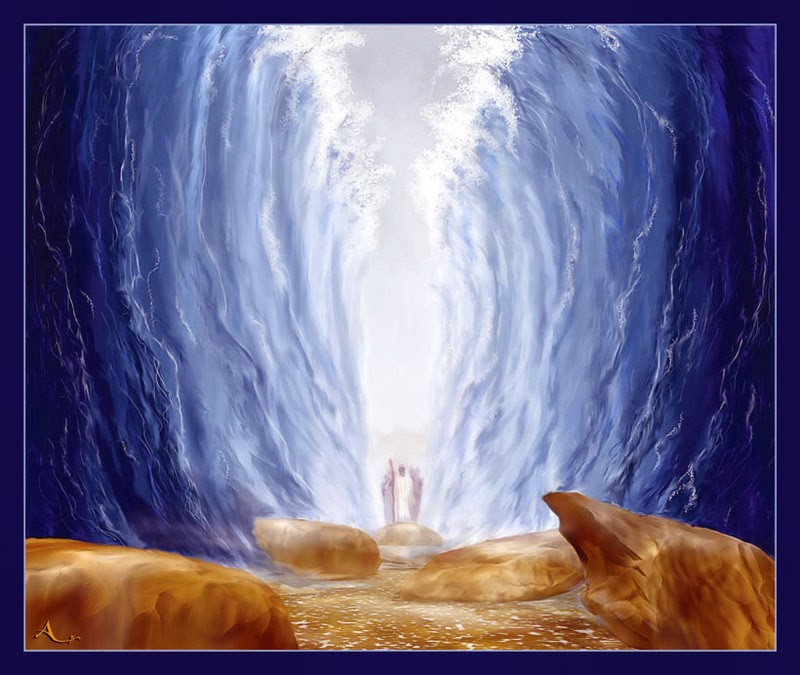
".....Fear ye not, stand still, and see the salvation of the Lord...." (Exodus 14:13)
When the children of Israel saw the Egyptians pursuing them with the entire chariot fleet of Egypt such fear took over them that they forgot all the miracles that had been wrought by Moses to persuade Pharoah to let Israel go. In fact, their fear of slaughter was so great that they even forgot all the pleading with God they had done so God would deliver them from slavery and blamed Moses for taking them out of Egypt almost against their will (Exodus 14:11,12) In the midst of that fear the picture of reality got totally distorted.
It has been said that all our worrying is fueled by fear of loss of life. Just about all our day to day worrying is associated with survival in this temporal world and most of it has to do with money. Without money you cannot meet your basic human needs such as shelter or food. Without shelter you might end up on the street and without food you will starve and eventually die. So the fear is not about lack of money but about your possible demise resulting in death. We fear death because we were born with the instinct to preserve life. In this context then surely fear would be a good thing would it not because it would drive us to act? However, quite the opposite is true. Fear robs us of peace and happiness and renders us powerless to act making us depressed and miserable. Where there is depression and misery, motivation is difficult to find. There is fortunately a better way of handling the stresses of every day life that are associated with our survival.
Because we live in a fallen world, we live in a world of opposites. Two opposing forces in this world are darkness and light. Darkness is of the adversary while light is of God. We are at all times either going towards light or darkness. Darkness renders us powerless while light makes us powerful. Where there is darkness, there is no God and the ensuing power he can give us. God is a god of glory and light and cannot be where darkness is. Fear produces darkness of the mind. When there is darkness in us, God cannot empower us to overcome, endure and achieve.
Consider Moses' encounter with God and Satan. After God departed and Satan made his entrance demanding that Moses worship him, Moses refused. Satan proceeded to unleash his displeasure as he 'cried with a loud voice and ranted upon the earth' (Moses 1:19) So frightening was his protestation and anger that 'Moses began to fear exceedingly; and as he began to fear, he saw the bitterness of hell' (Moses 1:20) There is only darkness in hell and there are no light switches there. I would imagine this darkness of hell frightened Moses to the extreme for verse 20 records that he immediately called upon God and as he did he received strength to repel Satan affirming his intention to only worship God, 'who is the God of glory'. A God of glory is filled with intense light which has the power to dispel all darkness for darkness and light cannot abide together. As Moses commanded Satan to depart and as Satan did so, the darkness left with him and the God of glory and light once again appeared to Moses.

Something interesting happened when God appeared to Moses the second time. Because Moses chose to worship God and appealed to Him to deliver him from darkness, God empowered Moses beyond his fondest dreams. In Moses 1:25 we read:
"...Blessed art thou Moses, for I, the Almighty, have chosen thee, and thou shall be made stronger than many waters; for they shall obey thy command as if thou wert God".
It would seem that the parting of the Red Sea was made possible long before Moses and the children of Israel stood on its' banks. Because Moses chose to turn to God rather than remain in fear, God empowered him to accomplish his earthly task of leading Israel out of bondage. This endowment of power had another purpose. Through it and by it, God proved to Israel that He is a God of miracles.
What is the lesson in all of this for us? When fear comes upon us, it distorts our reality. Because of that distortion, we cannot see things clearly and are more than often not able to act to change the picture. Most of the time we are not even aware that we have altered the reality in our minds. We no longer see things as they really are. At this point life becomes very bleak indeed. In that bleak darkness however exists a flicker of light which can be ignited to disperse the darkness from us and make us able to act. When we decide that we don't want to be incapacitated by darkness any longer and turn to God instead, we do two things: 1. We dis-empower the adversary and 2. we enable God to perform miracles on our behalf which makes deliverance from our bondage imminent. God is still a God of miracles which means that there is no situation in this life that He cannot deliver us from. When miracles fail to appear in our lives we either don't recognise them or do not ask for them with sufficient faith or it is not expedient for us to receive what we are asking. Sometimes even some repentance is needed on our behalf first. In Mormon we read:
"And if there were miracles wrought then, why has God ceased to be a God of miracles and yet be an unchangeable Being? And behold, I say unto you he changeth not; if so he would cease to be God; and he ceaseth not to be God, and is a God of miracles.
And the reason why he ceaseth to do miracles among the children of men is because that they dwindle in unbelief, and depart from the right way, and know not the God in whom they should trust." (Mormon 9:19,20)
I have had many revelations of God's miraculous power in my life. I will recount one incident in my life which proves this point. Following my divorce I struggled greatly to make ends meet as I worked to support my two children. One week in particular with a few more days to pay day, I realised that the fuel in my car would not last. I knelt down and prayed this one particular morning asking the Lord for $20 for fuel. I then went to work leaving it in Lord's hands and putting it out of my mind until lunch time when my co-worker came to my desk and put $20 on it. I asked what the money was for and he said he was coming back from lunch when he noticed $20 on the footpath. He said he picked up the note and wondered what to do with it. He decided he didn't need it and as he did so I immediately came into his mind and he resolved to give the money to me. There was no doubt in my mind that day who placed that $20 on the footpath where my co-worker would come across it. And there is even less doubt in my mind who inspired him to give that bank note to me. The value of that bank note was very small but the miracle to me was of enormous proportion.
It proved to me that there is little value in fear and much more to be gained from faith.
Fear is inverted faith. When we have little faith, fear flourishes. Being nourished by the word of God consistently increases our faith in God. Reading and studying the scriptures enables us to understand God's dealings with his children, the how, why and when. It also provides us with ample proof of his matchless power, ever present love and miracles he has wrought over the ages. If he loves us still, like he loved people of old, he can part our Red Sea too and make the path straight for our deliverance.
The antidote to fear is faith. Positive thoughts and spoken words affirm our faith and bring light into our understanding regarding our situation and trials we face. One way to counteract negative thoughts which lead to worry which leads to fear and accompanying darkness is to use scriptural affirmations. Familiarise yourself with positive phrases in the scriptures which have the power to elevate your ability to believe and say them out loud whenever you feel yourself sinking. Make one particular one your mantra. My favourite is: "...all things work together for good to them that love God" (Romans 8:28)

If you are standing on the banks of your Red Sea and are threatened with drowning, feeling overwhelmed with your life, do not despair. To despair is to turn your back on God denying his power to rescue you from the depths of the sea and bring you to shore. He can and will come to your aid if you put your trust in Him. He will flood your soul with hope and peace and assurance that all in your life is possible. The extent of your faith and devotion to Him will determine the magnitude of the power He will bestow upon you. Be faithful and do not deviate from your chosen course. If you are travelling on the path of righteousness, do not forsake it. If you are not, come back. God will honour your sacrifices and your commitment to Him. He will dry your tears and carry your sorrows and make your burdens light. "And He loveth those who will have Him be their God" (1 Nephi 17:40). Raise your staff, wade in waist deep and 'see the salvation of the Lord' as He parts your Red Sea. Fear not for you are walking on dry ground.